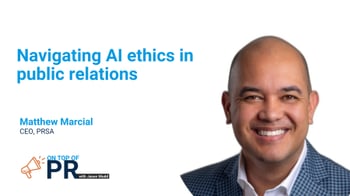
In this episode, PRSA CEO Matthew Marcial joins host Jason Mudd to discuss the ethical use of AI in PR and key insights for communicators.
Tune in to learn more!
Listen to the episode here:



Meet our guest:
Our episode guest is Matthew Marcial, CEO of the Public Relations Society of America. He leads PRSA’s strategic priorities, focusing on advancing the profession and guiding communicators through emerging challenges, including the ethical use of artificial intelligence.
5 things you’ll learn during the full episode:
- The biggest ethical risks with generative AI in PR
- The “Promise and Pitfalls” principles every PR team should adopt
- How smart PR teams are using AI without crossing ethical lines
- PRSA’s role in helping professionals navigate the fast-changing AI landscape
- Tips for rising PR pros who want to lead the profession forward
More about Matthew Marcial
Matthew Marcial, CAE, CMP, is the CEO of the Public Relations Society of America, the nation’s leading organization for public relations and communications professionals. Appointed in March 2025, he leads PRSA’s strategic priorities, focusing on advancing the profession, supporting member growth, and navigating emerging challenges, such as the ethical use of artificial intelligence. With more than 20 years of association leadership experience, Matthew is a frequent speaker on ethical leadership and professional development and has recently led sessions across PRSA’s regional districts on the organization’s AI Ethics Guide for PR professionals.
Watch the episode here:
Quotables
- “As a leader, you really need to be able to set clear expectations with your team around what the role of AI is and what it is for your organization.” — Matthew Marcial
- “Being comfortable with that, sharing, and training across your teams is really going to help leverage that (AI) insight and expertise.” — Matthew Marcial
- “I think that as a communicator, putting out anything that compromises your reputation is going to be a risk.” — Matthew Marcial
- “We are taking a bolder voice on issues that impact our members, the industry, and the profession.” — Matthew Marcial
- “The best way to learn is through trial and error.” — Jason Mudd
If you enjoyed this episode, please take a moment to share it with a colleague or friend. You may also support us through Buy Me a Coffee or by leaving us a quick podcast review.
Resources
Guest’s contact info and resources:
- Matthew Marcial on LinkedIn
- PRSA website
- PRSA’s Promise and Pitfalls: Ethical AI Guide
- PRSA’s DEI Toolkit
- PRSA’s Membership | Promo Code for Listeners: PRPROD25
- Axia’s PR Scholarship in collaboration with the PRSA Foundation
Additional Resources:
- PRSA’s Resources
- Axia’s AIVisibility service
- Will AI replace news desks?
- How PR pros are using AI today
- Axia's AI policy: 7 responsible principles to guide the use of AI in public relations
- How to influence AI-generated search results across every platform
If you like this episode, you're going to love this:
- How to ethically use AI in public relations
- How our PR firm is using AI and how you can too
- How AI is transforming strategic communications
- The power of AI in communications: Basic applications to strategic implementation
- AI storytelling and PR strategy
- 95% of AI citations come from PR content
Recorded: August 18, 2025
About your host Jason Mudd

Jason Mudd is a nationally recognized public relations expert featured by CNN, Entrepreneur, Forbes, NPR, The New York Times, PRWeek, and The Wall Street Journal.
Named North America’s top PR leader by the World Communication Forum, he serves as CEO of Axia Public Relations — recognized by Forbes as one of America’s Best PR Agencies.
Jason has advised some of the country’s most admired and fastest-growing companies, leading campaigns for iconic brands including American Airlines, Budweiser, Dave & Buster’s, GE, H&R Block, Hilton, HP, Miller Lite, New York Life, Pizza Hut, Southern Comfort, and Verizon.
He’s also a professional public speaker, accredited PR practitioner, published author, entrepreneur, and host of On Top of PR with Jason Mudd — a podcast ranked among the top 3% globally by Listen Notes and a top 100 marketing podcast on Apple Podcasts. His guests have included leaders from Disney, Mall of America, Priceline, Southwest Airlines, Tyson Foods, and Wells Fargo.
Find more On Top of PR episodes on:
Transcript
00:00:00:00 - 00:00:03:09
Jason
On this episode of On Top of PR, we're talking promises and pitfalls.
00:00:03:09 - 00:00:28:21
Jason
The ethical use of AI for public relations practitioners. Our guest is Matthew Marcial, the CEO of Prsa. And during this episode we're going to talk about AI in PR ethics, AI in practice, PR essays role, as well as some leadership tips he has for us as and a special offer for our audience today. So be sure to pay close attention as we go through this important topic.
00:00:28:21 - 00:00:31:13
Jason
And, you'll want to stick around for the end.
00:00:31:13 - 00:00:41:12
Announcer
Welcome to On Top of PR with Jason Mudd.
00:00:41:12 - 00:00:42:01
Jason
Matt, welcome to On Top of PR.
00:00:42:04 - 00:00:44:01
Matt
Thanks, Jason. It's great to be here with you.
00:00:44:03 - 00:01:02:06
Jason
Yeah, I'm glad to be here too. This is a great topic. Any time we talk about, I, it seems to be, very popular. So to set the stage for our audience, PR say develop this guide to help PR professionals use generative AI responsibly, balancing innovation with transparency, ethics, and credibility.
00:01:02:06 - 00:01:08:12
Jason
Matt, what led PRSA to develop the Promise and pitfalls guide on AI?
00:01:08:15 - 00:01:32:23
Matt
You know, PRSA really saw a need to to take a leadership stance around, informing not only our members, but having a resource for the industry, to know where to start. And, one of the things we really take pride in is our code of ethics. And so aligning our code of ethics with the resource that gives members a place to, understand, where to begin with AI guidelines.
00:01:32:29 - 00:01:38:05
Matt
And that was the core, message of what we wanted when we started promising pitfalls.
00:01:38:05 - 00:01:43:25
Jason
And so what are the biggest ethical risks that PR pros face when using generative AI tools?
00:01:43:27 - 00:02:16:21
Matt
Yeah, there's lots of concerns out there right now. I'd say one of the top concerns that, is out there for our members is really myths and disinformation continues to be one of the top things that we see. As you start to think about compliance issues, intellectual property, all of those things for communicators are top of mind and how they address those not only for themselves, but for their teams and how they, balance those risks and weigh those with the efficiencies that can really be gained by using AI.
00:02:16:24 - 00:02:30:26
Jason
You know, we feel that for sure at, at our PR firm as well, as we're guiding our clients. Okay. So next question. Can you walk us through the key principles from the guide that PR pros should be adopting immediately?
00:02:30:28 - 00:02:59:28
Matt
Yeah. You know, I'd say the the guide is really looking at it from a lens of if you're, if you're just starting out, looking at how you implement, how do we really leverage AI from a lens of trust and transparency? Those are Kauffman fundamentals of, you know, everyday communications. And we really want to give our members those tools that give them applications, to use that in that kind of fair way.
00:03:00:02 - 00:03:21:18
Matt
As one of the things that we see as we're starting to look at how we're modernizing, and advancing AI technology, there's been some, new advancements that we've seen that have been key. And I'll just highlight a couple of those things that are really, top of mind right now. And that's everything from, do we disclose that we're using AI?
00:03:21:24 - 00:03:45:04
Matt
It was interesting. Just last week, I was at, our Arkansas chapter put together their first AI event in conjunction with the, Arkansas business and one of the keynote speakers. She actually takes the stance of, did we disclose when we use, Google or the internet in general? And it's just because of where we are, where we're at right now.
00:03:45:06 - 00:04:05:16
Matt
Probably in a couple of years we won't be in the same place where we say this was generated with the AI, but because it's so early on, it's one of those things that you're looking at and thinking, yeah, it needs to be disclosed. So it's going to be really interesting as these things advance, and, and how our guidelines and guidance changes along the way.
00:04:05:19 - 00:04:34:21
Jason
Yeah, that's a good point. You know, it's funny because we started doing that disclosing. We used AI to do something in the spring of 2023, and then we started quickly getting away from it. And then I've noticed in my flash briefings on my, answer engine, my, Alexa device, that when I do my Wall Street Journal morning report, it has now set at the end of each take, it says, you know, heads up.
00:04:34:24 - 00:05:03:17
Jason
We used, you know, artificial intelligence to generate these briefings based on existing news reports. And then those summaries were reviewed by a human editor, and they just started doing that, like this month, maybe last month. And to me, I felt I feel like that's very unnecessary because I was already assuming you were doing it. And if you are having it reviewed by a human editor before a human is reading it, I don't know that that needs to be disclosed in the way that they're currently doing it.
00:05:03:17 - 00:05:08:20
Jason
And if if they're just now starting to do those things, I feel like they're a little bit behind.
00:05:08:22 - 00:05:11:00
Matt
Absolutely. Yeah. Yeah, that's a great point.
00:05:11:03 - 00:05:19:07
Jason
Yeah. So, walk us through the key principles from the guide that PR pros should be, adopting immediately.
00:05:19:09 - 00:05:44:12
Matt
Yeah, absolutely. The again, the transparency and disclosure in AI content right now, that's one of the key guidelines. Next, it's around training and education for communicators. There's some organizations right now not only in communication space but across the board where they've got different restrictions and, and, and so they're not really enabling their teams to, to tackle and understand how AI is advancing.
00:05:44:18 - 00:06:06:18
Matt
We take the stance that education and training is going to be key. You know, I'm sure we'll talk about how some folks see AI replacing roles. We don't see that is as what's happening. And so the upskilling and the advancement of training is going to be a big fundamental in that, next, automation and HR and hiring processes.
00:06:06:21 - 00:06:30:27
Matt
This is one of those things where, you know, one of those efficiency areas is key. And so some organizations with their ATS systems have already automated and leveraged AI in ways that's different. That's one of those things that we think needs to be really looked at. The the missing information piece. And combating that is probably one of our biggest areas for advocacy for, for the industry.
00:06:30:27 - 00:06:56:21
Matt
And that's really, the biggest area where we think members can fact check and authenticate the data that's out there and ensure that before putting something out, that, that your stamp is behind what's, what's there. And then finally responding to current and future, compliance and government regulations is going to be another big piece, of where this takes us.
00:06:56:23 - 00:07:18:06
Jason
Gotcha. Yeah. I, I agree with you is the, the fact checking could be a little tighter. And the accuracy that would be, very helpful. For everybody. I'm confident. So, yes, for our audience, we're in our first section where we're talking about AI and PR ethics. Then we're going to move on to AI and practice NSA's role, and then, talk a little about personal and leadership.
00:07:18:09 - 00:07:34:26
Jason
Also at the end, we've got a special offer from PRCA for our audience, so be sure to stick around for that. What advice would you have for leaders who want to empower their teams to use AI? But also protect brand integrity and trust? And I know you've address some of that, earlier.
00:07:34:29 - 00:08:00:20
Matt
Yeah. I think as a leader, you really need to be able to set clear expectations with your team around what, what what the role is of AI and what it is for your organization may be different than somebody else's organization. Whether it's a case of, hey, let's start to experiment, see how it might work for our business, versus, we're already in the trenches of, what I can do for us and starting to generate content.
00:08:00:22 - 00:08:39:22
Matt
I heard some interesting data recently, too, around, how communicators are leveraging AI tools. And right now, one of the top areas is around, brainstorming ideas, pitches. Things like that. Those are very low risk ways that you can start to implement and encourage your team to leverage, the data without compromising your organization's reputation. And so I would highly encourage leaders to not be afraid and start to embrace and, leverage your team's, insights, because folks at all levels, especially those coming up who may be newer to their roles, may be very, advanced and bring things to the table that other folks, don't have an interest in yet.
00:08:39:22 - 00:08:49:05
Matt
And so being comfortable with that, sharing and training across your teams is really going to help leverage that insight and expertise, right?
00:08:49:05 - 00:09:13:10
Jason
Yeah, I totally agree. I'm, I don't know about you know, I can't speak for our audience, but I know for sure we are actively using a lot of tools. AI tools at our agency and starting to use more AI tools than not AI tools, at least in my personal daily workflow and tech stack. Are there legal or reputational risks for organizations using AI generated content?
00:09:13:13 - 00:09:16:11
Jason
Without review or attribution?
00:09:16:13 - 00:09:46:29
Matt
I think so, you know, I, I haven't had deep conversations with, with the attorney, so I wouldn't take this as legal advice, but, you know, that where we are with missing disinformation, I think that as a communicator, putting out anything that, compromises your reputation is going to be a risk. And it's when you start to look at intellectual property and and what's out there, you want to ensure that, that accuracy is key and what you're communicating to your publics is, is front and center.
00:09:46:29 - 00:10:09:12
Matt
So I would definitely say consult with, your legal counsel around how you're starting to implement and, and use and leverage AI. Before you go out there and, one of the other big areas of risk is the approach of, a genetic AI. And I think that that side of it probably carries heavier risks than, than what's happening now with the communications.
00:10:09:14 - 00:10:18:25
Matt
But both sides, I would say that you've really got to take a stance and be prepared with, with what kind of information you're putting out.
00:10:18:27 - 00:10:22:03
Jason
For our audience when you say a genetic AI, what are you referring to?
00:10:22:05 - 00:10:50:02
Matt
Yeah, it's referring to the kind of automated decision making processes that companies are using. So it's more along the lines of, let's say an insurance company is using AI and data that they have for their customers to make automated decisions or, something along those lines, to make a right or wrong. And I think that that's where the human component plays a part again, where somebody's eyes are taking a look before AI decisions made on something.
00:10:50:04 - 00:10:53:07
Matt
And that's just good guidance, I think, across the board.
00:10:53:09 - 00:11:03:13
Jason
Sure. Okay. Last question on this section ism how can public relations professionals stay informed about evolving AI best practices without becoming overwhelmed?
00:11:03:21 - 00:11:28:16
Matt
Yeah, I think that, you know, these trends are evolving so quickly that, you have to find a way to stay on top of it. And so organizations like Prsa, our commitment is really developing those resources, training and education to help our members stay ahead of what's what's around the corner. And so, we've, launched and developed a new certificate program that'll be kicking off next month.
00:11:28:19 - 00:11:51:21
Matt
There's five modules. And basically within that, we try to prepare our members on, whether you're new to AI or it's something you've been using, how you can continue to employ that in your practice. And then I would say, when you attend conferences and, and be able to connect and network with colleagues, those are where you get some of the greatest ideas and insights of what's happening to stay on top of those trends any way you can.
00:11:51:26 - 00:11:57:00
Matt
We're all busy, but it's one of those things that you have to make time for.
00:11:57:02 - 00:12:09:27
Jason
That's great. Thank you for sharing that, Matt. Before we move on to the remainder topics we want to cover during this episode, including AI and practice, we're going to take a quick break and be right back with more from Matt Marcial with the Public Relations Society of America.
00:12:09:27 - 00:12:19:05
Jason
This episode is brought to you by Audible. Enjoy 30 days free of Audible Premium Plus by going to ontopofpr.com/audible.
00:12:19:05 - 00:12:43:22
Announcer
You're listening to On Top of PR with your host, Jason Mudd. Jason is a trusted advisor to some of America's most admired and fastest growing brands. He is the managing partner at Axia Public Relations, a PR agency that guides news, social and web strategies for national companies. And now, back to the show.
00:12:43:22 - 00:13:05:27
Jason
Welcome back to On Top of PR. We’re still talking about AI for public relations. And in this section we're going to talk about AI in practice. So Matt welcome back. Thank you for being here today. Glad to have you. And let's see. So what are some practical and responsible ways PR teams are already leveraging generative AI?
00:13:06:00 - 00:13:32:26
Matt
Yeah. You know, I heard an interesting statistic from the Conference Board recently that about 86% of, comms practitioners have have, utilized AI in some way. So it's it's not for, I think, some practical tips around and around the usage is really, just starting out in that that spirit of experimentation is going to be key to see how you can really leverage it for your business in ways that make sense.
00:13:32:29 - 00:13:54:01
Matt
There's going to be organizations that are, way ahead of the curve, and then you've got some that are very in the, the very early stages of, of trying things out. And the biggest thing to not get left behind is just to get started. And if you don't know where to get started, it's really about educating yourself and start to understand how you can use AI in ways that make sense.
00:13:54:01 - 00:14:01:05
Matt
And so just taking those steps are going to be a, you know, a big move forward to make sure that you're not left behind.
00:14:01:08 - 00:14:21:21
Jason
Yeah. I'm a big believer in the importance of, testing transparency and and collaboration. And your tips stood out to me earlier when you mentioned that you could put a document. I don't want to misquote, but you basically said you could put content into a generative AI tool and get feedback on it. And I think that's one of the most powerful ways.
00:14:21:21 - 00:14:40:20
Jason
You know, it's always helpful. I think we've got plenty of other podcasts, will episodes we'll link to in the episode notes, where we've talked in detail on different shows that we've done or episodes we've done, about using AI. But I do think that, you know, I've said before, AI is like an intern or an entry level employee.
00:14:40:23 - 00:14:57:28
Jason
You know, they need a supervisor, right? It's a great beginning, but a terrible ending. Meaning it's a great first draft, but a terrible, final draft. But I find that I'm in interacting with, generative AI tools by just saying, hey, make this better, make this clearer, shift the focus more on the audience than on this.
00:14:57:28 - 00:15:09:19
Jason
The sender or the sponsor of this message, you know, and things like that. But even then, it well, you know, as we talked about, will make mistakes and you'll have to go back and supervise its work ultimately.
00:15:09:22 - 00:15:34:20
Matt
Absolutely. Yeah. I mean, when you hear about some of these stories about the hallucinations or, those things that happen when you get, something back from the generative AI, that are just flat out wrong or inaccurate and people are taking those things. There's been, the, attorneys who have used that in legal briefings and they, they've been thrown out because, completely inaccurate.
00:15:34:20 - 00:15:43:12
Matt
So that is top of mind. That's got to be key. With, with anything that you're doing with, putting it into practice.
00:15:43:15 - 00:16:08:27
Jason
Exactly. Yeah. That's right. And, and I think unfortunately, there's, you know, the best way to learn is through trial and error. And sometimes those errors can be bigger than than the smaller errors. And I can remember one time we took a CEO of one of our clients, and we had generative AI write a bio for them. And I recorded a video showing, this working, and then took the document that, output and just kind of saved it in our drive.
00:16:08:29 - 00:16:31:09
Jason
You know, for somebody to go back to and look at later. Well, the person that we created that video for to go back and look at later actually never watched the video, found the bio and actually sent it to, a reporter for an interview that the, our client was doing. And fortunately, we were able to fix it early enough to save face, but, it had some hallucinations in it that weren't quite accurate.
00:16:31:11 - 00:16:53:01
Jason
And, I share that transparently is an example of, you know, good intent of demonstrating and doing a training session on a, on a, an example of an output, that had some hallucination, but we didn't properly label the file. And so there was an assumption that the file was not only correct, but approved, and it wasn't either one of those things.
00:16:53:01 - 00:16:54:20
Matt
So yeah, that's a great example.
00:16:54:27 - 00:16:55:20
Jason
Yeah.
00:16:55:20 - 00:17:10:10
Jason
So as we look at kind of the different areas of PR, media relations crisis, internal comms, do you have a sense on, you know, kind of, where, AI is having the most impact right now?
00:17:10:12 - 00:17:39:17
Matt
You know, I'd say that it's having an impact for anybody who's, who's leveraging it. The, the use case of research, I think is probably got the lowest adoption, compared to if you look at brainstorming and drafting initial content ideas, those have, very high pick up right now. So, those who are using it to say, how can I improve my, my output, that's, that's doing great use.
00:17:39:17 - 00:18:02:27
Matt
But I think that the research side is probably a little bit underestimated. When you think of what the definition is of an LLM, you know, these systems are designed to take massive amounts of data, and leverage that data for output. So, you know, it's it's a fantastic research assistant. If you can validate the information in the data that's coming out of it.
00:18:02:27 - 00:18:10:21
Matt
So all of those use cases are going to be great regardless of, where you are in the comm space. And, and leveraging it.
00:18:10:23 - 00:18:31:29
Jason
Yeah. Speaking of the, not being certain of where people are in our audience of the in the comm space. LM is largely language model for those that that aren't yet aware of that. So, Matt, do you see AI is more of a productivity tool or strategic partner? In the day to day communication role or is it both?
00:18:32:02 - 00:18:52:25
Matt
Yeah, I think it could be both. Right now. I'd say most are using it as a productivity tool, but I think is where we're headed as an industry. And when you start to hear folks talking about, is it going to replace my job, you know, we don't think it's going to replace, your job as long as you're staying on top of, what how how to use the tool and how to become more strategic.
00:18:52:28 - 00:19:13:01
Matt
I see it becoming more of a strategic partner so that those roles can really be elevated to being, more of folks who are designing more strategy for their clients and, and not spending so much time on those things that are taking up, you know, time to be less productive. So, that's how it's really moving forward.
00:19:13:01 - 00:19:19:16
Matt
And I think how you can start to, as you, as you advance your usage of it, where we'll be in several years.
00:19:19:18 - 00:19:32:27
Jason
All right. Well, let's transition to, our next series of questions that are about NSA's role in artificial intelligence. Matt, tell us, how is Prsa helping professionals navigate the fast changing AI landscape?
00:19:32:29 - 00:19:51:19
Matt
Yeah, first and foremost, we want to be, the go to resource for education. So we're investing a lot right now in developing new tools and research, to do just that. Like I mentioned earlier, we've got a new certificate program that'll be launching next month. We've got our international conference that's taking place in Washington, DC in October.
00:19:51:22 - 00:20:12:06
Matt
And in advance of that conference, we also have a pre-conference session just dedicated around AI. And so for those who have interest in those topics, those are going to be the types of things that you continue to see as an organization. Prsa really needs to be focused around how we're continuing to see around those curves, around the technology trends.
00:20:12:09 - 00:20:31:12
Matt
And then the second area is going to be around advocacy as an industry, as things impact us that we may not be aware of just yet. We're going to be the voice for how we're standing up for the profession and those folks who are serving the industry. And so those are things that we're committed to continually updating and continue to do.
00:20:31:14 - 00:20:46:04
Jason
So when you think about kind of prsa members and I, you know, what do you sense is the finger on the pulse of, of your membership? Are they excited, skeptical, concerned? Some sort of hybrid of those, those feelings?
00:20:46:04 - 00:21:07:01
Matt
Yeah. I think it's a mixed bag. I think we see folks across the whole spectrum right now. And as I'm talking to members, we have some who are very engaged, who are using it every day in their business, and they see the value in it. And then we've got some who don't even know where to begin. And so we want to be here for wherever you are on that journey.
00:21:07:03 - 00:21:43:04
Matt
But again, it's, it's it's where you're at where, just like any kind of education within the industry, we've got folks who are just starting out, who may be in the student community, SSA and transitioning into their first professional role. But I'll tell you, Jason, it's really interesting, as I've talked to industry leaders, one of the things that they're saying is, those entry level positions are going to be the first ones that, for those who are coming out of college, if they don't have that AI knowledge and insight already, it's going to be the toughest for them to find roles in the industry.
00:21:43:04 - 00:22:01:12
Matt
And so we want to prepare no matter if you're just starting out, just graduating, or if you're a seasoned professional wanting to advance your skill set, have something along the way for everybody on that, career journey in that AI path, to understanding what the tools are.
00:22:01:14 - 00:22:24:23
Jason
Yeah, I agree with you, man. In fact, I was recently on a panel with some other PR practitioners, and unfortunately, I was the only one on the panel, you know, giving a strong advisory to the room that they need to be adopting AI right now. This was, you know, earlier this same year, and of the all the other panelists, none of them were using AI in their agency at the moment.
00:22:24:26 - 00:22:56:16
Jason
Which baffled me. They were telling the audience that they didn't think that, you know, it was that necessary for them to stay on top of AI, which baffled me. And then the third thing they said was that I was no threat to their employment. And I was the, contrarian one saying, if you're doing what they're telling you right now, which is not exploring AI and not implementing it into your day to day professional functions, then yes, I will replace you because they'll just hire somebody who understands how to use it, and then that person will become more valuable.
00:22:56:18 - 00:23:19:02
Jason
And, you know, I've been doing this long enough. I can equate it to, you know, when email first came out and mobile phones came out and text messaging and social media, the organization and even, you know, search engines and search and optimization, the professionals who were not embracing and leveraging those technologies as they were emerging and the organizations they work for were all behind because they didn't jump on it earlier.
00:23:19:09 - 00:23:40:10
Jason
And just like you said earlier, you know, there's no point in attributing that you used a Google search to find this information you attributed to the actual source. That was used, just like you would, when you're using generative AI. So, you know, I my difference of opinion was that, hey, if you're not skilled with AI, you'll you'll be replaced by somebody who is number one.
00:23:40:13 - 00:24:08:12
Jason
And number two, I, I expressed that, you know, the other threat, I think to their employment is not only AI, but, you know, an overseas worker who has been well-educated. In our particular case, in US English, both speaking and writing and has a, you know, a very enthusiastic attitude about the ability to to do public relations and work at an, you know, for an American corporation from their overseas location for a lower wage than what somebody else might be asking in the marketplace.
00:24:08:12 - 00:24:17:02
Jason
So I think those are kind of 2 or 3 big disruptors that, our colleagues need to be looking at and paying close attention to 100%.
00:24:17:02 - 00:24:42:13
Matt
And we've been we've been asked, you know, are agencies, dying off? And, you know, I think that it is going to be those ones that don't want to adapt and change is if you're not moving forward, you will be left behind. It's just like, like you said, email, the internet, all of these things that come about, you know, we have to, to latch on and we have to continue to, upskill our teams and ourselves.
00:24:42:16 - 00:25:01:20
Jason
Yeah, I completely agree. And, you know, looking at our inbound leads and pipeline, I would say that, doesn't mean the marketplace thinks that PR agencies are going anywhere. Our our services in higher demand. We're recording this August 18th of 2025. Anything can change. But we haven't seen this level of demand since, you know, right after the pandemic.
00:25:01:20 - 00:25:22:03
Jason
So something is going on in the marketplace. It might be because of our thought leadership about talking about artificial intelligence. But I think at the end of the day that, you know, companies are still leaning on their agency not only to lead them through PR difficulties, but also guide them through, you know, evolutions and, and the profession like we're seeing right now with generative AI.
00:25:22:03 - 00:25:32:02
Matt
Aam absolutely absolutely the thought leadership and that that that latching on to where we're headed is key. And the clients see that.
00:25:32:05 - 00:25:40:19
Jason
Yeah. Yeah okay. So where do you see the biggest opportunities for growth or innovation within say over the next few years under your leadership.
00:25:40:21 - 00:26:10:03
Matt
Yeah. You know our, our, our our we have a new strategic plan that we launched just before I came on board. That was actually one of the things that drew me to the organization is the the forward thinking approach to where we're headed and taking the, the, the industry. And I'd say, our relevance to PR practitioners, not only those who who have always seen themselves as PR professionals, but those who are communicators outside of the scope of a, traditional, a PR professional.
00:26:10:03 - 00:26:41:27
Matt
And so that could be anybody who's leveraging communication, whether you're, a traditional writer, a videographer, folks who are using different means to communicate. Prsa is the resource where we want to be that all encompassing space for communicators and leveraging strategic communications. So we are, taking, bolder voice on, on issues that impact our, our members, the industry and the profession.
00:26:41:29 - 00:27:07:16
Matt
And, like I said, developing those tools and the education that is most relevant. And so technology we've done some recent surveys around what, what, areas are impacting our members and technology. AI development is top of mind for sure. And so this conversation is is right on time. And so we're like I said, we're investing more around those conversations in those resources, than ever before.
00:27:07:18 - 00:27:32:20
Jason
Excellent. So a quick little sidebar here we want to briefly mention, this, new DTI toolkit Prsa just released. The timing on this is, is, is interesting and notable in that, you know, in many ways, you know, DTI politically is falling a little bit out of favor. Under the new admin, the current administration and some companies have have backtracked a little bit on it.
00:27:32:20 - 00:27:53:16
Jason
Some companies are, you know, going even more full steam ahead. Prsa is, released a new toolkit. I want to know why is this important right now and how can PR leaders effectively, use it effectively? But also, I'm I'm assuming this toolkit was in in progress before we had a new administration. And maybe you could give a little background on that.
00:27:53:16 - 00:27:54:02
Jason
Matt.
00:27:54:04 - 00:28:16:02
Matt
Absolutely. Thanks for asking, Jason. So the DEA is, you know, it's fundamental to process core. We see it as something that's in the fabric of our organization that, that is not only just a standalone program or committee within. PRSA. But it's something that we see as critical to everything we do and what we stand for as an organization.
00:28:16:04 - 00:28:40:01
Matt
And so we have, we do have a DEI committee who's led the charge on this new toolkit. And what we wanted to develop was a resource for our chapters and our members to be able to have tangible takeaways that they can not only educate themselves around, modern day practices for implementing, DEI across their board to be more inclusive for their, local chapter members.
00:28:40:07 - 00:28:50:28
Matt
But things that, they could leverage, across the board. So that was the impetus for us developing, this toolkit that was, that that's now available.
00:28:50:28 - 00:29:11:19
Matt
And, we've received fantastic feedback from the members and, around our stance, not only for, for us not backtracking around DEI, but, moving forward and helping our members really understand how they can continue to, to play, play a part in and moving the needle forward.
00:29:11:22 - 00:29:31:00
Jason
We're definitely in an interesting point right now because, you know, there's there's a lot of business case and evidence to prove that, you know, DEI is good for business, and and good for the economy. And, and, you know, rising tide lifts all boats. And I think it's all about how it's positioned, how it's managed. And and how it's communicated.
00:29:31:00 - 00:30:09:07
Jason
Of course, we've seen clients, especially those that are owned, by overseas companies where, you know, they are all in on DEI and yet having to create a separate policy or a separate approach, domestically to their U.S communications or US. Com and and so that's been interesting to not only watch and guide our clients, and help them lead through it, but then we have other clients who are very active in, you know, government contracts and worried about, you know, they might say something that will cost them, you know, work from the federal government, for example.
00:30:09:07 - 00:30:34:13
Jason
So, you know, we're really been helping our clients navigate that. And I'm sure you know that, other, PR practitioners are, that are consuming this episode are probably under, you know, similar challenges of, you know, knowing what is in the best interest of the organization, but also having to balance, you know, external forces and factors and probably even internal concerns and frustrations.
00:30:34:13 - 00:30:41:13
Jason
So I'm sure this toolkit is a very, very helpful, to that practitioner who might find themselves in that role.
00:30:41:15 - 00:30:59:10
Matt
Absolutely. And we we've seen the same things with members who are coming from the government sector, academia, they're all facing those same challenges. And we, you know, we want to support them well, while holding strong to, to, you know, to what we believe is our core value as an organization.
00:30:59:12 - 00:31:14:00
Jason
Excellent. So I already you already covered what attracted you to take on this new role? And, so I'll skip over that and jump into, you know what advice would you have for today's rising PR professional who wants to lead the profession forward?
00:31:14:03 - 00:31:34:24
Matt
Yeah. You know, I think the the best thing you can do is, is get involved, find a mentor. And one of the best things about PRSA that I saw when I came on board is that it's such a passionate community. The folks are so welcoming. We have some we have, our API with, a PR, accreditation and C accreditation and public relations.
00:31:34:27 - 00:32:03:24
Matt
And I'm going through the process myself right now because I really want to understand, more of the, specific know how that our members are doing day to day. I come from an association background, but understanding that piece is key. So I would say if you're new to the, to the profession, really just finding a mentor, finding folks that you can talk to, those are going to be the best ways to really see how you can get involved if you're a part of PRSA or another organization, volunteer.
00:32:03:27 - 00:32:11:22
Matt
Those are some of the best ways that you can really engage and just find a path to, to your own growth and professional development.
00:32:11:25 - 00:32:24:06
Jason
Yeah. That's perfect. And so let's that is a natural tie in to talking about where our audience can go to learn more about PRSA and potentially get involved as, a member.
00:32:24:09 - 00:32:46:21
Matt
Absolutely. Yeah. And we'd love to offer, any of your listeners who are currently, a part of PRSA a special promo code. It is PR Pro D 25, and that'll waive your initial initiation fee for membership. Or if you're a lapsed member, it'll waive that reinstatement fee. We'd love to have you join the community and see what PRSA is all about.
00:32:46:23 - 00:32:51:18
Matt
There's a lot of great momentum and, and passion for the industry. Like, I said.
00:32:51:21 - 00:33:19:28
Jason
Well, Matt, I really appreciate you offering that, as a, a benefit to, our audience. And we always encourage our guests to do that. So thank you for supporting, on top of PR audience with this promo code. Again, that's PR pro, the letter D 25. So I would consider to be PR pro and D is and discount 25 and that will unlock, the re initiation fee or, or the first time initiation fee.
00:33:20:00 - 00:33:36:12
Jason
If you decide to join PRSA and you have, just a couple months to do, that's good till the end of the year. And so, it'd be a great way for our audience to have a little, benefit for being loyal to us and get them reconnected or connected with the Public Relations Society of America.
00:33:36:16 - 00:33:56:25
Jason
And, Matt, one more thing I just want to add is, you may not know this, but, Axia Public Relations has a scholarship program through the PRSA Foundation, where we award a scholarship, each year to a deserving college student, who does not have to be a a member. But obviously, you know, most PR students are.
00:33:57:02 - 00:34:14:25
Jason
And so we've been giving away that scholarship for I think, this is our 10th year and, really grateful for the PRSA Foundation to equip and enable us to be able to, to do that, because otherwise we would really struggle to be compliant and do it the right way if we if we didn't have a partner like you, your organization to do that with.
00:34:15:01 - 00:34:21:23
Matt
Fantastic. Yes, we appreciate that continued support. Jason. And I know the students, get a lot of value out of that.
00:34:21:25 - 00:34:38:10
Jason
Yeah, well, we're glad to do it. That's our way of giving back and advancing the profession. So as we wrap up, I want to make sure our audience, one knows how to get a hold of the, I resource guide. We've mentioned. We're going to put that in the episode notes, and a link to it from there for everybody's convenience.
00:34:38:10 - 00:34:55:22
Jason
So you can just go to, on top of Procom find this episode with Matt, or go to on top of Pre-comp. Matt. Marcia. And then, from there, we'll put in a link to your LinkedIn. But that seems to be the best way to connect with you on social media. Is that correct? Matt.
00:34:55:25 - 00:34:57:16
Matt
Yeah, LinkedIn is great.
00:34:57:18 - 00:35:03:11
Jason
Okay, perfect. All right. With that, is there anything else we should cover before we sign off today?
00:35:03:13 - 00:35:13:10
Matt
I know this has been a great conversation, Jason. It's been fantastic being with you today and, love to connect with any of your folks who want to learn more about PRSA.
00:35:13:13 - 00:35:24:14
Jason
Yeah. Same here. We appreciate it. We appreciate the advocacy and support of, prsa. We're very excited about your leadership there and the impact you're going to have to make it even better. Organization.
00:35:24:16 - 00:35:25:07
Matt
Thank you. Jason.
00:35:25:12 - 00:35:45:17
Jason
Yeah. Thank you. Okay. So with that, this has been another great episode of On Top of PR. I know you all, listening and viewing this. Appreciate us helping you stay on top of PR, especially when it comes to generative artificial intelligence. So if you found this episode helpful, do me a favor. And either leave us an online review.
00:35:45:19 - 00:36:05:10
Jason
Rate this podcast, slash on top of PR or even better, take a moment to share this episode with a colleague that you think would benefit from it. So we want to take a moment to thank Matt for participating in this episode and sharing his insights with us. And, we want to thank you for allowing us with the, opportunity to help you stay on top of PR. This is Jason Mudd from Axia Public Relations signing off. I hope something great happens to you today.
00:36:05:10 - 00:37:01:02
Announcer
This has been On Top of PR with Jason Mudd presented by ReviewMaxer. Be sure to subscribe so you don't miss an episode, and check out past episodes at ontopofpr.com.
Topics: ethics, On Top of PR, artificial intelligence



Comment on This Article