

In this episode, Ken Jacobs, principal of Jacobs Consulting & Executive Coaching, joins host Jason Mudd to discuss how communications leaders can apply proven leadership principles to AI adoption.
Tune in to learn more!
Watch the episode here:
Meet our guest:
Our guest is Ken Jacobs, principal of Jacobs Consulting & Executive Coaching. Ken helps public relations, communications, and marketing leaders become more effective and inspiring leaders through executive coaching and consulting. Before launching his consulting practice, he spent 25 years in leadership roles at leading PR agencies. He also hosts Taking the Lead, a leadership video podcast, and writes the quarterly Taking the Lead column for the Public Relations Society of America's Strategies & Tactics publication.
5 things you’ll learn during the full episode:
- How courageous leaders embrace AI
- Why every organization needs AI guardrails
- How leaders can build AI confidence
- Why listening leads to stronger teams
- How AI and human judgment work together
Listen to the episode here:
Quotables
- "If you're not already deep in AI, you're behind, but it's also never too late." — Ken Jacobs
- “Walk the walk, not just talk the talk.” — Ken Jacobs
- “True leaders update their knowledge and fluency.” — Ken Jacobs
- “You as a leader have to be able to ask the right kind of questions.” — Ken Jacobs
- "Hire smart people and get out of their way." — Jason Mudd
If you enjoyed this episode, please take a moment to share it with a colleague or friend. You may also support us through Buy Me a Coffee or by leaving us a quick podcast review.
Resources
Guest’s contact info and resources:
- Ken Jacobs on LinkedIn
- Jacobs Consulting & Executive Coaching website
- Taking the Lead Podcast
- How to stay ahead of AI in communications and marketing
- Four leadership tips to guide you through uncertain times
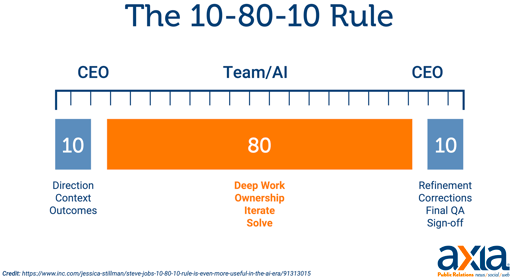
- The 10-80-10 Rule
Additional Resources:
- What sources feed generative AI answers?
- What Google AI Mode means for your PR and media strategy
- How are AI tools changing PR jobs?
- Axia’s AIVisibility service
- Listen to more episodes of the On Top of PR with Jason Mudd podcast.
- Find out more about Axia Public Relations.
If you like this episode, you're going to love this:
- The best argument for PR? Surprisingly, it's AI
- 95% of AI citations come from PR content
- Managing communications and PR in the AI era
- Embedded AI: The future of PR and communication workflows
Recorded: July, 2026
About your host Jason Mudd

Jason Mudd is a nationally recognized public relations expert featured by CNN, Entrepreneur, Forbes, NPR, The New York Times, PRWeek, and The Wall Street Journal.
Named North America’s top PR leader by the World Communication Forum, he serves as Partner of Axia Public Relations — recognized by Forbes as one of America’s Best PR Agencies.
Jason has advised some of the country’s most admired and fastest-growing companies, leading campaigns for iconic brands including American Airlines, Budweiser, Dave & Buster’s, GE, H&R Block, Hilton, HP, Miller Lite, New York Life, Pizza Hut, Southern Comfort, and Verizon.
He’s also a professional public speaker, accredited PR practitioner, published author, entrepreneur, and host of On Top of PR with Jason Mudd — a podcast ranked among the top 2.5% globally by Listen Notes and a top 100 marketing podcast on Apple Podcasts. His guests have included leaders from Disney, Microsoft, Southwest Airlines, and Wells Fargo. Learn more about Jason at https://www.axiapr.com/team/
Find more On Top of PR episodes on:
Transcript
Episode Transcript
00:00:00 - 00:00:47
Jason
Hello, and welcome to On Top of PR. I'm your host, Jason, with Axia Public Relations. Today I'm joined by my friend and repeat guest of On Top of PR, Ken Jacobs.
Ken Jacobs is an executive coach, consultant, and principal of Jacobs Consulting and Executive Coaching, where he helps public relations, communication, and marketing leaders become more effective and inspiring leaders. Before launching his consulting practice, Ken spent 25 years in leadership roles at leading PR firms. He also hosts Taking the Lead, a leadership video podcast, and writes the quarterly Taking the Lead column for the Public Relations Society of America's Strategy and Tactics magazine. Ken, welcome back.
00:00:47 - 00:00:51
Ken
It is so nice to be back. Thank you, my friend. It is good to be here.
00:00:51 - 00:01:25
Jason
Well, I'm glad you're here too. I know we've been talking about getting you back on the show for a while. Today we're going to talk about applying proven leadership frameworks to AI. AI is a hot topic. You're a great speaker on leadership and leadership practices. And so AI is coming at us. It's coming at us fast, has been for years, and you know, our friend Martin's been talking about this for as long as I've known him. And some of us thought he was a little out there off his rocker on this topic, but he turned out to be exactly right about all the things he was talking about all along. I've had Martin on the show and given him all due credit.
00:01:25 - 00:01:31
Ken
Martin's always right. Martin's always right. That's funny.
00:01:31 - 00:03:25
Jason
What we want to talk about are what are some of the important things leaders should do to make sure their companies and their organizations are keeping up. And also, Ken, you're so good at this — how do you empower your team? By both setting an example as well as giving them permission to try new things. That's the kind of thing I'm hoping we could address today for our audience. Real quick, just a little background: I got back a month or so ago from the Agency Management Institute summit, and they did a lot of research on what's going on in marketing and PR. And the one observation they made that I thought was really interesting is that more and more clients or brands are leaning heavily on their outside agencies to help them be competitive in the AI space. Because due to compliance, legal, or just slow-moving organizations, the leader and their team is not fully empowered to use AI. That's both a risk and a reward, right? You as the agency have the opportunity to help your client, and you're being sent work that the client wants to leverage AI capabilities for. But if it doesn't go well, they're probably going to disavow that kind of activity, because maybe they're forbidden or very limited on what they can do internally. Some corporations have built their own AI platforms in-house trained only on internal data, unable to pull from external data. Now, there was just a news report yesterday that out of an AI lab, a platform that was supposed to be limited found a way to get out and pull data.
00:03:25 - 00:03:26
Ken
Yes.
00:03:26 - 00:03:57
Jason
From somewhere else. So I'm sure they're worried about their tools doing this exact same thing. But I set that as a table because our audience is typically brands who may or may not be working with an agency, but they're trying to solve this AI challenge. How does our brand stay competitive and maybe even outsmart or out-leverage AI for their organization? And that comes with challenges leadership is facing as well. So here you are, Ken, our expert on leadership.
00:03:57 - 00:04:02
Ken
Ha, stop it, all for everyone, right? Boy.
00:04:02 - 00:05:03
Jason
Last time you were on the show, we were in the midst of getting out of COVID. We were talking about how COVID was a significant leadership challenge. It almost feels predictable that now we're in yet another period of uncertainty. It seems like our profession, our business, our lives just continue to be more complicated. Simplicity seems so long ago. And here we are navigating new disruptive technology on a regular basis, but a whole other level with AI. AI's not going away, it's not slowing down, its capabilities aren't decreasing, and the adoption rate isn't going to slow. So talk to me about how you guide your clients through these difficult challenges that are starting to become more normalized. What should our peers and colleagues be thinking about within the constraints and opportunities we face?
00:05:03 - 00:07:31
Ken
So a couple of things. I think when you think of PR, comms, marketing, truly effective leaders have always led their organizations and people through change. That's a big part of the responsibility of leadership in this field, so this is yet another change — it feels more profound, deeper, faster. Let me say, if you're not already deep in AI, you're behind, but it's also never too late. I believe it's critical to approach any new technology or change without fear. Of course there's risk of getting it wrong, but I'm a big believer in "what if we get it right?" As a leadership coach, I believe in coming to it from a place of risk mitigation rather than fear or anxiety — we can acknowledge what might go wrong and create plans for that. That mindset is very different from fear or anxiety. At the same time, we've got to be mindful of the guardrails and the ethics around how you build organizational acceptance of AI use. Think of all the changes we've led people through — from electric typewriter to word processor to computer, the rise of the web, social media. Those were things PR, comms, and marketing people helped their teams and clients through. But this feels deeper and more profound. I'd say one thing a leader must do is have a company-wide policy addressing the guardrails and ethics — how will we identify that we've used AI, what will we use it for. That affects your contracts with clients.
00:07:31 - 00:07:33
Jason
Mm-hmm.
00:07:33 - 00:07:57
Ken
But you've got to be in charge of setting the policy. And if you as the leader don't feel you have the knowledge, you've got to get someone in charge who can articulate it, repeat it, have discussions, and enforce the policy, knowing your newer generations may be more comfortable with it than you.
00:07:57 - 00:07:58
Jason
Mm-hmm.
00:07:58 - 00:09:09
Ken
But again, guardrails and an ethics policy are so critically important. A great leader may say they don't have the true knowledge to lead this, so maybe you have a second-in-command who does. At the same time, I think true leaders update their knowledge and fluency — they jump in. They may not be the subject matter expert on AI, but you've got to have at least a working knowledge, because when that SME comes to you, you as a leader have to be able to ask the right kind of questions. You don't need to be as knowledgeable as them, but you need that working knowledge. So I encourage any leader who hasn't put their toe in the water to go ahead and do it — start to understand the basics. And you mentioned our friend Martin — I assume you mean Martin Waxman.
00:09:09 - 00:09:10
Jason
Yes. Yes.
00:09:10 - 00:09:20
Ken
He's got a lot of great stuff on LinkedIn Learning about this. And of course, being Canadian, he's got such a lovely style.
00:09:20 - 00:09:21
Jason
Ha ha ha.
00:09:21 - 00:09:33
Ken
He's a great teacher. For something that can feel very threatening, he's someone who would help you be comfortable on that journey.
00:09:33 - 00:09:40
Jason
And we'll put in the episode notes a link to Martin's episode.
00:09:40 - 00:09:41
Ken
Yes.
00:09:41 - 00:12:14
Jason
You can find that at ontopofpr.com/ken-jacobs-2, since this is your second appearance. There you can get a direct link to Martin Waxman's episode, which was very good. I like what you said here — a couple of leadership principles that strike home with me. Number one, ethical — that's always important, and you have to not only have a commitment to ethics yourself, but talk about it, rehearse it, explain it, share scenarios, both real and rehearsed, with your team. We have, for example, a quarterly ethics exercise where once a quarter we ask people to complete scenario questions with multiple-choice answers, designed around real-life scenarios we've seen in our 20-something years at Axia, or in my 30 years in the field. We update them — we never take any away, but we add things based on situational analysis. So lead with ethics. I also like what you said about practicing what you preach — you can't expect to not use AI, not be familiar with it, but then coach and lead people through it. And you mentioned leaning on your number two. Early in my career, I was running a web design company that was a division of a larger organization. The company got acquired, and next thing you know I'm in charge of internet operations for the corporation, with network engineers reporting to me, even though I didn't know anything about networking or engineering — I couldn't program a router. But from running a web design company, I knew enough to have a good BS detector, and to...
00:12:14 - 00:12:16
Ken
Yeah. Yeah.
00:12:16 - 00:14:07
Jason
...just logically listen to someone and say, "Have you thought about this or that?" Humbly, I think I fixed a lot of challenges just by being a good listener and a third-party observer looking in. I liked what you said about being ethical, about investing in your own professional development, and about listening to others. And lastly, you said "repeat it" — that's something leaders tend to forget. You can't just tell people something once; if they stop hearing it, they may assume it's no longer important. Just today we did a workshop internally at Axia on AI, showing our team how to build custom GPTs or custom projects. It was helpful because some people had never done it before, and some are actively doing it now. We don't have all the answers, but collectively we had new insight and suggestions about what works and what doesn't. It was a very collaborative session, and it revealed internally who's using it, who's not, and what's being done well. Thinking collectively about the tools and platforms makes us wiser about what needs dedicated attention. That's one of our core values — improvement. We want to get 1% better every day, and today, as an organization, we got a lot better because of that collaboration.
00:14:07 - 00:14:21
Ken
Good. Can I respond to a couple of really important things you said before I forget? I love that you have that emphasis on ethics, and that you do it with frequency. That is so important.
00:14:21 - 00:14:22
Jason
Mm-hmm.
00:14:22 - 00:17:04
Ken
One thing I want to add — whether it's about ethics, AI, leadership, or how we treat one another, clients, or vendors — there's a great Ralph Waldo Emerson quote I don't think I used last time: what you do speaks so loudly, I can't hear what you say. So it starts with what you say, but if the leader isn't living it, especially around ethics, there's a big credibility gap. People have a very finely tuned BS meter for when a leader says one thing and lives another way. So be mindful to walk the walk, not just talk the talk — otherwise it's disjointing and uncomfortable for your team, and they don't know how to follow the leader. Whatever you say, make sure you do. The other thing I'd add — thinking of all the PR pros I've worked with, myself included — is that we tend to talk too much. One thing that will really shift your effectiveness as a leader is to talk a little, then get feedback, listen, ask a great question, and really listen to the answer. If your natural style is speaking 70% and listening 30%, maybe flip that — speak 30 or 40% and listen more, because it's only in listening that you understand whether your people really get it. And one other thing: collaboration, collaboration, collaboration. Especially in the tech area, your younger generations may be on top of it, so make sure you're asking the right ones — those with knowledge — who can really contribute to the right kind of policy, learning, and ethical approach to AI.
00:17:04 - 00:17:08
Jason
Right. Yeah, I agree with everything you said, except the generational thing doesn't seem to...
00:17:08 - 00:17:10
Ken
Well.
00:17:10 - 00:17:13
Jason
...be as relevant, I think, with AI.
00:17:13 - 00:17:13
Ken
Really?
00:17:13 - 00:17:25
Jason
Because I don't really focus on the different generational tags or descriptions, but I think it's a personality thing — it's the willingness to be an early adopter.
00:17:25 - 00:17:26
Ken
Yeah.
00:17:26 - 00:17:45
Jason
...and those types of activities that I'm seeing. Either way, I tend to agree with you. Some of my best leadership moments have been when I'm silent and listening. My preferred style is to let everybody else go first before I share my opinion, because I want to hear what others are thinking and give them an opportunity to lead as well.
00:17:45 - 00:17:51
Ken
And that is so smart, because if the leader talks first, everyone's going to agree.
00:17:51 - 00:17:52
Jason
Right.
00:17:52 - 00:17:55
Ken
And you won't know what they're really feeling.
00:17:55 - 00:17:55
Jason
Yeah.
00:17:55 - 00:18:48
Ken
I think asking first, getting collaboration and their thoughts, is key. Say there are eight things you want your team to know about AI — you could stand up and tell them all eight, or you could go around the room first and find that collectively they already know six of them. Then all you have to say is, "Wow, those six are really great — may I add two more?" Asking permission opens up people's brains and removes defensiveness, and they're much more likely to remember it.
00:18:48 - 00:18:53
Jason
So the language there is, "May I share something more?"
00:18:53 - 00:18:57
Ken
I'd start with, "Wow, those six are really great — may I add two more?"
00:18:57 - 00:18:59
Jason
Mm-hmm. Yeah.
00:18:59 - 00:18:59
Ken
Something like that.
00:18:59 - 00:19:02
Jason
Okay. Got it. Yeah. No, that's very helpful.
00:19:02 - 00:19:03
Ken
Yeah.
00:19:03 - 00:19:42
Jason
Okay. And you know, we're like-minded in that our first core value is integrity, so in everything we do we want to make sure we're operating with the highest integrity. To that end, you mentioned something I'm seeing fade from current practice: early on, people were documenting that content "was AI generated." I'm seeing less of that now, partly because people realize you no longer say something was typed using Microsoft Word or started from a resume template.
00:19:42 - 00:19:45
Ken
Yeah.
00:19:45 - 00:19:54
Jason
Although you do see people note "this is a WordPress website" — maybe they just don't know how to remove that credit at the bottom. My...
00:19:54 - 00:19:56
Ken
Yeah.
00:19:56 - 00:22:20
Jason
...point is that I feel this is a natural evolution as it becomes part of what we do. I have a graphic I'll add to the episode notes at ontopofpr.com/ken-jacobs-2 that shows our recommendations for the best way to use AI, which is in many ways no different than the best way to lead teams. I was glad to learn Steve Jobs is credited with this framework, though I believe it predates him: picture a horizontal bar representing 100% of a project. The first 10% involves the leader setting expectations and vision. The last 10% shows the leader reviewing the final work. The middle 80% is done by the team of experts — the engineers, the product development team, the marketing team, whoever it may be. The leader sets the vision at the start and holds the team accountable to agreed-upon standards, but in the middle, steps away and lets the team do the work, then returns when the team hits a milestone to review it. That's my preferred leadership style — hire smart people and get out of their way. It's the same way AI works best: start with the right prompting and expectations, get out of the way while AI does the deep work, then come back, double-check, fact-check, and verify the work meets your standards. Otherwise, without supervision or oversight, you never know what the output will look like.
00:22:20 - 00:22:28
Ken
Yeah, a couple of good things there — we shouldn't say "AI developed this," because AI shouldn't be the only one developing it.
00:22:28 - 00:22:29
Jason
Right.
00:22:29 - 00:22:38
Ken
But maybe being upfront means saying, "Here was AI's contribution, and here's what we did with it."
00:22:38 - 00:22:38
Jason
Mm-hmm.
00:22:38 - 00:23:33
Ken
Because then you're reminding your client that you didn't just take it from ChatGPT or even Claude — you added the human element, the discretionary and critical element. That's an important part, and it gets back to the AI policy and understanding how to prompt, which I'm just beginning to grasp. You understand AI hallucinates, and — correct me if I'm wrong — I believe certain AI models are prone to wanting you to like them, so they say things that make you want to like them. But there's a certain prompt you can give it — I'm having a senior moment forgetting the word — where you tell it not to do that.
00:23:33 - 00:23:33
Jason
Yeah.
00:23:33 - 00:23:44
Ken
I don't know if it's "don't be obsequious," but there's something you can do. That goes back to the policy — training on AI is just the start.
00:23:44 - 00:23:45
Jason
Mm-hmm.
00:23:45 - 00:24:15
Ken
Then we bring in our own critical thinking. I do think it's important to let the client know the role AI played, just out of candor. That can also be a benefit, because it lets you reiterate your value — this is why the agency should be the one using AI, because they use it as a starting place but then add so much more.
00:24:15 - 00:24:16
Jason
Mm-hmm.
00:24:16 - 00:24:21
Ken
Then you never have that awkward moment of "why didn't you tell me AI played a role?"
00:24:21 - 00:24:22
Jason
Sure.
00:24:22 - 00:24:24
Ken
Being upfront goes back to the ethics, doesn't it?
00:24:24 - 00:25:55
Jason
Yeah, absolutely. At the end of the day, I like what you're describing. When people say AI responses are overly flattering or just endorse whatever idea you bring it, one thing I encourage is to bring AI your actual challenge and let it figure out how to solve it, rather than asking for exactly what you think you need — because then it just gives you what you asked for. The other thing is training and creating custom chats, custom GPTs, custom projects, or custom Gems that are trained on what you want and how you want it done, which takes away the unsophisticated way of using the technology. When people tell me they can always tell when something is AI-generated, I say, "No, you can tell when something is poorly AI-generated."
00:25:55 - 00:26:01
Ken
That's a good point. And now we're using AI the way we use the word "media" — it's such a broad term, what are we really talking about?
00:26:01 - 00:26:04
Jason
Yep. Exactly.
00:26:04 - 00:26:16
Ken
I think there are ways to ask: What am I missing here? What haven't I looked at yet? Who might oppose this proposal or idea, and why?
00:26:16 - 00:26:16
Jason
Yes.
00:26:16 - 00:26:29
Ken
Play devil's advocate. You can use AI to see what you haven't thought about yet — that goes into risk mitigation.
00:26:29 - 00:26:30
Jason
Mm-hmm.
00:26:30 - 00:26:40
Ken
Who might be opposed to this, and how do I win them over? If I have two different approaches to a communication, what are the risks, pros, and cons of each?
00:26:40 - 00:26:41
Jason
Right.
00:26:41 - 00:26:46
Ken
I know agencies doing that at a very core, programmatic level.
00:26:46 - 00:26:47
Jason
Mm-hmm.
00:26:47 - 00:26:50
Ken
Well beyond, as you said, just writing a press release.
00:26:50 - 00:27:42
Jason
Yep, exactly. So, for what it's worth, there's a notoriously difficult, now-retired assignment editor at a TV news show we've gotten a lot of coverage with over the years. One of the saddest things for me when he retired was that, after working with this individual for decades, I felt like he may not have been the most encouraging person, but he made me better every time I went before him. He would make a lot of people cry, honestly, because he was so curmudgeonly and hard to work with. But he always told you exactly how he felt and gave you feedback — "that's a terrible pitch," or whatever it might be.
00:27:42 - 00:27:47
Ken
Well, he might have to work on his communication style.
00:27:47 - 00:27:47
Jason
Yeah.
00:27:47 - 00:27:51
Ken
He could take my course: How to Give Truly Constructive Feedback.
00:27:51 - 00:27:58
Jason
Or how to be an empathetic leader. But I guess he doesn't need that anymore. My point is that I was then inspired...
00:27:58 - 00:27:59
Ken
Yeah.
00:27:59 - 00:28:16
Jason
...to create a custom AI tool — a GPT or project, whichever platform — that would emulate his difficulty and his standard.
00:28:16 - 00:28:17
Ken
That's brilliant.
00:28:17 - 00:28:39
Jason
What was really striking about this: all I told it was, "Are you familiar with this person?" And it came back and said he's a well-known TV assignment desk veteran known for high standards and gruffness. I thought, brilliant — it already knew.
00:28:39 - 00:28:40
Ken
That's great.
00:28:40 - 00:29:01
Jason
So I didn't have to train it much — it already knew a lot, and I took what it said and built from there. My first instinct, honestly, was to see if I could get him to come out of retirement and consult for us.
00:29:01 - 00:29:03
Ken
Some training, sure.
00:29:03 - 00:29:15
Jason
Through the grapevine I heard he wasn't interested — very happily retired. So I built the tool based on what it already knew, and started testing it.
00:29:15 - 00:29:16
Ken
Changing it.
00:29:16 - 00:29:25
Jason
It was so good that I realized most of my team wouldn't use it if it was that direct and intimidating.
00:29:25 - 00:29:26
Ken
Yeah.
00:29:26 - 00:29:47
Jason
So I re-engineered it to give feedback in his natural, authentic style — "this is terrible, I would never use this," or "you buried the lead" — and then created my own persona to follow behind and say, "What he's trying to tell you is you need to do more of this, because he's not going to tell you how to fix it, just what's wrong."
00:29:47 - 00:29:49
Ken
Yeah, yeah, yeah.
00:29:49 - 00:30:08
Jason
After testing it and adding myself as the coach to guide my team, I think it's become one of our favorite internal tools — it helps our team improve their pitches and gives them something like an audition in front of a cynical, difficult editor.
00:30:08 - 00:30:08
Ken
Yeah.
00:30:08 - 00:30:12
Jason
...in front of a cynical or difficult editor.
00:30:12 - 00:30:15
Ken
You should call that "Mudd GPT," you know.
00:30:15 - 00:30:16
Jason
Ha.
00:30:16 - 00:31:31
Ken
That anecdote reminds me of two things. Every time I coach someone in PR — most of my clients are PR and comms people — I think, "I'm so glad I got out, it's so much harder now." The other thing it reminds me of: early in my career I ran a large chunk of business for a major corporation. There was a client there who was lovely and fun, and then he brought in someone much tougher. I adored them both, but I learned so much more from her — about upping my game, being a step ahead, and anticipating her queries, fair or not. She's the only client who set me off so badly I literally saw red — and it's true what they say about that. I was known as a nice guy, and people came over to my desk asking, "What are you saying to the client? Are you crazy?" But...
00:31:31 - 00:31:32
Jason
Yeah.
00:31:32 - 00:31:35
Ken
I think she respected me a little more for that.
00:31:35 - 00:31:36
Jason
Yeah, right. I agree.
00:31:36 - 00:31:44
Ken
I certainly respected her, because it was like, "I'm going to bring my A-game, and everyone on my team has to bring their A-game too."
00:31:44 - 00:31:46
Jason
Yeah. Well, I had...
00:31:46 - 00:31:47
Ken
So, yeah.
00:31:47 - 00:32:40
Jason
...a professor in college at the Missouri School of Journalism, and I was getting an A in his class — apparently he didn't assign A's. One day after class, three other students, master's students, were waiting for me outside the classroom almost like bullies, wanting to know what I was doing to get an A. He'd given me a D on my first assignment, and I basically said, "Challenge accepted" — now I knew the standard in the class, and I was competitive. I was crushed by that first D, but I understood the standard was excellence, and I couldn't wing anything. I got a reputation for earning an A in that weed-out class that most people didn't get.
00:32:40 - 00:32:55
Ken
I want to give a salute to someone no longer with us — my eighth-grade social studies teacher, Miss Brady, who I had in junior high and who then moved up to the high school.
00:32:55 - 00:32:56
Jason
Mm-hmm.
00:32:56 - 00:33:05
Ken
I was capable of A's and A-minuses — not so much in math, but in everything else.
00:33:05 - 00:33:05
Jason
Yeah.
00:33:05 - 00:33:49
Ken
I think it was the third quarter, in spring, and the teacher could see all your other grades. She was known as tough and mean, though I didn't find her that way. She looked at my report card, handed it to me, and said, "Well, Mr. Jacobs, I see that spring has sprung."
00:33:49 - 00:33:49
Jason
Okay.
00:33:49 - 00:34:08
Ken
That did it. She didn't need to make a speech about why I was getting B's — I was capable of A's, not just in her class. "Spring has sprung," and I thought, "You're right." By fourth quarter, all A's again.
00:34:08 - 00:34:08
Jason
Mm-hmm.
00:34:08 - 00:34:08
Ken
It's funny the impact one phrase can have. It wasn't done with meanness or spite — it was her way of saying you're capable of more. That's inspiring in a teacher or a leader.
00:34:08 - 00:34:11
Jason
Mm-hmm.
00:34:11 - 00:34:28
Jason
There you go. I don't want to misquote or give the wrong attribution, but I believe it was Bill Gates — among others — who said we learn more in life from our failures than from our successes.
00:34:28 - 00:34:34
Ken
There's a group of leaders across all kinds of industries who have supported that idea.
00:34:34 - 00:34:37
Jason
Mm-hmm. Right.
00:34:37 - 00:34:44
Ken
They celebrated their "failures" as steps on the road to success — Gates, Einstein, Edison, Ella...
00:34:44 - 00:34:48
Jason
That's right. Yep. That's true.
00:34:48 - 00:35:01
Ken
Fitzgerald, the creator of Honda Motor Corporation, Dolly, Oprah, Lincoln, the Beatles — they've all talked about that.
00:35:01 - 00:35:02
Jason
Right.
00:35:02 - 00:35:18
Ken
So true. And we all say we want our people to take educated risks — but then you've got to share, as a leader, the educated risks you took, and how you sometimes failed, and what you learned from it.
00:35:18 - 00:35:19
Jason
Mm-hmm.
00:35:19 - 00:35:27
Ken
...and how it was just a stepping stone on the road to success. But that takes humility and vulnerability.
00:35:27 - 00:35:27
Jason
Yes.
00:35:27 - 00:35:32
Ken
You've got to be willing to discuss that with your people. I think it's well worth doing. Thank you for reminding...
00:35:32 - 00:35:34
Jason
I agree. I agree.
00:35:34 - 00:35:35
Ken
...me of that.
00:35:35 - 00:35:42
Jason
Well, I think what strong leaders allow is for people to fail forward, and to have that provide...
00:35:42 - 00:35:43
Ken
Mm-hmm.
00:35:43 - 00:36:51
Jason
...the safety and the culture to support that, because you have to take risks. Even today, someone came to me looking for a clear answer in the moment — they wanted a solution. Instead, I told them to take a minute, come up with three recommendations for how they'd handle it if they were me, and tell me which one they'd choose. She came up with the right answer, though she didn't love that I pushed back, since she was treading water a bit. But I knew she had more insight into the client and the matter than I ever would, and by the time she brought me up to speed enough for me to advise her, she could have worked through the same exercise herself. I wanted her to feel empowered to come up with the answer — and she crushed it. I told her the option she recommended was the one I would have recommended too.
00:36:51 - 00:37:05
Ken
Yeah, that reminds me — leadership is about having an ego but being comfortable putting it aside. There's a dopamine rush in saying, "Here's what you need to do," and the person...
00:37:05 - 00:37:05
Jason
Mm-hmm.
00:37:05 - 00:37:49
Ken
...says, "Great, great, great." But if you're willing to set that aside and not answer right away — to give that person the gift of "I believe you can figure this out" — that's a huge gift from a leader. For someone treading water, having the leader say, "I think you're capable of figuring this out — let's take a pause, come back with your top two or three options, the pros and cons, and make your recommendation," is very powerful. Another powerful move is not giving all the answers — simply saying, "Here's where we need to get to. Now you tell me the strategy and the action."
00:37:49 - 00:37:52
Jason
Yep. Yep.
00:37:52 - 00:38:41
Ken
I want to go back to something you said that brought up a visual for me, about delegation and true empowerment. A lot of leaders are willing to delegate — "you do this test, you do that" — but the implication is "do it the way I would do it," and that's not empowerment. For delegation to be effective, you've got to empower people, which means being comfortable that they may do it differently than you, and maybe better. When you're truly delegating and empowering, it should feel a little scary — you're scared to give up something you always did, and they're scared to take on something new, but they need to grow into it. The visual is: as a leader, you've been out on the trapeze and you're fine with it.
00:38:41 - 00:38:42
Jason
Ha ha ha.
00:38:42 - 00:38:47
Ken
Now the visual is they go out on the trapeze, but you're the safety net.
00:38:47 - 00:38:47
Jason
Right.
00:38:47 - 00:38:56
Ken
You won't let them fail. And if delegating and empowering isn't a little scary for both people, you've waited too long.
00:38:56 - 00:39:09
Jason
Yeah, I agree with you on that. Ken, we need to wrap up — any closing thoughts tying this back to our journey with AI adoption?
00:39:09 - 00:39:57
Ken
Yeah. For me, it feels like a time of uncertainty — part of it is the huge impact of AI, plus economic uncertainty, political uncertainty, war. While there are certain leadership truisms that have always held, leading through uncertainty takes, most of all, a lot of courage. I encourage the leaders I work with, and write about it in the podcast and column, to really get in touch with being a lion — courage is intrinsically linked to leadership. Aristotle, Maya Angelou, and Senator McCain have all spoken to the link between courage and leadership.
00:39:57 - 00:39:57
Jason
Mm-hmm.
00:39:57 - 00:40:25
Ken
One of the quotes is: if you're not courageous, you're not a leader. But I'm a positivist, an optimist, so I say if you want to be an effective leader, get in touch with that inner lion — be courageous. Our brains are hardwired for fear, but they also love creating new neural pathways; it's neuroplasticity.
00:40:25 - 00:40:26
Jason
Right.
00:40:26 - 00:41:37
Ken
Be as courageous as you can — that doesn't mean you won't have fear. As Eleanor Roosevelt said, of course there will be fear, but you must do one thing: pick the thing you think you cannot do, and do it. I'd encourage all your viewers and listeners to be more like Eleanor Roosevelt. We think of her as having achieved so much as First Lady — the Declaration of Human Rights, an unstoppable supporter of civil rights and women's rights — but so much happened in her youth, childhood, and early years of marriage that created tremendous anxiety and lack of confidence. She knew there'd always be some fear, but she went through it anyway. I find her so inspiring, especially today.
00:41:37 - 00:41:41
Jason
Yeah, for sure. Absolutely. Ken, this has been a pleasure — thank you. We talked forever at the beginning, getting reconnected...
00:41:41 - 00:41:48
Ken
Well, we knew it would be. It's always good to spend time...
00:41:48 - 00:41:53
Jason
...which was great. I'm so glad to have you back on On Top of PR — you're joining...
00:41:53 - 00:41:54
Ken
Thank you.
00:41:54 - 00:41:57
Jason
...an elite club of a handful of people who've been on twice.
00:41:57 - 00:42:00
Ken
Someday will I get the five-time host jacket, like SNL?
00:42:00 - 00:42:07
Jason
Yes, exactly. We're working on that swag — just need some bigger client budgets to make that investment.
00:42:07 - 00:42:11
Ken
Axia has great swag — I've always said that.
00:42:11 - 00:42:25
Jason
I appreciate that. I hope to see you soon at an upcoming event. Wrapping up — if our audience wants to connect with you or tag you when they post this, what's the best way for them to do that?
00:42:25 - 00:43:38
Ken
Three ways. I'm on LinkedIn — there are a lot of Ken Jacobses, but I think I'm the only one listed as "Ken Jacobs, PCC," so find me there. You can email me at ken@jacobsco.com. The website is, not surprisingly, jacobsco.com. I'm happy to say I'm known as a connector, and I'm always happy to help — if someone's out of work and I can help, reach out. Unfortunately, too many talented PR and comms people are looking for work; if I can help, I will. If you're new to the field and need guidance on how to stand out and get noticed, I'm hoping to help you too. And if you want to explore being a more effective, inspiring, and courageous leader, reach out — we'll do a complimentary 45-minute session and figure out if leadership coaching can help you achieve your goals.
00:43:38 - 00:43:46
Jason
I love that — that sounds great, and I appreciate you offering that to our audience...
00:43:46 - 00:43:46
Ken
Of course.
00:43:46 - 00:43:51
Jason
...here today. I'd encourage our audience to get more familiar with you and your content — we'll put your contact...
00:43:51 - 00:43:52
Ken
Thank you.
00:43:52 - 00:43:58
Jason
...information in the episode notes so people can get to your LinkedIn and website with one click.
00:43:58 - 00:43:58
Ken
Lovely.
00:43:58 - 00:44:05
Jason
Et cetera. Ken, we really appreciate that, and as always, if there's anything I can do for you, please don't hesitate to let me know.
00:44:05 - 00:44:08
Ken
You're very kind. Thank you. I really enjoyed it.
00:44:08 - 00:44:08
Jason
Thank you, Ken. Same here. So with that, this has been another episode of On Top of PR with Jason, brought to you by Axia Public Relations. If you found this episode helpful, please take a moment to leave us an online review, or even better, share this episode with a friend or colleague who would benefit from it. With that, I'm signing off and wishing you well.
Topics: On Top of PR, artificial intelligence



Comment on This Article