
In this episode, Jessica Barber Scott joins host Jason Mudd to discuss how public relations professionals can move beyond impressions and advertising value equivalency to measure outcomes and impact, build measurement frameworks around business objectives, and use AI without losing the human judgment a CFO relationship requires.
Tune in to learn more!
Watch the episode here:
Meet our guest:
Our guest is Jessica Barber Scott, a senior communication professional with 15 years of experience across regulated financial services, state government, and higher education. She is a PRSA Silver Anvil Award winner for crisis communication and has advised C-suite leaders at organizations including TIAA, Corebridge Financial, and EverBank.
5 things you’ll learn during the full episode:
- Why AVE still shows up in reporting and what it costs you
- How to climb the three tiers of PR measurement (outputs, outcomes, and impact)
- Why your measurement framework should start with the business objective—not the data
- Four moves that change the dynamic of any CFO budget meeting
- What AI can do for measurement and what it can’t replace
Listen to the episode here:
Quotables
- “The numbers are getting smaller as the work gets credible.” — Jessica Scott
- “Come in with the data. Not with an apology, with data.” — Jessica Scott
- “AI can pull faster. It can synthesize more broadly. It can find patterns across data at a scale that really no human team can match. But what it can't do is tell you whether you're measuring the right thing in the first place.” — Jessica Scott
- “Getting media coverage is not a result. It's an output of the work and the effort that you made.” — Jason Mudd
If you enjoyed this episode, please take a moment to share it with a colleague or friend. You may also support us through Buy Me a Coffee or by leaving us a quick podcast review.
Resources
Guest’s contact info and resources:
- Jessica Scott on LinkedIn
- AMEC
- The 10-80-10 Rule
Additional Resources:
- How do you measure PR?
- Yes, PR is measurable. How to measure and report public relations and strategic corporate communications
- The 3 biggest PR measurement mistakes
- 5 metrics you should measure in PR
- Listen to more episodes of the On Top of PR with Jason Mudd podcast.
- Find out more about Axia Public Relations.
If you like this episode, you're going to love this:
- What you should be measuring in your PR campaigns with Johna Burke
- Barcelona Principles 4.0: How to measure PR effectively with AMEC CEO Johna Burke
- The power of PR measurement with Katie Delahaye Paine
Recorded: August, 2026
About your host Jason Mudd

Jason Mudd is a nationally recognized public relations expert featured by CNN, Entrepreneur, Forbes, NPR, The New York Times, PRWeek, and The Wall Street Journal.
Named North America’s top PR leader by the World Communication Forum, he serves as Partner of Axia Public Relations — recognized by Forbes as one of America’s Best PR Agencies.
Jason has advised some of the country’s most admired and fastest-growing companies, leading campaigns for iconic brands including American Airlines, Budweiser, Dave & Buster’s, GE, H&R Block, Hilton, HP, Miller Lite, New York Life, Pizza Hut, Southern Comfort, and Verizon.
He’s also a professional public speaker, accredited PR practitioner, published author, entrepreneur, and host of On Top of PR with Jason Mudd — a podcast ranked among the top 2.5% globally by Listen Notes and a top 100 marketing podcast on Apple Podcasts. His guests have included leaders from Disney, Microsoft, Southwest Airlines, and Wells Fargo. Learn more about Jason at https://www.axiapr.com/team/
Find more On Top of PR episodes on:
Transcript
Episode Transcript
00:00:00:00 - 00:00:37:00
Jessica Barber Scott
a report is delivered after work is done. it describes what happens. The audience they can accept it, they can question it, they can ignore it, but this the decisions they've already been made. A treaty itself is negotiated before the work begins. Both parties agree on what that success looks like and what will be measured and how the results will be interpreted. That agreement changes everything. It changes, the communications team isn't defending its numbers after the fact. It's actually reporting against the definition of success that the business leadership co authored.
00:00:37:00 - 00:01:22:00
Jason Mudd
Hello, and welcome to On Top of PR. I'm your host, Jason Mudd with Axia Public Relations. Today our special guest is Jessica Barber Scott. Jessica is a senior communication professional and independent consultant with 15 years of experience across regulated financial services, state government, and higher education. She's a PRSA Silver Anvil Award winner for crisis communication and has advised C-suite leaders at organizations including TIAA, Corebridge Financial, and Everbank. Her work spans communication governance, executive positioning, and measurement frameworks built to survive contact with the CFO. And that's why we're here today to talk about PR measurement and AI. Jessica, welcome to On Top of PR.
00:01:22:00 - 00:01:24:00
Jessica Barber Scott
Hey, thanks Jason. It's nice to be with you.
00:01:24:00 - 00:03:30:00
Jason Mudd
Yeah, I'm glad to be here too. I'm really glad that we're able to do this and we appreciate our mutual friend Chris making the introduction today. Yeah, well, this is one of my favorite topics, PR, measurement, and AI. I think that I'm excited because I know our focus for our time together is going to be on measurement, and then we'll talk about how AI changes it. I think this is a really good conversation. And, as we were talking before we press record, we're both actively publishing on LinkedIn with these similar topics and I'm just gonna take a leap and say, pet peeves, you know, about how people don't think the right way about measurement. And I don't know about you, but my LinkedIn feed is always full of people kind of boasting about impressions and the number of impressions that they've earned or created. And I'm just, you know, it's hard to kind of just keep scrolling when you see that 'cause you're like, impressions don't tell you anything or much meaningful and it's not the full picture and what happened next. But I just I hold back my tongue, I hold back my keyboard and I just keep scrolling. So hopefully today someone will benefit from this conversation and kind of rethink how they're measuring, how they're reporting and we can elevate the profession and give back to the profession today by you know making everybody better and thinking differently about measurement in our episode notes which you'll find at ontopa.com slash jessica dash scott you will find links to other episodes where measurement was a topic and I think our audience will really benefit from that. So Jessica let's talk let's just cut right to it and tear off the band-aid advertising value equivalency I'm glad to say that's a word I haven't heard much lately, maybe even not at all this calendar year, but it's come up recently, partially because I've been really pushing back, like I said earlier, on some visibility and impression posts that I've seen where it just seems like the only thing they're measuring is impressions. And to me, I'm like, that's about as savvy as only measuring AVEs and sometimes I wonder if AVEs might be slightly or equally as ridiculous. So yeah, let's talk about it.
00:03:30:00 - 00:04:17:00
Jessica Barber Scott
Yeah, yeah. You know, I think I've probably not heard AVE as much as I've heard impressions, but AVE when you're specifically talking to folks in finance, they see that as an equivalent, you know, people who are not practitioners, who aren't digging around in, you know, media hits and tracking it. So they see that value and they think, Okay, these are these are equitable. They're not. We know that. And you know, most practitioners do know that somewhere in the back of their heads. But we know, I don't know about you Jason, but I know that the industry declared AVE dead in like twenty ten. But it's still showing up on board decks. And I think the reason that those comms leaders reach for it, I mean because it shows a dollar value. And oftentimes,
00:04:17:00 - 00:04:18:00
Jason Mudd
yeah.
00:04:18:00 - 00:04:26:00
Jessica Barber Scott
you know, when you're in there in the room with a C suite executive, particularly with your finance guy, they want to know, well what does this mean for our bottom line? Well A
00:04:26:00 - 00:04:26:00
Jason Mudd
Right.
00:04:26:00 - 00:04:39:00
Jessica Barber Scott
VE doesn't say that. AVE says this is how much it would cost if we ran an ad, which we all know, earned. That's not the same thing. I mean I don't know about you, but I don't go looking at news outlets for an ad. specifically read about. So
00:04:39:00 - 00:04:42:00
Jason Mudd
Mm-hmm. Right. Right. Yeah.
00:04:42:00 - 00:04:52:00
Jessica Barber Scott
yeah. So yeah, I mean like the reason that it came up for me, look, I inherited a reporting deck where AVE was the headline metric. And this was years ago. And
00:04:52:00 - 00:04:54:00
Jason Mudd
Mm-hmm.
00:04:54:00 - 00:05:23:00
Jessica Barber Scott
it was this big font on the very first slide. And at first, you know, I had kind of that same reaction you do when you're scrolling, right? Like, I kind of want to fight back about this. But instead, I took a second and said, you know what, I'm not gonna fight this directly. Instead, I started adding a second slide, like right underneath it, where I translated into outcomes language rather than AVE. I think the same thing can happen there with impressions, right? You start adding in the language that you really wanna use. So this is
00:05:23:00 - 00:05:24:00
Jason Mudd
Right.
00:05:24:00 - 00:05:29:00
Jessica Barber Scott
this is a relationship management, you're speaking the same language, but you've got to first teach the language.
00:05:29:00 - 00:05:30:00
Jason Mudd
Mm-hmm.
00:05:30:00 - 00:05:57:00
Jessica Barber Scott
So, you know, a couple of quarters in, there was someone in leadership who kind of pushed back and asked why the AVE number had gone down. Well, we know that was an opening for me to talk about how it hadn't actually gone down. it had never been a real number, right? Like that it's just what it would have cost. So I was able in that instance to retire the AVE slide, excuse me. I was able to eventually retire that AVE slide entirely. Nobody
00:05:57:00 - 00:05:58:00
Jason Mudd
Right.
00:05:58:00 - 00:06:03:00
Jessica Barber Scott
noticed it was gone, you know, and that silence that silence actually speaks volumes for
00:06:03:00 - 00:06:03:00
Jason Mudd
Yeah.
00:06:03:00 - 00:06:05:00
Jessica Barber Scott
what real work that number was ever doing. So
00:06:05:00 - 00:08:15:00
Jason Mudd
Mm-hmm. I always hear people say, Well, you know, my CEO, my CFO wants to see the advertising value equivalency. But I also think that sometimes that may or may not be the full honest answer. It might be just that's what they're used to seeing, so that's what they want to see. You know, so I'll just share my story. When I was earlier in my career, I started Axia almost 25 years ago and I believed in AVEs. And when I heard people give pushback back in 2000, 2002-ish or 2003-ish, I felt at the time I didn't really understand why they would push back, but I also knew that the practitioners who heard that and held on to that were often the ones who I felt like were not generating much AVE number, a very high AVE number. And just to spell it out, I think these people were not getting much earned media coverage for their client. And so then they were like, Well, let's not look at advertising value equivalency because that's not a, you know, a meaningful measure. And so I looked at it at first, my instinct was, okay, you're just using that as a crutch. You're parroting back a phrase you heard someone else say. When how else are you gonna measure? PR. Now, 2002, we'll call it, the world has changed a lot since then as far as attribution, technology, tracking. You know, I'm not even sure if Google Analytics was a thing back then, right? I'm not even sure that Google was the, you know, 800-pound gorilla yet, although it was an up-and-comer for sure. So my point is to say that times have changed significantly. And you know, I'm glad it has. We have case studies on our website today that talk about AVE still because it's a little dated, but it's still really good work and campaigns that we did. We've got case studies on our website today that talk about impressions because as you and I talked about before we press record, there's a lot of environments where it's really hard to go deeper, whether that's control, whether that's technology, whether that's just overall business savviness and willingness of a corporation to give access even to their own marketing department, much less to an outside agency. So we've got a lot to work with here, Jessica.
00:08:15:00 - 00:09:43:00
Jessica Barber Scott
You're right. We do. There's, we are in an environment that is rich with data, right? It's just having access to the data. And part of that is a trust build, right? That you've got good relationships across departments, that you've got good relationships with the people, the keepers of the data, and building those, building that out, you know, and showing them the value of that shared data. It benefits everybody. And I mean, as you think about it, you know, what we're reporting out when we start talking about our media and impressions, sure, we can talk about these big huge, we have one point five billion impressions. Great. What did that actually do? And that's where I actually, and I'm sure you do this too, where you start thinking about, okay, well, rather than just the impressions, what does that three-tier climb look like, right? The outputs, the outcomes, the impact, what does it actually look like? And I think one of the things that practitioners get a little scared, a little nervous about is that as you go through those, that number gets smaller. but as the number gets smaller the work gets more credible, right? I think about this retirement equity campaign I did a while back and I was trying to tell this story about impact and I actually had a choice between sharing a Today Show placement, like Today Show, and then there was a smaller piece in a parenting publication. by a well-known economist writer. Now, most people would go, the Today Show was the obvious output win, right?
00:09:43:00 - 00:09:45:00
Jason Mudd
Hm. Right.
00:09:45:00 - 00:10:02:00
Jessica Barber Scott
I mean, of course. But I chose the smaller placement to tell the story because it reached women at the exact life stage where retirement planning decisions get deferred or skipped. The outcome-level thinking there over the output-level reach. it changed the conversation. And
00:10:02:00 - 00:10:03:00
Jason Mudd
Uh-huh.
00:10:03:00 - 00:10:35:00
Jessica Barber Scott
so, you know, full transparency, I didn't have the impact-layer data to close the loop on that one. And that is where that gap is kind of part of the point of this conversation, at least, is that most communicators aren't even getting that far. And so thinking about that measurement, especially when you're telling the story. 'Cause listen, we are storytellers, right? We're using the data. We're using it to tell the story of what we're doing and how it's impacting our organizations. You gotta have the data to be able to tell the story. So yeah.
00:10:35:00 - 00:11:21:00
Jason Mudd
Mm-hmm. Yeah. Yeah. Well, I like how you're describing basically using discernment and a little bit of, you know, if I got a word, like a strategy to approach your media relations. 'Cause, this is another thing that kind of gets me on my soapbox, this idea of, explaining to a client or a leader the difference between a publicist and a media relations professional or a trusted advisor, right? So a publicist is looking to be anywhere, everywhere, all the time, and probably subscribes to there's no such thing as bad publicity and there's no such thing as overexposure, where, you know, frankly I disagree. And so, you know, I like to jokingly ask those individuals, okay, so you want to make sure you're getting the most media coverage you can. I'm like, well then let's go mess something up really bad, like, you know,
00:11:21:00 - 00:11:22:00
Jessica Barber Scott
Exactly.
00:11:22:00 - 00:11:39:00
Jason Mudd
or the CEO is like, We need much more visibility and we need guaranteed media coverage. I'm like, Okay. So you can jump off a building or you can shoot somebody or you could steal some money or something and, you know, rob a bank or get arrested. That's the kind of thing I can guarantee you headlines. You know, at
00:11:39:00 - 00:11:40:00
Jessica Barber Scott
Absolutely.
00:11:40:00 - 00:12:19:00
Jason Mudd
And I know that's not what they want, but I try to use a little humor to break the tension, and then try to express to them that, you know, there are other ways we can go about doing it. And, the idea, and the bigger challenge as you know, is that a lot of companies, and even the companies, for example, that you worked at, they're never gonna be as newsworthy as Coca-Cola, Disney, Nike, et cetera. And there's probably wasn't a beat writer waiting for you guys to post something on the wire like I've seen other people work at a big company. They're like, if you want media coverage, you just write a news release and you throw it on the wire and the phone rings. I'm like, yeah, that works great if you're a Fortune 100. But anybody other than that, you gotta do it. There's more work involved here.
00:12:19:00 - 00:13:34:00
Jessica Barber Scott
I'd even push back and say that even in the Fortune 100 these days, with the state of media, if you think about it, they are operating on such limited resource, limited bandwidth, right? So I don't, the fact that there are still beats is kind of amazing. But even then, I feel like it's not necessarily just the silver bullet of, put it on the wire and we'll get the calls. And I've always joked, like you have those folks who come to you and say, just put it on the press release and they'll call you. Or can't you just pick up the phone and call, like, the New York Times? And I'm like, you really don't want me to do that. That is not a thing that you want me to do. And here's why. And so I'd even say we just have to be strategic whenever we're you know, thinking about placements and really it is about impact and being able to show, hey, this doesn't, from the outside might not look like a huge win, right? The Today Show, wow, that's huge. It is huge. But how much did you see an impact in your business whenever, you know, compared to that smaller more targeted publication because we were targeting that audience. That's who we wanted. Yeah, they were probably both watching, there was overlap, but where's the impact to your bottom line? So
00:13:34:00 - 00:13:55:00
Jason Mudd
Yeah, So Jessica, I'm eager to jump into the next step, which is talking about what we're calling here a three-tier climb of outputs, outcomes, and impacts. Before we go further, let's define that three-tier climb for our audience. Let's use an example, pick one example and walk through that for our audience, so we're all on the same page.
00:13:55:00 - 00:14:59:00
Jessica Barber Scott
Yeah, so if you think about it, most dashboards stop at outputs and then they kind of dress them up with font size, right? Big number, bold typeface, slide one, done. Outputs are real. They're impressions, they're placements, it's reach. They measure something, right? But they don't measure whether anything happened because of the communication. So that's outcomes. But outcomes aren't the same as asking, did the organization's situation actually change? That is impact. So, outputs, which was your first question, explain the difference. Outputs: what we produced. In my example, the Today Show segment. 2.4 million impressions, 47 placements. Outcomes: what shifted in the audience? Awareness, consideration, intent, behavior. Impact: what changed for the organization as a result? Right? Cost avoidance, market position, public trust. And when you're thinking about a conversation with the CFO, those are the things that actually track. So I know I gave you the example of that retirement equity campaign.
00:14:59:00 - 00:17:08:00
Jessica Barber Scott
And I really lean on that just because having a big show like the Today Show versus the smaller publication that's so targeted, and it is not the one that people reach for, right? They look for those massive reaches. Well, if we were only going to talk about outputs, sure. that Today Show is where we would stop. We'd stop at the outputs, actually. We wouldn't even get to the outcomes because it would be implied. When we're starting to talk about impact. we wanna look at those more targeted placements. We wanna look at what it actually looks like on the bottom line, right? Like that's what your CFO, when you're in the room with the CFO, they wanna know, hey, okay, so forty-seven placements, great. Two million people saw this, excellent. How many of them came to the website? How many of them called an advisor? How many of them opened an account? Like, what does that look like? 'Cause all they care about is the money, right? Like the bottom line, the impact to the business, what it looks like. When you're thinking about outcome over output, you know, it's a harder argument to make in the room. And it actually really requires you to understand the audience that a campaign is trying to move or reach, not just the one that's gonna look impressive. So, I'm not sure if women who read the piece opened a retirement account, right? I don't have that information. And that's kind of one of the reasons I started writing about this, was because I've found in my career that having a really good relationship, an understanding of a campaign, and then an understanding of, what the bottom line looks like down the line, it helps me tell that story, right? Because it's not the whole story. There's a gap, it's real, it is not unusual. And so we don't often get to the impact layer as communicators, right? Sometimes the data isn't there, sometimes the relationship with the team tracking it isn't there. Oftentimes it's because we don't ask for it. So knowing why you made the call, being honest about what you can and can't measure, it's still better measurement than a slide full of impressions at a seventy-two point font. That's kind of where this whole idea started, right? It's not a bug. The numbers are getting smaller as the work gets credible, right? It's not a bug.
00:17:08:00 - 00:17:15:00
Jason Mudd
Yeah, or it's like a workflow, right? You start at the top with maybe the impressions, right? So you're gonna get a lot of impressions at the top
00:17:15:00 - 00:17:15:00
Jessica Barber Scott
Mm-hmm.
00:17:15:00 - 00:23:00:00
Jason Mudd
level. And then as the funnel moves down, you're gonna have people that didn't click through, that didn't click follow or subscribe or, you know, engage with your company beyond hitting the home page. You're gonna see other people who might have dug in a little bit about your services or your product. Maybe they even added some to the cart, but then they abandoned the cart. Or they don't come back. So I mean, that I think that's the simplest way to explain it to our audience here. And I think at the end of the day, what's important is that they realize that, and this is my other soapbox, is getting media coverage is not a result. And a lot of people will post about, man, I got a great result for this client. And it's typically I see it on LinkedIn where, you know, I think they have the best of intentions of, promoting the good work they do and they're excited about the good work that they've done. But getting your client in an article or a feature story or a mention or a quote is not a result. It's an output of the work and the effort that you made and it's a good start to the campaign. But like you said, what happens next? What did that audience do? What did they learn? What did they do? And did they support your organization? And in fairness, it may not be an action that they took that same day. They may not even take an action that month, but it's planting a seed for the long term. And that's honestly what makes it so hard to measure, especially something like PR, is the impression you make. And this story just popped in my head, so I'm gonna share it real quick. A client we have today, literally 15 years ago, called me one day and said, Hey, I'd like to take you to lunch. You've got a great reputation, you know, whatever. And so we went to lunch and he told me, he's like, Look, I'm an executive vice president of this company. One day I'm gonna be in a position where I can hire a PR firm and I wanted to get to know you because you've caught my eye, and I'm thinking about you and your PR firm, you know, when I get in that position. And I said, Great. We went to lunch, it was a great conversation. We're about the same age, I enjoyed the conversation. And just kind of moved on with my life. And you know, many years later, 15 years or however long it was later, I get a call from his marketing chief or vice president. And she says, Hey, this guy has great thoughts about you. We're looking for a PR firm. He wanted to make sure we got connected. And so I talked to her, connected with him. We started a whole process of seeing how we might do business together, and it happened. And you know, this is a pretty big billion-dollar corporation. And when I tell people this story, they're like, Well, surely, Jason, surely you followed up with him, surely you kept in touch and stayed top of mind. And I'm just, no, I really didn't, you know, like I wasn't sure if he was ever gonna be in a position to be able to hire us. I meant no disrespect by it. I just simply was like, Hey, well, if he's ready, he'll contact us. And, at the end of the day, that's not how most people think, right? Most people are like, I've got to lead, I've got to stay on top of it, or whatever. But what I focused on was just building a strong brand and great reputation for myself and my agency. And I think I was able to stay top of mind because this person was invested in our organization and our content and the things I was saying. And I think there was an element also that we were demonstrating what we say we do, right? We do a great job of getting our own PR. One compliment I've received from a total stranger who called our PR firm wanting to hire us, he said, either I see you guys everywhere, is what he said. So either you're really good at what you do or you have a lot of free time on your hands and you need another client. And I said, yes, yes to both, right? We're really good at what we do and we'd love another client. So at the end of the day, I think that's the long-term viewpoint that people need to consider, is that PR is a long-term business strategy. And I say that all the time. it's not an overnight, big shotgun effect, that you can have those moments, right? I call them the moment of PR, but what we really need is an ongoing situation where to our buyer we feel, or the buyer feels, omnipresent. Just like in real estate, right? It's location, location, location. In PR, in marketing, and advertising, I say it's frequency, frequency, frequency. So I can tell you from experience that if you stay out of the radar of organizations, they will forget about you. And so, you know, thank goodness we're in this modern era where we have a lot of technology and a lot of capabilities at our fingertips. It's a blessing and a curse because, you know, you can easily misstep and overwhelm your audience. But as we're walking through this three-tier climb of outputs, outcomes, and impacts, I think a funnel is a good way to look at it. And that explains why the numbers get smaller as the work gets more valuable, credible, and meaningful. And I think, as you said earlier, and I think you said this very well, it's really important that you educate the CFO or the CEO, and they may be using levers and measurements or factors that aren't as relevant or aren't as solid as they once thought, or someone previously impressed them by, or looked at. And while we're talking about it, if I'm giving advice here to our audience, the one thing I would say is measure PR quarter over quarter and year over year to avoid the seasonality of, you know, the slow month perhaps of December, or maybe it's a slow season in December or January for your business. And instead just look at it quarter over quarter, because like I said, PR is a long-term business strategy. I tell our clients all the time, if you're not looking to do this for at least a year, then let's have a conversation about why you're not willing to do it for at least a year, and why, and maybe we shouldn't do this at all. Now that doesn't mean I want to lock them into a one-year contract, right? In fact, it's quite the opposite. I don't mind giving them a 90-day out at any time for any reason. What I'm looking for, though, is to make sure they understand that in the reputation-building business, Warren Buffett said it takes 10 years to build a reputation and a few minutes to lose it, right?
00:23:00:00 - 00:23:04:00
Jessica Barber Scott
Hm. Absolutely, absolutely. You and I both know that. From experience, I'm sure.
00:23:04:00 - 00:25:01:00
Jason Mudd
Yeah. Yeah. So you're doing a great job. You're doing such a good job. You're transitioning a little ahead of us, which I like. And you mentioned build the framework backwards, right? And so it's a common measurement mistake, you've said, with pulling information and working forward. So tell us more. I mean, I think you said start with the business objective, right? And let the metric earn its place. I'm a big believer in, and this is a common thing I'm sure you see, Jessica, a comms department, a PR department, a marketing department, they're like measuring their own stuff that no one else is measuring, that no one else is paying attention to, and no one else cares. So shout out to AMEC, who is the foundation of communications measurement globally, and they're the organization we follow at our agency. But you know, I learned early from our involvement with their association that you measure what the organization is measuring. Figure out what the CEO and CFO are tracking and then align so that you're talking the same language, speaking the same language, and presenting the same content and measures as that audience is doing. And I think that's really the important thing here is, you're calling it build the framework backwards. And I like that. We actually start at the beginning by aligning on what are the business objectives, make sure the communication, public relations, marketing storytelling objectives are the same as what the overall organization is working toward. So you're in lockstep with every other department in the organization instead of, you know, whether it's AVEs or impressions, reporting something back. I don't think I've ever heard a CEO on a quarterly earnings call tell shareholders about the impressions that they created or the AVE they created. What they want is market share gained, efficiencies, and other things like that. And if PR is out there speaking a completely different language, that's why you're not valued as the trusted advisor that they're looking for.
00:25:01:00 - 00:25:08:00
Jessica Barber Scott
Yeah, I think I used this terminology about a treaty, right? Like fr
00:25:08:00 - 00:25:09:00
Jason Mudd
Yes, I like that.
00:25:09:00 - 00:25:50:00
Jessica Barber Scott
right, framing, because it's an agreement that you're all coming to. It's coming to the same language, using the same language and understanding, hey, we have these same objectives, same goals. And I like the way that you said that about making sure you're measuring the same things, it does not make sense not to measure those things, right? Because that's gonna show success, especially to folks who aren't in the trenches of communications. When I say building backwards, it means starting with what you're already your organization's already measuring, and not what you think they should care about, right? Which, as PR people, as comms people, we often, we know what we know and it's very easy for us to go, well you should really know about this. They don't care about it. They care
00:25:50:00 - 00:25:51:00
Jason Mudd
Yeah.
00:25:51:00 - 00:29:15:00
Jessica Barber Scott
about the bottom line, right? Like you said. So building the bridge from the metrics that they're already using into communications activity, that's the bridge, that's your framework, is the bridge. So when you start thinking about that treaty, you know, a report is delivered after work is done. It describes what happens. The audience, they can accept it, they can question it, they can ignore it, but the decisions have already been made. A treaty itself is negotiated before the work begins. Both parties agree on what that success looks like and what will be measured and how the results will be interpreted. That agreement changes everything. It changes, the communications team isn't defending its numbers after the fact. It's actually reporting against the definition of success that the business leadership co-authored. So as you kind of go into campaigns or into budget seasons, before anyone's invested anything, I feel like that's the first place to start. You know, an example of this is let's say you're in a financial services company and the business objective for the year is increasing retirement plan enrollment among employees who've never contributed, right? So the CFO tracks enrollment rates by segment, the benefits team tracks it, and it shows up in board reporting. Most comms teams would launch an enrollment awareness campaign and then report, we generated X impressions, we did this many media placements and this many social engagements. Leadership nods, nobody knows if the campaign worked. Building backwards, you sit down with the benefits team and whoever owns that enrollment metric. You do that before the campaign launches and you ask, so what does a successful quarter look like to you? They tell you, okay, enrollment among never-contributors, we wanted it up five points in the 35-to-45 age band. Now you have a target that exists in their language, and now you work backwards. Okay, great. What does communication have to do to contribute to that movement? Well, it's got to reach that specific segment, not the whole employee population, not a broad consumer audience, right? At a moment when they're open to acting. You want them, you know, during that enrollment period. And it's got to drive them to the enrollment tool, not just to the content. So your measurement framework, it's got to track, it's got to get reach within the target segment, not your total impressions. It's got to get click-through to the enrollment portal. And if you can get the data handoff, it's good to know what happened after they clicked. You're not measuring communications activity anymore. You're measuring communications activity against a business metric that the CFO already owns. And so that's what it means to speak the same language. You're not translating your metrics into business terms after the fact. You're agreeing on those business terms first and then designing measurement to connect them. And it can feel uncomfortable, especially for communicators, PR practitioners, you know, that conversation can feel uncomfortable at first because it requires us to commit to something before we really know what the results are going to be. But that's the point, right? It's also the thing that earns you a seat at the table next time the budget decisions get made.
00:29:15:00 - 00:29:15:00
Jason Mudd
Right, right.
00:29:15:00 - 00:29:21:00
Jessica Barber Scott
You're the yeah, you're the person who showed up with the shared stakes, not just a slide deck.
00:29:21:00 - 00:33:10:00
Jason Mudd
Yeah, and kind of, you're making me think of an uncomfortable truth that I've seen people talk about online, and that is CEOs have a responsibility to maximize profits for shareholders. That's the job of a corporation, is to maximize profits for shareholders. Now, some will say, no, a company should do more, like be a good corporate citizen and make a quality product and all those things. But that's the reason why we're talking about a corporation instead of a nonprofit, right? And so a CEO's role, they have a responsibility, not the responsibility, they have other responsibilities, but it's ultimately to maximize profits for shareholders. Now, again, some of you won't like that expression, but let's assume that it is true, or part of their role. And therefore, if we are public relations practitioners, how do we speak a language that the CEO values, how we're helping them maximize profits for shareholders? Well, the best way to do that is not the altruistic, well, we've got a bunch of impressions and people feel good about our organization. It's demonstrating how PR can align with what the CEO needs to not only keep their job but keep the shareholders happy, which ultimately means a healthy, prosperous for-profit organization. And then, you know, the CEO is definitely concerned about reputation. He's definitely concerned about liability, or she's concerned about exposure in the marketplace. But a lot of CEOs get promoted from being either in sales or in finance or accounting, or were CFOs beforehand. So your CFO and CEO are not two different audiences, they're just looking at this from a different perspective, and in our experience as a PR firm, CFOs typically love us because we try to align with these measures, right? We're not coming to them talking about AVEs and impressions. We're talking about how this helped them save money instead of going about it with a less efficient vehicle like advertising or, in some cases, certain types of marketing, that really help us deliver for them the value and show them the efficiency. But if you're not measuring, you can't do that. And so PR moves when you measure it properly. And you go from a nice-to-have, right, that okay, we feel good about this and how we look from a PR standpoint, to a must-have, right, and to that long-term strategy. One of our longest-term clients that we ever signed was wanting to hire us, wanting to hire us, but they couldn't get approval from the CEO and CFO. Well, this was a global billion-dollar corporation. They sponsored a golf tournament. The CEO and CFO played a golf foursome. They had two of their clients, or friends, I think it was friends, with them. And they looked at the bag, the swag bag, the golf bag from the tournament that our client's logo was on. And at some point during the round of golf, somebody said to the CFO or the CEO, I think it was the CFO, the guest said to him, Well, who's this company anyway? I've never heard of them. And the CFO is like, I work for that company. Like, you know, how do you not know the company that I work for? And you're my friend, or my neighbor, or whatever he was. And immediately after that golf tournament, the marketing, or this chief marketing officer, got a call saying, Whatever that PR firm wanted to charge us, let's hire them. Right. And so that worked out great for me, but I think it's an example of the pain point that you have to have management experience in order for them to see the value of the work that you're doing. So in that particular case, this company was a holding company. They had a lot of brands that were more well known in a niche, but for lack of a better word, the ego of the leadership team wanted people to know how big of a deal the company was they worked with.
00:33:10:00 - 00:33:11:00
Jessica Barber Scott
Yeah. Yeah, different
00:33:11:00 - 00:33:12:00
Jason Mudd
But
00:33:12:00 - 00:33:14:00
Jessica Barber Scott
conversation, right? Like that's a different conversation. Yeah.
00:33:14:00 - 00:33:23:00
Jason Mudd
Yeah. Yeah. So you've got four moves that change the CFO meeting. I'm probably most excited about this part of our conversation.
00:33:23:00 - 00:35:44:00
Jessica Barber Scott
Yeah, I mean, listen, these things, when you say them out loud, they don't sound earth-shattering, right? It feels like common sense, but oftentimes, again, we're PR people, we walk in either overselling or apologizing. And that's not the dynamic you want when you go into that meeting. So, you know, as I've kind of already said, the bring smaller numbers on purpose, it's a smaller, defensible number that's gonna earn trust more than an inflated one, right? You gotta translate to their language before you walk in. You gotta reframe in terms of the CFO and what they're already tracking, right, that cost avoidance, the share of voice. You wanna do that instead of leading with those reaches and impressions because that's not their language. you gotta show the miss and not just the win, right? You bring a metric that didn't move, explain why. If you walk in and say everything is coming up roses, it's all daisies, it's all good, that doesn't read as honest. In fact, it often either reads as you are purposefully distorting the numbers, or just incredibly lucky. And neither of those does anything to build trust, right? And then you want to tie any ask that you have to an outcome and not the department. This outcome costs this much to sustain, not comms needs more budget. Okay, well why? Well, if we want to do these things, this is how much it's gonna cost. And honestly, bringing those four moves changes the whole dynamic. It's a conversation where you're in partnership, where you are building trust, where you are laying the groundwork for future conversations, where you are sort of putting that trust bank, you know, building and depositing into that trust bank so that later when you want to have a larger campaign, when you want to take maybe an experimental leap on something, you've built the trust. And it also gets you invited to the table and your voice is respected and you've got the ear of the people who are writing the checks.
00:35:44:00 - 00:35:50:00
Jason Mudd
Yeah, I actually really like the way you positioned that. And to be honest, I wasn't sure where you were going at first,
00:35:50:00 - 00:35:51:00
Jessica Barber Scott
Ha ha
00:35:51:00 - 00:36:20:00
Jason Mudd
but I think that makes a lot of sense. So, you're not asking for a department to receive more money, you're asking for an investment. And that's the word I like to use, not budget, not cost or whatever, but investment. So if I heard you correctly, I think what you're saying is you're asking the organization to make an investment in getting an additional outcome value and hopefully a result on behalf of the organization.
00:36:20:00 - 00:36:37:00
Jessica Barber Scott
Yeah, I mean, you are literally saying this outcome, the thing that we're seeing, it costs this much to sustain. So if you want this, we have to invest, is the right word, we have to invest to sustain it or to grow it. And if that's
00:36:37:00 - 00:36:38:00
Jason Mudd
Mm-hmm.
00:36:38:00 - 00:36:53:00
Jessica Barber Scott
the case, then you need to come with the numbers, or get the numbers, to say, okay, if we want to grow this, it's gonna cost this much. And oftentimes that's gonna be more than it cost to sustain. Not always, but usually it's a little more to grow something.
00:36:53:00 - 00:36:56:00
Jason Mudd
Well, it's always more up front, right? And the
00:36:56:00 - 00:36:56:00
Jessica Barber Scott
Always.
00:36:56:00 - 00:37:18:00
Jason Mudd
then, you know, maintenance becomes a little bit easier. So, you know, just like, I don't know, you buy a car, right? You don't expect to have to maintain the car at the higher price than you originally purchased it, unless it's not a new car, then that can certainly happen. But yeah. So all right, I want to make sure I didn't miss anything. So the four moves that change the CFO meeting, can you walk us through what those are?
00:37:18:00 - 00:37:20:00
Jessica Barber Scott
So bring smaller numbers on purpose,
00:37:20:00 - 00:37:21:00
Jason Mudd
Okay.
00:37:21:00 - 00:37:24:00
Jessica Barber Scott
translate into their language before you walk into the meeting,
00:37:24:00 - 00:37:24:00
Jason Mudd
Sure.
00:37:24:00 - 00:37:30:00
Jessica Barber Scott
show the miss, not just the win, and tie the ask to the outcome, not the department.
00:37:30:00 - 00:37:40:00
Jason Mudd
Okay. Love that. And when you're talking about show the miss, this is very nuanced or technique-driven, but do you lead with the miss first? 'Cause that's how I do it.
00:37:40:00 - 00:38:06:00
Jessica Barber Scott
I do. I think it's always good, we want to start with a good feeling, and not necessarily with something that didn't move. Not that it's bad, it's just not every metric moves. But having that, it's a juxtaposition, right? It's a bitter and a sweet, one makes the other more intense, or sheds more light on it, you get more of an appreciation for it. I think
00:38:06:00 - 00:38:07:00
Jason Mudd
Mm-hmm.
00:38:07:00 - 00:38:41:00
Jessica Barber Scott
starting with, hey, listen, it didn't work this way, this didn't do what we thought it was gonna do. We tried it, whatever the metric is, right, that didn't move. And thorough, not an apology, but an explanation of why. Come in with the data, not with an apology, with data. And then you move into, but here is what works, and here is why. And again, this can't be all sunshine, daisies, and roses. This was planned, this was strategic, this was not luck. We did this intentionally.
00:38:41:00 - 00:42:16:00
Jason Mudd
Yeah, I love that you're talking about daisies and roses because I think that's really important that, you know, we think that way. Also, I want to just rewind because you're reminding me of, this goes back to when I first went through the accreditation and public relations process. When you're writing a strategic plan, which you should be doing for every initiative, you start out with measurable objectives, right? SMARTER, right? And you take the acronym there, which I might mess up in the moment here, but you know, specific, measurable, attainable, I'm gonna forget them right now. But anyway, you set those out and they should match exactly back to how you're gonna measure the program, right? So specific, measurable, attainable, relevant, time-bound, evaluated or ethical depending on who you ask, and then reported or revised, again depending on who you ask, is what SMARTER stands for. But ultimately, so if you say we want to grow share of voice, I'm just making up a number, and I don't even know if that's a good SMART objective off the cuff, but if you want to say we want to grow share of voice by 20%, then when you evaluate the campaign, you have in the evaluation the same exact thing. Did we grow share of voice by 20%? If yes or no, what was the total number and what made us able to be successful or what caused us to be unsuccessful? So when you're looking at a SMARTER objective, right, it's specific, measurable, obtainable, time-bound, ethical, and reported. You know, you want to make sure that also allows you to in turn evaluate by the same standards, because if there's a moving target, that's going to cause problems, complications, or confusion down the road. Now again, what do we agree upon? We agreed upon aligning ourselves with the goals of the C-suite and the leadership and the organization overall. I'm pretty sure accounting and HR and sales are not going around saying, we must grow share of voice by 20%, right? That would be the PR person and myself getting in the way of creating our own metrics that no one else cares about. So, my corporate clients have aspirations like, you know, we need to grow shareholder value by this percentage, we need to grow our Asia business by this piece, or whatever. Sometimes, behind closed doors, we've got to sell this particular division off by the end of the year because it's hemorrhaging and we can't figure out how to make it better. And sometimes I've seen, literally, the company's goal is, hey, we just simply want to acquire this major competitor. And in order to do that, we've got to raise revenue, we've got to cut costs so we have some profit margin to be able to acquire that asset. So finding out what that is could be very insightful. And the way I would drive this home real quick is, you know, when we have clients that have multiple divisions, they might come to us very privately and quietly and say, Hey, stop doing PR for this division because we're trying to dump it, you know. And so we don't want to invest any more money in that division right now. Or maybe it's already sold, we just don't close for another 90 days or something like that. And so that's how you get to be the trusted advisor, is by aligning yourself with their goals. So you hear these things and you can react and help manage the company's priorities instead of wondering why you don't have a seat at the table. So I really like your four moves, I'm glad we clarified exactly what those were. And a last piece of our conversation today, Jessica, I think we could just keep talking, is what AI changes in measurement and what it doesn't change. So I'm eager to hear your thoughts on this.
00:42:16:00 - 00:42:30:00
Jessica Barber Scott
Yeah, you know, AI feels like it's everywhere, right? Like, you talked about LinkedIn earlier, it's in every single LinkedIn post, it feels like somebody's talking about AI. And
00:42:30:00 - 00:42:30:00
Jason Mudd
Mm-hmm.
00:42:30:00 - 00:44:11:00
Jessica Barber Scott
we're hearing about it like it's changing the job market, it's changing the way we apply for things, it's changing everything. PR and comms is no different from that. AI can pull faster, right? It can synthesize more broadly. It can find patterns across data at a scale that no human team can match. But what it can't do is tell you whether you're measuring the right thing in the first place. So framework discipline, that business alignment, the CFO relationship, or the C-suite relationship, those are irreducibly human, right? That's the human connection and it's what makes it work. In regulated industries especially, there's a gap between what AI can count and what a practitioner can interpret. And it's a line between a useful tool and a liability. So, you know, I see all this discussion about, well, AI is gonna replace communications people. I mean, listen, if you are relying on an AI, an LLM, to write your press releases, your press releases are not gonna be great. They're gonna be okay, probably, but they're not gonna be great. If you're relying on it to advise a C-suite member, a CEO, a CFO, a CMO, if it's not gonna speak their language, for sure, because it doesn't have the relationship that you do, it doesn't have the experience that you do, does it have access to all the data? Absolutely. And it's gonna synthesize much faster than these eyes are, right
00:44:11:00 - 00:44:13:00
Jason Mudd
Right, right.
00:44:13:00 - 00:44:51:00
Jessica Barber Scott
but at the end of the day, and I know I feel like I'm just saying it over and over again, your experience as a practitioner, as a seasoned practitioner, is so invaluable in this time where we just have to take all this wall of data and make
00:44:51:00 - 00:44:52:00
Jason Mudd
Mm-hmm.
00:44:52:00 - 00:45:01:00
Jessica Barber Scott
It so that it is consumable and it makes sense. Because honestly, if I walked up to anybody, like if you walked into a meeting with a C-suite member and said, Okay, here is this spreadsheet of all of this data, can you imagine? That CFO, that C-suite member is gonna look at you and go, I don't, what what do you want me to do with this? Yes,
00:45:01:00 - 00:45:01:00
Jason Mudd
Mm-hmm, mm-hmm.
00:45:01:00 - 00:45:01:00
Jessica Barber Scott
an AI doing that, giving them a wall of data isn't helpful. You've got to interpret, and that's the part that we play.
00:45:01:00 - 00:45:26:00
Jason Mudd
Yeah, I agree with you. I think the other thing that should be said is the idea of taking your AI tools and training and developing them just like you would an employee. And, you know, the saying we've been saying for about five years now when it comes to AI is garbage in, garbage out. So the idea is that if you can train up your AI tools that you're using, you actually could get a fairly decent news release product out of them. But what
00:45:26:00 - 00:45:27:00
Jessica Barber Scott
Mm-hmm.
00:45:27:00 - 00:47:26:00
Jason Mudd
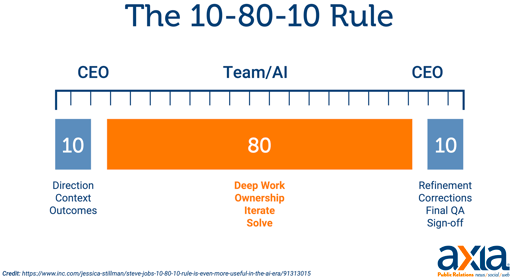
you need is a senior-level or experienced practitioner giving it another review just to make sure it's not gold, uh, so it can be a great first draft, right? There's a chart that we've shared in the past and I'll ask Ava to insert it into the episode notes here today. But it shows kind of like how leaders manage, and it also has been reproduced for how to manage AI. And so the first 10% is investing in the right input, right, the right training, the right input, the right data, but mostly in my experience, training. And then just like you said earlier, the maintenance becomes the easy part. So you gotta build it first by training it. So you do the first 10% up front, then you let the AI do 80% of the deep work or the difficult work, and then on the back end, 10% should go into fact-checking and verifying and improving and all that stuff. Now here's the wrinkle, right? We all know that the last 10% takes as long as the first 90%, right, to produce a really good product. But at the end of the day, that's the efficiency of using AI. It's not, you know, your receptionist, your intern, or even your founder going into AI and saying, create a press release, because you're going to get just that, right? But you know what we've done is we've actually taken the opportunity to say, okay, here are the top-performing press releases that we've done, here's outside top-performing news releases that others have done, what is their commonality? Now, we already knew the commonality, but it was fun to put it into AI and see what it said. And then we build rules and instructions around it, right, and so then we can have a news-release-generating AI engine that will help us accomplish just that. But we don't start with, hey, just figure out a news release today, right? We go in and say, hey, this has happened, or this is happening, or we want to give commentary on this. And then we've got the tools and equipment to be able to do our very best work very efficiently. So
00:47:26:00 - 00:47:37:00
Jessica Barber Scott
talk about AI as if it's the intern that you start with, and you're sort of building them and getting them ready to eventually become
00:47:37:00 - 00:47:38:00
Jason Mudd
Right.
00:47:38:00 - 00:47:50:00
Jessica Barber Scott
right, your star player. And that's the way I talk about it. You wouldn't hand a big press release, a media statement, you wouldn't just take whatever the intern gave you and send it on to a local outlet, right? Same thing.
00:47:50:00 - 00:48:16:00
Jason Mudd
Yeah. Yeah. Yeah. Yeah. I've shared that same sentiment as well. But yeah, at the end of the day, it's an entry-level employee or an intern. By itself, it's been educated, it knows some stuff, but it doesn't really know the practical application nor the ramifications of the work product. So, you know, when I was an intern, I was pretty good, but I didn't know what I didn't know, right? They call that the Dunning-Kruger effect, right? So yeah.
00:48:16:00 - 00:48:19:00
Jessica Barber Scott
The Dunning-Kruger effect. It is one of my favorite things to talk about.
00:48:19:00 - 00:48:19:00
Jason Mudd
Yeah, same, same. So yeah. I mean, I was pretty sharp as an intern, but I was still an intern, right? And a rookie might be a great athlete in the NFL or somewhere else, or a freshman in college, but there's still a rookie or a freshman, and they need reps and they need wisdom, and wisdom comes from experience. So yeah, that's right. Jessica, this has been a great conversation. I'm so glad we got connected. It's such a small world to find out that we literally live walking distance from each other and yet did not realize it. But here we are in the small world we call Earth and in the profession we call PR. It was really great to have you. We're gonna post episode notes from this episode at ontopofpr.com/jessica-scott. There you'll see a link to her LinkedIn profile where you can get connected with her. There you'll see the transcript and the episode notes and just some other valuable resources related to what we talked about here today. And so with that, this is Jason Mudd signing off from On Top of PR and Axia Public Relations. Thanking you for the opportunity to share some of our insights with you. And ultimately we hope that this episode helped you stay on top of PR. And if it did, please take a moment to share it with a colleague or friend who you think would benefit from watching On Top of PR. Be well.
Topics: On Top of PR, artificial intelligence



Comment on This Article