
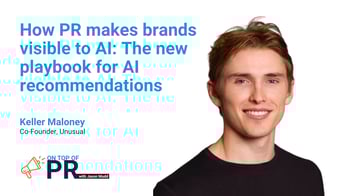
 In this episode, Keller Maloney joins host Jason Mudd to discuss why PR drives AI recommendations and how earned media and brand trust shape how AI models talk about brands.
Tune in to learn more!
Listen to the episode here:



5 things you’ll learn during the full episode:
- AI as a new audience: Why PR has to persuade machines, not just humans
- Why the AI era goes beyond traditional SEO
- How AI determines and delivers recommendations
- The two key hurdles brands must overcome for AI visibility
- PR’s renaissance: Thriving in an AI-driven world
About Keller Maloney
Keller Maloney is the co-founder of Unusual, a platform he built with his co-founder Will to help marketers understand and influence how AI models perceive their brands. Their work takes classic PR principles and applies them to a new audience — artificial intelligence. A Los Angeles native, Keller went to Princeton University, where he earned All-American honors in water polo.
Watch the episode here:
Quotables
- If you give AI models clear claims, real proof, consistent messaging, they reward your brand like a human reviewer would. You can just do what PR folks have always been excellent at doing, which is building a brand.” — Keller Maloney
- “The first thing that you need to make sure of when marketing to a customer is awareness. If they don't know you exist, then there's no hope in having them buy your product. The second is specificity, to actually get recommended. When ChatGPT is having a conversation with a specific user about their specific problem, in order for that model to recommend you, they need to know that your product or your solution is the best solution for their user's very specific problem.” — Keller Maloney
- “The real key is earned media. It’s like convincing a human. Earned media and a corroboration across trusted sources goes a really long way in helping these models find out about your brand and then determine that you are legitimate enough to consider as a recommendation for their customer.” — Keller Maloney
- “Getting more AI recommendations looks a lot more like PR than anything else.” — Keller Maloney
- “The things that help an AI model refer to your brand are the same things that help humans refer your brand, which is strong brand presence, earned media trust, and presence across sources.” — Keller Maloney
- “The best PR work is helping people, educating people. Steve Jobs is famous for saying, ‘Advertising helps with sales, but good PR educates.’” — Jason Mudd
If you enjoyed this episode, please take a moment to share it with a colleague or friend. You may also support us through Buy Me a Coffee or by leaving us a quick podcast review.
Resources
Guest’s contact info and resources:
Additional Resources:
If you like this episode, you're going to love this:
- How AI is transforming strategic communications
- Google's AI Mode and the rise of reputation-driven visibility
- Rethinking press releases with the rise of AI
- Do news releases influence AI visibility?
- 95% of AI citations come from PR content
- What’s the difference between GEO, AEO, and AI relations?
- AI storytelling and PR strategy with Egnyte’s Jessica Pantages
Recorded: November 26, 2025
About your host Jason Mudd

Jason Mudd is a nationally recognized public relations expert featured by CNN, Entrepreneur, Forbes, NPR, The New York Times, PRWeek, and The Wall Street Journal.
Named North America’s top PR leader by the World Communication Forum, he serves as CEO of Axia Public Relations — recognized by Forbes as one of America’s Best PR Agencies.
Jason has advised some of the country’s most admired and fastest-growing companies, leading campaigns for iconic brands including American Airlines, Budweiser, Dave & Buster’s, GE, H&R Block, Hilton, HP, Miller Lite, New York Life, Pizza Hut, Southern Comfort, and Verizon.
He’s also a professional public speaker, accredited PR practitioner, published author, entrepreneur, and host of On Top of PR with Jason Mudd — a podcast ranked among the top 3% globally by Listen Notes and a top 100 marketing podcast on Apple Podcasts. His guests have included leaders from Disney, Mall of America, Priceline, Southwest Airlines, Tyson Foods, and Wells Fargo.
Find more On Top of PR episodes on:
Transcript
00:00:00:00 - 00:00:32:15
Keller
And so the things that help an AI model refer to your brand are the same things that help humans prefer your brand, which is, strong brand presence, earned media trust and kind of presence across sources. And, and we think, and I think that there's really going to be a renaissance in PR in the next 5 or 10 years as this becomes, as marketing kind of makes a return from gaming a specific algorithm to, building a strong and enduring brand.
00:00:32:18 - 00:00:42:07
Announcer
Welcome to On Top of PR with Jason Mudd.
00:00:42:09 - 00:00:46:02
Jason
Hello. Welcome to on top of PR. I'm Jason Mudd, your host from Axia Public Relations.
00:00:46:04 - 00:01:13:05
Jason
Today we're talking about the PR playbook for getting recommended by AI apps. We have a guest today. I'm joined by Keller Maloney. Keller is the co-founder of Unusual, a platform that he built with his co-founder Wil to help marketers understand and influence how AI models perceive their brands. Their work takes classic PR principles and applies them to a new audience artificial intelligence.
00:01:13:07 - 00:01:23:27
Jason
A Los Angeles native. Keller went on to Princeton University, where he earned All-American honors in water polo. Keller. Welcome to On top of PR.
00:01:23:29 - 00:01:26:11
Keller
Thanks for having me, Jason. Good to be here.
00:01:26:14 - 00:01:37:19
Jason
Yeah, I'm glad to have you here, too. Water polo is not something I knew that you, specialized in until I got your bio here. But that's very cool. How did you get into water polo?
00:01:37:22 - 00:02:01:29
Keller
My dad played, and and it's not something a lot of people know about in general. Right. I'm originally from LA, as you said, and California, it's a big thing. Lots of public high schools have pools. Which is awesome. But when I went, when I went over to the East Coast and Prince, that I would tell folks I played water polo and they'd ask me how the horses, how they kept the horses from drowning.
00:02:02:01 - 00:02:08:00
Keller
And so I'm glad to know it's I consider it a small win that you even know what it is.
00:02:08:03 - 00:02:24:00
Jason
I swear, somebody earlier this week made the same joke. About that. And I don't know how that even came up, but now that you mention it so. Well, tell or tell us a little bit more about yourself and your experience, and more specifically, what made you get interested in creating a platform for PR pros?
00:02:24:03 - 00:02:55:09
Keller
Yeah, absolutely. So you know, my co-founder, Will Jack and I run a company called unusual. We're Y Combinator backed. And, to your point, we drive more leads by help drive more leads for brands, by helping them change how ChatGPT and other AI models talk about them. The big kind of problem that PR folks and marketing professionals are facing, facing today is that AI is increasingly a middleman between brands and their customers.
00:02:55:12 - 00:03:25:28
Keller
In 2024, there were 700 million conversations with ChatGPT about purchasing a product. And we're seeing just the these AI models kind of disintermediate lots of, our traditional digital marketing channels like Google Search. And, you know, we see organic web traffic dropping off 15 to 25% across the entire internet. Zero click traffic, meaning the percentage of Google searches that end without clicking into a one of the blue links, is that almost 60% today?
00:03:26:01 - 00:03:45:23
Keller
And so I think this is kind of an existential threat for a lot of digital marketers and just brands that rely on that channel, which is almost every brand today. And so, so, yeah, we, you know, both my co-founder and I have a deep background in AI interpretability research. And my co-founder especially, he's been working in AI since the Stone age of 2014.
00:03:45:25 - 00:03:52:00
Keller
And so, we decided to, kind of see if we could help out brands in this space.
00:03:52:03 - 00:04:13:03
Jason
Very nice, very nice. So our topic today is the PR playbook for getting recommended by AI apps, AI platforms, whatever you want to call them. You know, I as a new audience, right. That's what we want to talk about. And so, you know, we're seeing some good data that's come out saying that, you know, 95% of AI citations come from PR content.
00:04:13:05 - 00:04:25:25
Jason
So the timing for this is very relevant. So let's jump right in AI and kind of tell us, our audience, share our audience, your perspective and your insights on AI is a new audience.
00:04:25:27 - 00:04:52:25
Keller
Yeah. You know, I think that the, it's the long short of it is that brands are having a harder time communicating directly with their customers. And they almost have to communicate through AI models. Right. I mean, I'm sure this is not a huge surprise to any of your listeners here, right? I mean, I've used ChatGPT to figure out which hiking backpack to buy.
00:04:52:27 - 00:05:14:18
Keller
To, you know, how to cook a Thanksgiving turkey. To which CRM I should, go with for my business. And so increasingly, humans are trusting these models with more and more of their purchasing decisions. And the argument that, you know, we can we can we can obviously get back get a little bit more into this later.
00:05:14:18 - 00:05:29:16
Keller
But a lot of folks are treating this like SEO for AI. And our argument is that, it makes a lot more sense to approach these models like a new human audience, to understand and then to persuade.
00:05:29:18 - 00:05:54:22
Jason
Yeah, it's funny you say that because I just posted today. And of course, today is November 26th, the day for Thanksgiving 2025. And I share that because by the time this airs, you know, it'll be a later date and things change quickly in the AI world. But, today I posted on LinkedIn just kind of saying, look, you know, guys, you know, generative engine optimization is not just SEO 2.0.
00:05:54:24 - 00:06:32:07
Jason
And I'm seeing a faction of people who are search engine optimization focused individuals. And that's what they're that's their that's their stance. You know, they're going around just saying, you know, this is all overrated and it's just search and optimization and, you know, the and I'm seeing them even double down on it. And I think that the more you're doubling down on it, the more I think you're showing a lack of appreciation of what's really happening right in front of your eyes and almost comes across as being, you know, desperate or, you know, trying to self validate, in many ways.
00:06:32:07 - 00:06:50:09
Jason
And. Yeah, so my, my post today on LinkedIn was just as simple as saying, you know, if 95% of AI citations come from PR content, is your SEO guy, really good at making PR content? I highly doubt it. Yeah. You know, and and that's all I want to say about it. I don't want to go any further than that.
00:06:50:11 - 00:07:10:25
Jason
That's just kind of what I wanted to express, to, to my LinkedIn audience. And literally every day, in the same scroll, I can see one person saying it's just search and optimization 2.0, and I can see someone else saying, you know, this is really needs, you know, a PR person to be going and doing what PR does best.
00:07:10:26 - 00:07:15:01
Jason
So yeah, it's what I think. I know your take on that. But yeah.
00:07:15:03 - 00:07:40:10
Keller
Share more. Yeah, absolutely. I, I think that, SEO is important for this, and we can, I can get into a little bit more of the details there later, but, I think it's it's easy to see why your first reaction is to, I mean, is to say that this is just SEO part two. Right. You see Google and SEO and organic traffic dropping at the same time.
00:07:40:10 - 00:08:05:26
Keller
You see traffic increasing. Dramatically. And, and so it's easy to, to look at that, those two trend lines and think, okay, great, let's just do SEO for ChatGPT. But this fails for two reasons. It's the first is that air models don't work like search engines. And then the second is that people use AI models for a lot more than just search and discovery.
00:08:05:28 - 00:08:10:11
Keller
And, can go into more of can dig into that more if you'd like.
00:08:10:13 - 00:08:19:27
Jason
You know, I would actually. So let's let's go into both of those a little bit based on, you know, your insights and, and your observations. Yeah. You want to start with the first one.
00:08:20:04 - 00:08:52:29
Keller
Yeah, absolutely. So, so, you know, the first reason why just kind of treating this problem like SEO part two is incomplete is that it overlooks the fact that AI models behave fundamentally differently than search engines. And in fact, I'll actually argue that AI models behave a lot closer to sort of fallible, biased humans than algorithms. The first of which is that it's kind of an inconsistency or personalization, a matter of inconsistency, of personalization.
00:08:53:02 - 00:09:15:10
Keller
Right. No matter who asked Google a question, a specific query. Google gave the same ordered list of search results. And the job of SEO was to just climb that static list. But if you, Jason and me, Keller, and every single one of your listeners asked ChatGPT, what hiking shoes should I buy? Every single one of us would get a different answer.
00:09:15:10 - 00:09:34:26
Keller
Personalize based on what each knows about us in the past, where it thinks we like to hike, our budget, write a whole bunch, all of these constraints, that we have either plugged into that exact conversation about the hiking boots or from the past. And that's actually a feature of these platforms rather than a book.
00:09:34:26 - 00:10:02:22
Keller
Right? It's personalizing its answer to be as helpful as possible to you and to nobody else. And then the second thing, the second reason that I brought up is that AI models or that people use these models for more than just search and discovery. And if you ever talk to ChatGPT and Claude and Grok, you can tell that these models sort of have distinct personalities.
00:10:02:24 - 00:10:25:00
Keller
Especially if you talk to grok. It's not a huge jump to say that they actually have opinions and they inject those opinions in during a conversation. So the average chat would be conversation is, you know, eight messages long. And that's such a different interaction than just a one turn Google search. Right?
00:10:25:02 - 00:10:44:25
Jason
Yeah. No, it can become a conversation. And in fact, that's something that I've really enjoyed doing is either on a on a long walk or a long drive or something. I might just start a conversation, with the, the voice capability, specifically with ChatGPT. And I've had some fun things like saying, hey, I want to have a conversation with you.
00:10:44:25 - 00:11:02:17
Jason
I want you to act like, a business coach. I want you to act like a performance coach. I want you to act like you know, and I just name a person and, you know, and let's have a conversation about, you know, this or whatever. And I think that's where I'm getting a lot of my learning done.
00:11:02:20 - 00:11:19:21
Jason
I enjoy learning. I enjoy walking. So combining those together has been interesting. And, you know, I don't know if I'd recommend this, but I know some people who, like, you know, use that feature, like, you know, hey, I want you to be my mental health therapist, or I want you to be my performance coach and guide me in these areas or whatever.
00:11:19:21 - 00:11:27:20
Jason
And it's certainly not perfect, but it it can be amusing if you and you know, and perhaps helpful if you understand the limitations.
00:11:27:25 - 00:11:54:17
Keller
Yeah, absolutely. And and the, and, you know, before, you know, prior to the release of these models, people would search and discover products via Google, and then they go and do their evaluation, research, comparison, read reviews. Kind of through the resources online. That could be it on Reddit, that could be on specific review sites, that could be on New York Times, wired, great stuff like that.
00:11:54:20 - 00:12:24:28
Keller
Now all of that is happening inside is getting compressed into the ChatGPT conversation. Right? So catch me. T is now reading all of these sites, doing all this research, doing all the comparisons and reviews, and, and, you know, OpenAI actually on Monday when the, on the, you know, two days before this was recorded, OpenAI just released a shopping research which they say turns shopping into a conversation.
00:12:25:01 - 00:12:26:21
Keller
This is kind of the writing on the wall.
00:12:26:23 - 00:12:27:10
Jason
Right.
00:12:27:13 - 00:12:28:03
Keller
Yeah.
00:12:28:05 - 00:12:53:28
Jason
Yeah. And and ChatGPT ads are coming soon too. And so, you know, it's, it's all going to be very interesting. You know, I'm, I'm very excited about it and glad that we're being part we're part of it now early in the, you know, in the equation or in the conversation. So, I know we kind of touched on this a little bit, already, but the second point we want to get into is why this is a new and unique challenge.
00:12:53:28 - 00:13:00:03
Jason
Rather than just search and optimization 2.0. I'm sure you have a few more thoughts to share about that.
00:13:00:07 - 00:13:32:03
Keller
Yeah, totally. Yeah, I think that the, the key here is that the things that get the things that spelled success in SEO were reverse engineering a search algorithm, which was deterministic, and then, kind of running the optimal strategy or game gaming the system in such a way that you could sort of get to the top of the jump to the top of, of any of those kind of static ranked ordered lists.
00:13:32:05 - 00:13:52:19
Keller
And models are way more complex than that. And, and overall, I would say that the kind of the big takeaway I think is that AI models behave and behave a lot more like humans when it comes to actually talking to them than giving recommendations. But also they can be convinced a lot more like humans than search engines.
00:13:52:22 - 00:14:18:18
Keller
So if you give AI models kind of clear claims, real proof, consistent messaging, they reward your brand like a human reviewer would. And, that's actually really good news, right? Like, you don't need to learn a new algorithm or learn a new that, that you can game it, optimize. You can just do what PR folks have always been excellent at doing, which is building a brand.
00:14:18:21 - 00:14:32:04
Jason
Yeah, I got that, I believe that. Yeah. I want to jump back for just a second. You threw out kind of two factoids that I thought were very interesting. You mentioned that, search traffic is down. Did you say 15 to 25%? Was that.
00:14:32:04 - 00:14:35:14
Keller
Right? Yeah. That's, I think I have been okay.
00:14:35:14 - 00:14:41:12
Jason
Been. Yeah. And then the other, stat you threw out was about 60%. And and what was that again?
00:14:41:15 - 00:14:47:03
Keller
So 60% of all Google searches today and without a click.
00:14:47:06 - 00:14:50:29
Jason
Right. Zero click right. Yeah. And what's the sauce on that.
00:14:51:02 - 00:14:57:02
Keller
I think it was pull that up.
00:14:57:04 - 00:15:13:01
Jason
Oh we'll definitely put it in the episode notes. Later. And if you can find it, that'd be great. But I don't want to, get us distracted here with that. But I did just want to kind of figure out what those were. I would ask you this. I mean, you know, I'm hearing this from other, you know, digital marketers.
00:15:13:01 - 00:15:34:03
Jason
I'm hearing this from other PR pros about the 15 to 25% search traffic being down. But, you know, I've been saying this for months, like our clients, based on the reports I'm seeing, they're not seeing that. And, and so I know it's happening just based on my own use. Right. Of of of, of generative AI.
00:15:34:06 - 00:15:43:19
Jason
I'm wondering, you know, why that might be, that our our clients are actually seeing, you know, double digit percentage increase in this period of time where others aren't seeing it.
00:15:43:22 - 00:16:08:10
Keller
Yeah. I mean, I think that, you know, this is this gets into a little bit of what, what it takes to get AI to recommend you. I mean, and, so those, those companies that already have a strong PR presence that have sort of proof and presence across the internet, across sources. So like I said, it helps here, right?
00:16:08:10 - 00:16:34:14
Keller
So if they have strong SEO that then that helps to but I think a lot of it's kind of like the ultimate Google search algorithm update, right. The the update just now no longer Google search. It's now just AI models. And less. And so so there were always some companies that benefited from a Google algorithm update, and there were some companies that that ended up that were trying to game the, the game, the system.
00:16:34:17 - 00:16:38:12
Keller
Yeah. And ended up worse off. And so I think we're you know, we're seeing the same thing here.
00:16:38:14 - 00:17:02:10
Jason
Yeah. No, it's very interesting. In fact, you know, I was talking to a digital marketing agency owner last week, and I guess it's it's harming their business so much that, you know, that, that they're thinking about no longer offering, Google ads and, search and optimization, which I thought was a little bit crazy.
00:17:02:12 - 00:17:21:24
Jason
You know, given how important that is, I would imagine, to their business. Yeah. And how dramatic their clients are seeing the impact. But I think it's a good case for what kind of what we're talking about today, which is more of a holistic approach. You know, people will ask me, you know, well, how do you generate the most leads for your agency?
00:17:21:26 - 00:17:42:02
Jason
And my candid answer is, I'm not really sure, but I know when I stop doing something holistically, it impacts, ultimately, our omnipresence, if you will, for lack of a better word, and the number of leads that we get. So even though one piece of something we might be doing doesn't seem to contribute. The minute we turn it off, we see an impact.
00:17:42:02 - 00:17:45:19
Jason
And when we turn it back on, it jumps right back. Yeah, exactly.
00:17:45:19 - 00:18:07:22
Keller
It's it's, it's kind of a it's a drop in the bucket thing. Where, you know, if you turn off, if you turn it, if you stop adding, adding water to that bucket, it it slowly leaks away. And so but, you know, and any one thing doesn't feel like it's moving the needle, but, but integrate it over all of your efforts.
00:18:07:22 - 00:18:10:11
Keller
It's it's really powerful.
00:18:10:13 - 00:18:30:14
Jason
Right? Yeah, I totally agree. So let's talk for a minute about, the third point we want to talk about today, which is, from search and optimization to AI relations or PR for AI. The PR playbook for getting recommended by ChatGPT. That was the second thing we would talk about. But first of all, what, you know, we talked about this before we press record.
00:18:30:14 - 00:18:41:20
Jason
Keller. When you say that, you know, ChatGPT are you just talking about, you know, kind of AI platforms, AI apps in general, or specifically to ChatGPT and why?
00:18:41:23 - 00:19:07:06
Keller
Yeah, it's a good question. The way the way I'm using it here is just because is is as a, stand in for all AI models. I do say ChatGPT because of, of all of the AI and that of all the interactions that humans have with chat bots, of all the chat bot sessions across all these models, a massive majority of that is ChatGPT.
00:19:07:08 - 00:19:28:23
Keller
I think I've seen numbers like 90%, and I've seen even higher than that. That's not counting Google's AI overview, right? People are still searching on Google and running into those, AI generated summaries. But, but yeah, I think that we know what works. What works for each of these models might be slightly different. But they're more similar than they are dissimilar.
00:19:28:25 - 00:19:40:19
Jason
Okay. Got it. Got it. So, so if we want a playbook for getting recommended by ChatGPT. What are the two hurdles that brands need to overcome?
00:19:40:22 - 00:20:08:10
Keller
Yeah. So I mean, similar. I think that, you know, you you mentioned you call this the, you know, a PR playbook for getting mentioned by ChatGPT. And I think that that's an apt description of this, because the first is you can kind of approach ChatGPT. And the argument that's I'll be making here is that you should brands will do best by treating these models like a new audience, like a new customer segment.
00:20:08:12 - 00:20:44:17
Keller
And so the first thing that you need to make sure when, marketing to a customer segment is awareness, right? If they don't know you exist, then there's no hope in, in having them buy your product. And the second is specificity is to actually get recommended. Is that when ChatGPT is having a conversation with a specific user about their specific problem, they need in order for them for that model to recommend you, they need to know that your product or your solution is the best solution for their for their users very specific problem.
00:20:44:19 - 00:21:01:23
Keller
It doesn't matter if you've solved thousands, a thousand others that are like this user, but they need to know that you can handle exactly what the user is asking for. These models have been trained to be helpful. And so if you help them be helpful that it will redound to your benefit.
00:21:01:26 - 00:21:22:14
Jason
Okay. So the first challenge is to be visible at all, right. The platform specifically ChatGPT, which we agreed before we press record that that's what most people are using. And seems to be in certain areas a superior go to product. Yeah. I think others will attempt to catch up.
00:21:22:16 - 00:21:23:29
Keller
That's for sure.
00:21:24:01 - 00:21:35:03
Jason
And that might just be through, you know, acquisition or otherwise. Right? But they need to know that you exist in the second is what you're saying is the harder piece is to get recommended.
00:21:35:09 - 00:21:36:19
Keller
Yeah. That's right.
00:21:36:21 - 00:21:46:02
Jason
This episode is brought to you by Audible. Enjoy 30 days free of Audible Premium Plus by going to ontopofpr.com/audible.
00:21:46:04 - 00:22:10:11
Announcer
You're listening to On Top of PR with your host, Jason Mudd. Jason is a trusted advisor to some of America's most admired and fastest growing brands. He is the managing partner at Axia Public Relations, a PR agency that guides news, social and web strategies for national companies. And now, back to the show.
00:22:10:14 - 00:22:33:15
Jason
Where do you recommend let's say somebody is listening to this and they're like, this is exactly what I need. For our company, this is what my you know, leadership team needs to hear, or this is what my leadership team is tasked me with. If you're that public relations practitioner and honestly, I mean, a lot of our audience is, marketing director, a marketing vice president, a chief marketing officer, you know, who's looking to get more familiar with PR.
00:22:33:18 - 00:22:35:15
Jason
Where do they get started?
00:22:35:17 - 00:23:03:20
Keller
Yeah. You know, those two hurdles. What often happens is that brands. There's a bottleneck for brands at one of those two hurdles. If you are an established brand, like, you know, Salesforce, and I'm asking about what's the best CRM for my company. Well, ChatGPT will always consider Salesforce. There's just enough content out there. It's a well known brand.
00:23:03:22 - 00:23:23:29
Keller
But for Salesforce, it might be that, you know, I run a startup. There's, it might be kind of legacy. It might be too expensive. There's a whole bunch of reasons not to choose Salesforce for me or recommend Salesforce. But for a lot of brands, and I imagine for a lot of folks listening, their main concern is visibility or awareness, right?
00:23:24:00 - 00:23:54:01
Keller
Making sure that ChatGPT even considers them an option when someone's asking for a specific query related to their company or their brand. In, in that case, and that sort of visibility and awareness challenge, traditional SEO takes you a long way. Right. Just having your content out on the internet, in these models, training data, which if you put it on the internet, these research labs are kind of constantly scraping and pulling the entire internet into their training corpuses.
00:23:54:04 - 00:24:14:15
Keller
And then, and then the models themselves, when you ask them a question, will often, you know, fan out and send agents to sort of search the internet for various queries. So, you know, if I look up, hey, what's the best CRM for my company? It will go and make, you know, 10 or 11 searches. It will come back.
00:24:14:15 - 00:24:48:08
Keller
It will look at the results. These aren't necessarily Google searches chatting. It's actually built its own search engine under the hood. But the real key is earned media. And, you know, like, convincing a human, convincing a earned media and kind of corroboration across trusted sources goes a really long way in helping these models find out about your brand and then determine that you are legitimate enough to consider, as a recommendation for their customer.
00:24:48:11 - 00:25:09:20
Jason
Gotcha. That makes a lot of sense to me. I think that I like to think 90% of our audience is going to know exactly what we mean when we say earned media, especially if they've been listening long enough. But I recently, you know, was speaking to a group of marketing and somebody, marketers, somebody raised their hand and said, can you clarify what earned media means?
00:25:09:20 - 00:25:14:11
Jason
And so I want to give the benefit to our audience, to give you a chance to explain that to them as well.
00:25:14:13 - 00:25:43:03
Keller
Yeah, sure. So, I mean, Jason, you're you're much more of a PR pro than I am, but my understanding of earned media and what I mean in this case is, let's say any source online or, accessible that mentions, talks about your brand. That could be a listicle. It could be kind of a round up of, hey, the steer of the 17 best running shoes for 2025.
00:25:43:05 - 00:26:06:21
Keller
Right. But it could also be, you know, an exclusive article interviewing your founder. It could be, at any type of media that's essentially I would also even include Wikipedia and Reddit. So anything that's that, a piece of media that you do not own as a brand, but where you can show up and ideally show up in a positive light.
00:26:06:24 - 00:26:31:18
Jason
Yeah, that's exactly right. And the muck rack study, you know, that found that the, you know, 90, 5% of AI citations come from PR content. Categorize that as earned media and journalistic content. And honestly, I had to be like, well, what's the difference? You know, and, and, and I didn't really think that through, but, you know, journalistic content means exactly that.
00:26:31:18 - 00:26:55:20
Jason
It's like a subcategory of earned media that's specifically done by journalists and then earned media, I guess is more broadly about, you know, analyst content and different, you know, third parties. Writing about you is categorically earned media. And, you know, it wasn't shocking to me that that was the, the clarification, but I've just never I've always just bolted it on or grouped it all together as earned media.
00:26:55:24 - 00:26:56:10
Jason
Yeah.
00:26:56:13 - 00:27:20:11
Keller
Definitely. The way that these models, it's worth mentioning where these models kind of make their initial, they do their initial research and make their initial searches is they'll, you know, similar to a human might do, when you ask, hey, what are the best hiking boots? It will first prioritize these kind of general, roundups, listicles, stuff like that, and compile a short list.
00:27:20:13 - 00:27:46:12
Keller
And it's and it's mine. Right. So here, here, here are 20 different candidates that I can consider for the user asking me this question and then know like a human as well. It'll narrow down its research and go and do research on each of those 20 candidates or short list items. And so kind of getting in those roundups, listicles, Reddit threads, whatever, that whatever matters for your brand.
00:27:46:14 - 00:27:55:09
Keller
And there's, you know, way of figuring that out that, that we can, we can dive more into. But the, that that usually goes a long way.
00:27:55:12 - 00:27:58:06
Jason
I mean, if you're comfortable, let's dive into that a little bit.
00:27:58:08 - 00:28:32:11
Keller
Yeah, absolutely. So, I think this, you know, gets into the question of how do you I mean, you ask, hey, where does where does a PR pro where does a marketer start here? And, and kind of deploying a strategy for, for getting your brand more recommendations by AI models. The so one of the, you know, the first step is to figure out how ChatGPT views your brand, you know, on the one on the one side of that spectrum, the results could be that ChatGPT doesn't know you exist.
00:28:32:13 - 00:28:53:11
Keller
You know, that's that you really got to do a lot of work there with earned media, with traditional SEO. And make sure you're visible across surfaces on the internet. But a lot of, a lot of the time the models will actually consider your business but just can't find the specific evidence. And these models are very pedantic, right?
00:28:53:11 - 00:29:16:06
Keller
So they don't they they'll they'll check their sources. They've been trained to, this has been the, you know, we all hear about hallucinations, right? The way that these research labs have reduced hallucinate hallucinations is made. These models check over their work. So if you say on your website, hey, we serve, you know, we're a law firm and we specialize in patent law.
00:29:16:09 - 00:29:48:28
Keller
And, you know, we also can do corporate litigation. Well, if they're trying to if a user is trying to find a corporate litigator and Chaturvedi sees that on your website, they'll go, it will say, okay, cool, let me see if I can find any evidence for that. And, you know, it's unclear to me that this firm can actually actually does a good job or specializes in corporate litigation, and it would be good for my user to respond with a with a recommendation that actually has some specialty in this space.
00:29:49:04 - 00:30:21:19
Keller
And you can actually see how the model is thinking about this. On some of these new models, they have a kind of internal train of thought that you can pull out, when you ask it, specific questions. And it's a hugely rich source of information. I mean, you can imagine if you could sit down with your customers, ask them questions related to your brand, but you also could just, you know, stick a brain probe in them and hear how they're thinking not only what they're saying to you, but also actually how they're thinking about it, how they're feeling about it.
00:30:21:21 - 00:30:49:14
Keller
And and so, you know, we, we I'd suggest going and serving these models with questions that you might survey to customers. Right. Does the model think your premium doesn't think you're budget? Does it think you're better for enterprises or for startups or SMEs? Look into that train of thinking or that chain of thought, and then look at the sources that it's looking at and it's pulling from and, see what's informing or driving these opinions.
00:30:49:17 - 00:30:57:26
Keller
And once you actually understand all this stuff at a deep level, it becomes pretty easy to, to fix it. Yeah.
00:30:57:28 - 00:31:08:06
Jason
Okay. So you've got a conclusion, to all that's going on here. I want to give you an opportunity to share that. And then I've got a couple of follow up questions for you.
00:31:08:09 - 00:31:32:27
Keller
Yeah, totally. I think the big takeaway here is that getting more AI recommendations looks a lot more like PR than anything else. You know, the way that these I, you know, I've been arguing this whole time, I've been making the point this whole time that hair models act a lot more like humans with biases, with, fallibility than anything else than search engines.
00:31:33:00 - 00:32:06:02
Keller
And so the things that help an AI model refer to your brand are the same things that help humans prefer your brand, which is, strong brand presence, earned media trust and kind of presence across sources. And, and we think, and I think that there's really going to be a renaissance in PR in the next 5 or 10 years as this becomes, as marketing kind of makes a return from gaming a specific algorithm to, building a strong and enduring brand.
00:32:06:04 - 00:32:23:05
Jason
Nice. Yeah, I like that, too. I feel like the Renaissance is happening right now right in front of us. And like you said, probably continue for the next several years. But, you know, anything can change in a moment. And, and all that. So I want to give you the opportunity to kind of share a little bit more about your company.
00:32:23:05 - 00:32:39:17
Jason
Unusual. It's online and unusual AI and, kind of give a, like, a, an elevator, explainer, not necessarily a pitch, but, you know, an explainer of, of the platform and what it does and what who's a good customer for it?
00:32:39:19 - 00:33:03:10
Keller
Yeah, absolutely. We tend to work with, we tend to work with brands, that have, you know, larger and more established brands that that are not quite so bottlenecked by visibility and are more of a bottleneck by specificity. So, so our, I'll give you an example of how we work with, one of our, one of our customers.
00:33:03:10 - 00:33:33:24
Keller
And this might be to illustrate an example for just how ChatGPT, might be failing to give you the recommendations that you deserve. One of our customers is a document parsing tool. So they can essentially pull out information and data from, you know, your company documents like PDFs. They work, they're smart. They you know, they've only been around for a couple of years, but they, work with the fortune ten, you know, so some of the largest companies ever created.
00:33:33:26 - 00:33:59:21
Keller
Well, we'll what we did for them was we ran a brand survey on ChatGPT and other AI models. So asking them questions, asking chat with the questions, thousands of questions like, hey, are you do you think you know the company's more of a premium solution or a budget solution? Would you recommend it more for enterprises? Do you think it's enterprise ready or do you think it's more of a solution for startups and SMEs?
00:33:59:23 - 00:34:20:18
Keller
You know, rank X company on its customer support from 1 to 10, right. These are questions that you could levy towards. You could level towards one of your, one of your customers or prospects. We were doing it towards ChatGPT. And what we can then do is pull out the responses, look at the reasoning, look at the searches that it makes.
00:34:20:21 - 00:34:48:02
Keller
And kind of find patterns and insights throughout and then get a sense for how to actually use that brand. Right. So it as it turns out, chatbot thought despite them working with fortune ten companies, ChatGPT thought that this company was a, niche or kind of vertical solution, better for startups and small and medium companies. Could that seriously costs?
00:34:48:02 - 00:35:26:03
Keller
That hurts them. Right. And, and so what we can then do is go in and, and help them publish content and suggest content, actually create some content, that that highlights their enterprise readiness. And what we can see is, you know, over a over a month or two, the perception start to change. And so and I think that's, you know, I appreciate you letting me plug the plug the business, but the, but I think that's actually a good example of just how this playbook could be run and also how, how a misconception in the model can seriously harm the, yeah, the inbound that you that you should be getting from
00:35:26:03 - 00:35:27:25
Keller
these models.
00:35:27:28 - 00:35:46:14
Jason
Yeah. It's interesting you mentioned that in, previous episode, I talked about how, an engineering firm hired us because they had experienced fast growth, rapid growth, and the principals still thought that, you know, most people thought they were, like, more of a mom and pop engineering firm. Yeah. And they wanted us to create a PR program to overcome that.
00:35:46:16 - 00:36:04:06
Jason
And I just said, hey, would you let us talk to the market? You know, give us a list of 50 people you think are influencers and past customers, current, you know, current customers, whatever. And so we can kind of survey them and see what their perception is to affirm what you're saying is true. And they really didn't want, want us to.
00:36:04:06 - 00:36:23:19
Jason
And I've shared this story before on the podcast. And so we talked to 50 different people, that were influential in the space. And only one of them thought they were still like a mom. And pop, you know, kind of organization. And so I explained to the client, you know, hey, we could have spent a year or more trying to change a perception that didn't need to be changed.
00:36:23:21 - 00:36:49:03
Jason
We could have worked towards, you know, changing people's minds when they it was a perception that you had internally, whether that was just your internal, understanding or imposter syndrome or whatever the case may be, you know, and it's reminding me of that story and that, you know, we saved this client, you know, a year of of investment in PR by doing, you know, a month's worth of some, you know, due diligence, which paid off very well.
00:36:49:08 - 00:37:12:14
Keller
Yeah, absolutely. Yeah. It's interesting, you know, you said at the very beginning, Jason, you know, there's, and I saw that LinkedIn post that you, that you posted, it's funny to me that there's such a hesitancy to accept this new challenge with, with a fresh mind on, you know, that it looks a little bit more like PR than SEO.
00:37:12:17 - 00:37:35:02
Keller
Because in many ways, I just as SEO was all about trying to peer into a, a system that you didn't quite fully understand. And, and, you know, it was a little bit, like reading the tea leaves at times. And what's so cool about this new challenge is that it's just a lot more, it's a lot more natural.
00:37:35:05 - 00:37:57:05
Keller
Right? It's just about you need to build a brand. You need to build trust. And, and, you know, it's it's a, it's just I'm optimistic about the sort of future of of marketing here in general about returning to a something where marketing used to just be about telling people what you do and trying to help people.
00:37:57:07 - 00:37:59:19
Keller
And I think that's what it's going to return to.
00:37:59:21 - 00:38:16:11
Jason
Yeah, I think that's right. I think that, you know, helping people is, is the big thing. I mean, I tell people all the time that, you know, I'm not sure how I got into PR. I mean, I know my own story, but the truth is, I'm a problem solver who likes to help people, and I'm pretty good at communicating about it.
00:38:16:13 - 00:38:48:28
Jason
So. And I think at the end of the day, the best PR work is helping people, educating people. You know, I think Steve Jobs, is famous for saying, you know, you know, advertising helps with sales, but good PR, educates. And at the end of the day, you know, my PR firm has grown the more that I've become focused on educating buyers of PR firm services and educating my team on, you know, what I'm seeing and what I'm perceiving and my insights, to help them become better PR practitioners.
00:38:49:03 - 00:39:26:13
Keller
Yeah, absolutely. And and these, I think you can extend that to the challenge with AI models, right? Is that they are they they're very smart. ChatGPT is a very is, you know, smarter than me now for sure. And is but has lots of misconceptions about, you know, my business, the world, you know, our customers, our ICP and, and the, and the kind of the goal of PR for AI is to just educate the model on who you can help and how well you can help them.
00:39:26:13 - 00:39:28:19
Keller
It's actually quite simple.
00:39:28:22 - 00:39:55:20
Jason
Yeah. Exactly. Well I think we could all benefit from being a little more helpful and a little bit more kinder to each other, especially as we're you know, entering the holiday season, but of 2025, of course, by the time this airs, it'll probably be 2026. But I think this is a great conversation. I want to thank you for being here today and and being helpful, to our audience, by sharing your insights, we'll be sure to link to your website, to your LinkedIn profile.
00:39:55:23 - 00:40:04:27
Jason
Is there a preferred way that you would want people to connect with you? And, and, and also we'll put a link to book a demo with your, your unusual, solution as well.
00:40:05:00 - 00:40:28:13
Keller
Yeah, yeah. Please feel free to email me at Keller at unusual. I you can also hit both Will and I, you know, I, I think, Jason, I think you should chat with Will at some point in the future. He's he's an awesome guy and, incredibly smart and, and and. Well, well, well read and well thought out through this, what the challenges we're facing here.
00:40:28:13 - 00:40:40:22
Keller
And so, you can hit him at will at Unusual Eye or just both of us at founders at unusually. I we'd love to chat with anyone, anyone, anyone who's coming from, from Jason is a friend of ours.
00:40:40:24 - 00:40:57:12
Jason
Oh, that's very kind of you. Thank you. I appreciate that. So with that, that's been another great episode of On Top of PR. We're we're doing our best to just do exactly that. Help you stay on top of PR if you enjoyed this episode, would you take a moment and share it with a friend or colleague who you think would benefit from this episode?
00:40:57:14 - 00:41:16:22
Jason
And if we could just ask as well, would you leave us a review on the platform you're consuming this, content right now. If you're on YouTube, make sure you're subscribing. If you're on Apple or some other platform, take a moment to just leave us a review. We really appreciate that. That's how our audience grows. And the bigger our audience gets, the more value we can bring to you.
00:41:16:24 - 00:41:25:20
Jason
And so we really appreciate you tuning in and helping you help, allowing us to help you stay on top of PR, be well.
00:41:25:23 - 00:41:38:02
Announcer
This has been On Top of PR with Jason Mudd presented by ReviewMaxer. Be sure to subscribe so you don't miss an episode, and check out past episodes at ontopofpr.com.
Topics: earned media, On Top of PR, artificial intelligence, AI Visibility



Comment on This Article