
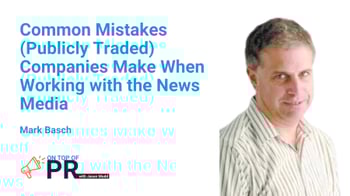
 In this episode, Mark Basch joins host Jason Mudd to discuss the common media mistakes publicly traded companies make.
Tune in to learn more!
Listen to the episode here:



5 things you’ll learn during the full episode:
- Consequences of companies mishandling bad news
- Best practices for publicly traded companies to work effectively with journalists
- Why preparation and anticipation are key to effective media interactions
- Why understanding media evolution is critical for PR
- The difference between embargoes and advance news, and how to use them strategically
About Mark Basch
Mark Basch is a seasoned business journalist who’s covered publicly traded companies for decades. His reporting focuses on economics, business trends, manufacturing, real estate, and unemployment, drawing regularly from data releases and press statements.
Watch the episode here:
Quotables
- “When something is happening, it's a good idea to preemptively get together with the key people and have a response ready because one of the things that could happen in today's world is the story is going to be posted online and nobody is ready to respond.” — Mark Basch
- “Clever is great, but it better be accurate.” — Mark Basch
- “The headline … is designed to get you to read the story but also should tell you what the story is.” — Mark Basch
- “If you want to make this newsworthy, if you want to get media coverage about your company, its success and its growth, we've got to have credible indicators of how quickly you are growing.” — Jason Mudd
- “Always prepare, always assume the worst, and have proper preparations.” — Jason Mudd
- “Have a plan, but have a plan in case the plan fails of what you're going to do secondarily.” — Jason Mudd
If you enjoyed this episode, please take a moment to share it with a colleague or friend. You may also support us through Buy Me a Coffee or by leaving us a quick podcast review.
Resources
Guest’s contact info and resources:
Episode Resources:
- The best and worst media relations efforts from public relations professionals
- How to speak with clarity and authority during a crisis
- 11 crisis management tactics to avoid or prepare for a PR disaster
- The 4 R’s of media relations: Responsive, resourceful, rapid, and respect
- Examples to prepare your company for a crisis
- What to do after a crisis
- 10 steps to prepare your company for crisis
Recorded: June 25, 2025
Our On Top of PR sponsors:
- Production sponsor: Axia Public Relations, one of America’s Best PR Agencies, according to Forbes Magazine
- Coffee sponsor: Fans like you fuel our efforts through Buy Me a Coffee.
About your host Jason Mudd

Jason Mudd is a nationally recognized public relations expert featured by CNN, Entrepreneur, Forbes, NPR, The New York Times, PRWeek, and The Wall Street Journal.
Named North America’s top PR leader by the World Communication Forum, he serves as CEO of Axia Public Relations — recognized by Forbes as one of America’s Best PR Agencies.
Jason has advised some of the country’s most admired and fastest-growing companies, leading campaigns for iconic brands including American Airlines, Budweiser, Dave & Buster’s, GE, H&R Block, Hilton, HP, Miller Lite, New York Life, Pizza Hut, Southern Comfort, and Verizon.
He’s also a professional public speaker, accredited PR practitioner, published author, entrepreneur, and host of On Top of PR with Jason Mudd — a podcast ranked among the top 3% globally by Listen Notes and a top 100 marketing podcast on Apple Podcasts. His guests have included leaders from Disney, Mall of America, Priceline, Southwest Airlines, Tyson Foods, and Wells Fargo.
Find more On Top of PR episodes on:
Transcript
00:00:00:00 - 00:00:13:19
Mark
When I say I'm doing the story, that's that's the chance you really need to get out in front and have a response. And, you know, I don't know, maybe they maybe they thought maybe they were surprised the story was a front page story.
00:00:13:19 - 00:00:32:14
Mark
I don't, you know, I don't know, but, you know, I don't make those decisions. Anyway, I just said, here's the story. And then the editors would decide what to do with it. But, but but the point being, they weren't prepared. They they thought they could just ride it out until they saw the story. And then they decided, oh, my God, this is so negative.
00:00:32:14 - 00:00:35:24
Mark
We have to do something about it. Right? Right. You needed to anticipate that
00:00:35:24 - 00:00:45:23
Announcer
Welcome to On Top of PR with Jason Mudd.
00:00:45:23 - 00:00:48:14
Jason
Hello and welcome to On Top of PR, I'm your host Jason Mudd with Axia Public Relations.
00:00:48:20 - 00:01:15:14
Jason
And I'm joined today by a longtime contact of my name, Mark bash. Mark is a seasoned business journalist who's covered publicly traded companies for decades. His reporting focuses on economic business trends, manufacturing, real estate and unemployment, drawing regularly from data releases and press statements. And today, we're talking about common mistakes companies make when working with the news media and more specifically, publicly traded companies.
00:01:15:14 - 00:01:19:00
Jason
So Mark bash, welcome to on top of PR.
00:01:19:02 - 00:01:25:08
Mark
Hi, Jason. Good to talk to you again. We've talked a lot over the years, but good to talk to you in this forum.
00:01:25:10 - 00:01:48:09
Jason
Yeah, absolutely. And thank you for taking time out of your schedule to help our audience. You know, we love having, journalist on our show because you bring unique insights and maybe some kind of behind the scenes feedback that would be valuable to our audience. And specifically today. I know we want to talk about companies that did a poor job of handling bad news and the consequences of doing that.
00:01:48:09 - 00:02:07:29
Jason
And then we'll wrap up by talking about one particular example of a company that did a really good job as they were going through bankruptcy, in your opinion of, you know, how they handled, themselves and how that benefited them. And, and then we've got another thing we'll talk about towards the end, which I'm curious to explore with you, and we'll get to that later.
00:02:07:29 - 00:02:20:26
Jason
But, so, Mark, let's start off so you've got a couple of examples of companies that, did a poor job handling, bad news and the consequences of that. Let's start off with one of your examples.
00:02:20:29 - 00:02:48:02
Mark
Okay. Yeah. I, I'm going to go way back in time here to the early 90s. And the example of them, I'm not going to name the company, but if you remember the early 90s, there were, if you remember the credit crunch, which started in 1990, and what happened was, commercial real estate developers found that they couldn't get bank loans anymore because banks were banks were under pressure from regulators, and they basically just cut off the spigot and people weren't.
00:02:48:04 - 00:03:25:27
Mark
And so a lot of developers didn't couldn't get loans. And as a result of that, there were a ton of foreclosures, major projects in the Jacksonville area. And one of my responsibilities back then was I was just going through the lawsuits that were filed in the courthouse, and I just kept coming across, foreclosure suits filed against either, you know, a well known developers, but also be well known projects, 1 or 2 buildings and, in a lot of cases, the the companies had to lose their project, had to give up on their project.
00:03:25:27 - 00:03:48:14
Mark
And, and, and it was very commonplace. It was happening to a lot of companies. So the example I'm going to give is so there's one developer in particular, who had never returned my phone calls. They were I can't remember the number, but there were several, foreclosure suits against his company. And and he, you know, he just
00:03:48:14 - 00:03:51:20
Mark
I, he just would return the phone call and my attitude it.
00:03:51:22 - 00:04:06:08
Mark
Well, you know, as a reporter, my attitude was. Okay, fine. And I've got the court filing. I have all kinds of information here. So I have a story whether you want to respond or not. Right. And and, you know, part of the message is the story is going to get written whether you want to respond or not.
00:04:06:08 - 00:04:16:05
Mark
So, at what point I was contacted by his attorney and he requested a meeting.
00:04:16:07 - 00:04:49:19
Mark
We hit, a meeting with myself and my editor, and he wanted to come in with his attorney. I was like, okay, you know, I will do that. So we come in and we're just. And he has a copies of a bunch of stories I wrote about other companies, and we're in the same situation. And his complaint was these all, you know, he showed me these things, and they all said, well, you know, these seem a lot more positive than the stories you're writing about that my company and I, you know, before he got there, I didn't know what I didn't know what he was, you know, what do you want to talk.
00:04:49:21 - 00:05:17:14
Mark
You know, what he's going to say. But so I'm looking at all the stories and I'm saying, you know, you know what the common thread is here. Every one of these other stories, they set their response to me. The response may have been, well, you know, I mean, sometimes the response is just like, yes, unfortunately, you know, we got caught in a bad situation and we're going to have to give up this project or, or or even to the extent of, well, you know, we're hoping to work it out.
00:05:17:16 - 00:05:42:02
Mark
We're not ready to comment at this time. And the point is, you know, it's my responsibility whether I, you know, you know, you know, sometimes in a lawsuit story, you know, you're not getting the truth. Well, you know, somebody wants to put their spin on it. But but that's but that's fine. I mean I, you know, and that's and that's what you should be and that's why I'm giving you the opportunity.
00:05:42:04 - 00:06:01:26
Mark
And whatever you tell me, I'm going to add that to the story. I'm not you know, I'm not going to, I don't go in with an agenda where I'm just, you know, oh, I want to write a negative story here. You know, I'm I'm trying to be fair and balanced, and I'm going to take your comment, you know, whatever the comment is and add that to the story.
00:06:01:29 - 00:06:37:09
Mark
So, yeah. And I said that to him and, and, it was, it was interesting because, because I actually they took it to heart and they and they became more accessible going forward after that. We're, where they would return my calls. And it and, you know, I in that situation, you know, I'm glad that they, you know, that instead of sitting there and stewing about like, why are these stories so bad about, you know, they actually brought it up and I had it.
00:06:37:10 - 00:06:47:05
Mark
I mean, it was a very simple answer. And I told them and, and it actually, it actually worked until we actually improved the relationship. So that's.
00:06:47:05 - 00:07:14:25
Jason
Yeah, that sounds like a really good, you know, opportunity to kind of inform and educate them about how the news cycle, the news process works. And, as you were talking, I just wrote down a couple of notes. One, you know, what you're reminding is, our audience, I think, is the importance of participation, right? I mean, if you if you participate in the story, then you have a chance to what I wrote down second is the opportunity to set the narrative, tell your story, and maybe even control a little bit about what's said otherwise.
00:07:14:25 - 00:07:33:22
Jason
You are letting someone else tell the story, or a good journalist like yourself. Mark is going to go find somebody who's willing to talk. And then something I learned very early in my career, Mark, was, a quote that goes something like this. When you put your head in the sand, you show your rear. Right? And so if you're going to act like, I guess what?
00:07:33:22 - 00:07:59:13
Jason
And osterhage, you know, when you stick your head in the sand, you know, you really just ended up showing your rear. I can think of a couple of times, Mark, where, you know, a good journalist, you know, would follow up with one of our clients who's, you know, happens to be publicly traded, and they would say, look, my editor has told me, if you're not willing to give me a statement that I need to start calling, board members, shareholders and employees until someone talks to me.
00:07:59:15 - 00:08:26:00
Jason
And that's pretty good motivation for, you know, most of my clients to say, okay, we probably need to say something because we don't want, journalists calling board members. We don't want journalists calling leadership team members. And in this particular story I'm thinking of was literally like on Christmas Eve. So no shareholder or no board member wants to call about bad news about a company that they work with or invest in on Christmas Eve to interrupt their family time together.
00:08:26:02 - 00:08:50:05
Jason
To hear, you know, maybe for the first time, because the board doesn't even know what's happened yet, kind of thing. And our client was hoping to kind of keep it under wraps. So. Yeah, I mean, that's a good motivator. Because, you know, I'm sure oftentimes journalists don't like calling people on Christmas Eve to, you know, interrupt time to tell a story, but they're on call or they're on a shift and they've got to produce content.
00:08:50:05 - 00:08:55:14
Jason
And if this is the best news story of the day, they're going to pursue it because they have an obligation to do so.
00:08:55:17 - 00:09:34:19
Mark
Yeah. I mean, you know, and and also the fact that the it an even more so today than I guess, you know, you know, than it was 30 years ago when, when we didn't have the internet, the, the news breaks want to break. So it's, and it's, you know, it it may be online instantaneously. So, so, so so, you know, because that was also one of the also going to talk about is that you need to I mean, whatever I'm calling you about, it should not be a surprise to you because whatever's going on, I mean, you know, you know what the story is, whether, you know, whether you whether you
00:09:34:19 - 00:09:58:01
Mark
wanted it revealed or not. So I think, you know, when something is happening, it's a good idea to to actually, you know, preemptively get together with the key people and have a response ready, because one of the things that could happen in today's world is the story is going to be posted online and nobody is ready to respond.
00:09:58:01 - 00:10:21:05
Mark
And, you know what? What do we do? What do we do? So, you know, so so that's the there's a lesson there about not knowing what is newsworthy and what's going what's going. You know, I said make the make the papers. I'm I hate saying that now because more often than not, it's it's our mind.
00:10:21:07 - 00:10:41:06
Mark
It's what's going to make the internet or something. But, but the point is to be prepared for that. You're going to get the questions and, and to respond in a timely manner because that's that I mean, honestly, it's a tough thing to wrestle with that, you know, how long do you hold it waiting for a response before you say, okay, we got to go with it.
00:10:41:09 - 00:10:45:03
Mark
We don't know if we're going to get a response or not. So that's just there.
00:10:45:06 - 00:11:02:17
Jason
Well, the good thing about online, right, is that you have the opportunity to revise the story. Yes, you as you get that input. The bad thing about online is the bad news stays there forever as opposed to, you know, back in the day, you know, like people don't keep their print publications or don't have a library of past news articles very often.
00:11:02:19 - 00:11:39:11
Mark
Yeah. You know, and actually, that's just a little as an aside that that's an interesting point is back in the day. Okay. But, if the story in print had an error, you would get a correction. Okay. We have to write a correction and the corrections would go on page two of the newspaper. And I think a lot, you know, if the story, you know, the story that had been on page one or even just page one of the business section, they're not the readers may not be used to looking at page two of The Corrections, but today, you know, when a story is posted on the internet, it gets corrected there.
00:11:39:11 - 00:11:59:26
Mark
And the original version is gone. And you know me, if it was something really significant, that would probably be a little note that like the story was corrected from its original version, but, right. But the fact is, you know, like hopefully if, you know, if you're looking up a past story, you're never going to see something that was incorrect or incomplete when you're looking it up on the internet.
00:11:59:26 - 00:12:01:20
Mark
So, I mean, that's a positive part of that.
00:12:01:20 - 00:12:08:29
Jason
So sure, sure. Okay, Mark, so let's talk about, another story that you have how a company did a poor job.
00:12:09:01 - 00:12:42:21
Mark
Okay. This this was a family owned business. That was. Well, I'm not going to mention again, I'm not going to mention it was well known about, you know, many 30 years ago. It's no longer a business. And it's not. Well, sort of related to the story going to tell about the story is it was a privately is privately owned, family owned, and there was a lawsuit involving the CEO and some other relatives of him because they, you know, they were descendants of the of the founder of the company.
00:12:42:21 - 00:13:03:27
Mark
And the shares were distributed among different family members. And the other family members thought the CEO was shutting them out. So they filed the lawsuit. Now, from my standpoint, the lawsuit itself was I, I don't, you know, I don't need to hear the family squabble and, and I don't it may be salacious, but but it's not something I really want to get into and try to figure this out.
00:13:03:27 - 00:13:30:01
Mark
But the story really interested me because it revealed financial data from this private company. Right. So that's what made it a good story as far as I was concerned. Because because, like all the financial data was laid out there for a company that we never had seen financial data from before. Right. So, yet. So it's really interesting. And, you know, I'm sure nobody, you know, they didn't want this out there, but it was right there in the public documents filed in the courthouse.
00:13:30:03 - 00:13:55:11
Mark
But but the story when the tell about the public relations aspect of this is, you know what, I did not follow the day to day, you know, the back and forth filings and court proceedings, everything on that. Because, like I said, I was just not so interested in this, in this battle, this family squabble. But when they got to the end of the case and I think I don't think it was a jury trial, I think it was it's a judge.
00:13:55:13 - 00:14:16:00
Mark
And I didn't attend the trial. But then he issued a decision which I which I read, and his decision was an absolute scathing rebuke of the CEO, and in favor of the other family members. And, and it was interesting enough that it ended up being the story ended up being on the front page of the times. You know, the next step.
00:14:16:03 - 00:14:39:07
Mark
Now, I had called, you know, you know what I said, okay, I don't want to take sides in a lawsuit. I never want to take sides in a lawsuit. Just like, you know, it's one side against the other and let the court decide, right. But when the court decides in this case, the judge, I, you know, it's I thought it was newsworthy and there was a lot of money involved, too.
00:14:39:07 - 00:15:06:24
Mark
I couldn't I can't, you know, you well, a huge settlement. So of course, I tried to get the, you know, the CEO or representative to, to return my, you know, I wanted to hear from the I wanted to hear from them, just, you know, they, you know, they wouldn't return the call. They wouldn't comment. So the next day, after they saw the story in the paper was like, okay, the story is going to be ruined anyway, you know?
00:15:06:28 - 00:15:37:03
Mark
So and the next day when the story appeared in the paper, his, his public relations representative, who, you know, who was actually a seasoned PR, PR person who I guess what I'm not going mentioning, they called me and said, you know, well, the CEO is disappointed in your story, and he thinks that you think the judges really had many errors and he wants to give you an exclusive interview that only you can get, but only if it guaranteed.
00:15:37:03 - 00:15:58:14
Mark
Giving us a prominent place in the newspaper. And my response was, well, I can't guarantee you anything like that. Right. You know, I don't even know what he's going to say. Number one and number two, the, you know, the the story, what the story was done today. I mean, the story is there. He had a chance to respond and he didn't.
00:15:58:14 - 00:16:23:24
Mark
And it's, and, you know, I and regardless, the story is going to heavily lean toward the judge because because the judge is I mean, you know, obviously there are judges who have an agenda. But hopefully, when I take it on faith that this judge was an impartial arbiter who made this decision, and I said, look, I'll talk to him, but I'm not going to guarantee you anything.
00:16:23:27 - 00:16:29:29
Mark
You know, and and the lesson I'm trying to impart there is that, you know,
00:16:29:29 - 00:16:43:18
Mark
when I say I'm doing the story, that's that's the chance you really need to get out in front and have a response. And, you know, I don't know, maybe they maybe they thought maybe they were surprised the story was a front page story.
00:16:43:18 - 00:17:02:15
Mark
I don't, you know, I don't know, but, you know, I don't make those decisions. Anyway, I just said, here's the story. And then the editors would decide what to do with it. But, but but the point being, they weren't prepared. They they thought they could just ride it out until they saw the story. And then they decided, oh, my God, this is so negative.
00:17:02:15 - 00:17:06:19
Mark
We have to do something about it. Right? Right. You needed to anticipate that the
00:17:06:19 - 00:17:18:12
Mark
because you knew what the decision was from the judge. So you had to know how that story was, was going to portray it, but portrayed and that's yeah, that was sort of the lesson there.
00:17:18:12 - 00:17:45:28
Jason
So nice. Yeah. That's that's definitely a good lesson there. So again participate. So you can control the narrative a little bit or at least represent your side of the story. Otherwise people are going to assume, I think, the worst. If you're not participating in the story, then there there's kind of like implied guilt or implied negativity. And I would also add that just simply, you know, and then, you know, they may or may not have the opportunity to have a second story told later, when they decide to do it.
00:17:45:28 - 00:18:10:02
Jason
Because Mark, at the end of the day is you're describing, but maybe not. So, clearly or specifically I would say is that there's still an editor involved who has to give you the yes or no right now. Number one, number two, the placement of that story, or if the story even runs, depends on the quantity and quality of the conversation, and how newsworthy their responses to, later on.
00:18:10:05 - 00:18:32:16
Jason
And I'm sure if I can kind of put on my crystal ball or whatever and kind of think about this, they're probably thinking, well, what you're hoping is the the previous story was, negative and prominent. Hopefully we can have a more neutral story told as prominently the next day or in the coming days so that it pops or gets as many eyeballs or views as the other stories.
00:18:32:16 - 00:18:35:17
Jason
So we can kind of control that narrative a little bit.
00:18:35:20 - 00:18:59:26
Mark
Yeah. And, but but also, you know, it's like I'm not just going to let you sit there and talk and tell your story. It's going to include what the judge said about, I mean, I'm going to have to repeat the original decision from the front for the judge. So, you know, so but yeah, but it's a good point about, you know, I would write the story, I might make a recommendation to the editor about how big it is, what they want to do with it.
00:18:59:26 - 00:19:32:13
Mark
But it's up to them eventually. And also, you know, and also when you're talking to a reporter that you want to give them the story and you said, you know, we want a prominent place, so the reporter can't promise anything because, you know, I'm thinking I'm thinking about this in terms of a newspaper. It's, you know, I'm sure a lot of times now you're just talking just to an independent journalist who is posting the story somewhere that maybe, you know, maybe you can't get to the promises for the most part, for, you know, like, I was not authorized to give you any promises about how it's, you know, how much
00:19:32:13 - 00:19:36:08
Mark
coverage you're going to get. So, but,
00:19:36:11 - 00:19:59:13
Jason
But and I think journalists are, civilians, if you will, or are corporations, executives, whatever it might be, they they don't know the whole process. Like, you might write a story and you leave it, I don't know, five, six, 7:00 and somebody afterwards is editing that story. Somebody afterwards is writing that headline. Somebody afterwards is inserting a photo and a caption.
00:19:59:16 - 00:20:17:11
Jason
You might be involved or make recommendation, depending on the outlet, to some of that. But I know when I worked at this same newspaper, you know, I tried to write headlines and they basically just said, stop writing headlines. We don't want you to even write the headlines. And I'm like, I would think that that would be helpful if the person who wrote the story has some vision of what the headline could be.
00:20:17:13 - 00:20:29:07
Jason
And and oftentimes I'd give 2 or 3 options. And then eventually my hand just got slapped enough times that I just stopped doing it. So, talk about that for a minute. Mark, help, help educate our audience on that.
00:20:29:09 - 00:20:58:13
Mark
Yeah. You know, I used to find that funny, too, because, I would a lot of times I never saw the headline until I picked up the paper in the morning. And, I oh, my God, you know, and then and then a lot of times, even if I, you know, I would get and I would hear from a representative of some company and complain about the headline and I said, I said, you know, look, I don't want to pass the buck, but I didn't write it.
00:20:58:15 - 00:21:27:19
Mark
And they were like, shocked. Like, what? Yeah, yeah. That's not how it works in a newspaper. The news. You know, I wrote the story and, and a copy editor who may not understand the story that that was a real problem, especially with business stories. For whatever reason. I don't know why they found them so hard, but they get them, and it it has to fit the space that, you know, in the newspaper you had elevated, you had a specific space that you had or had to fit.
00:21:27:22 - 00:21:28:04
Mark
And.
00:21:28:04 - 00:21:33:03
Jason
And even in the digital era, you have a limited number of characters that a headline can fit in a story, too.
00:21:33:06 - 00:21:58:23
Mark
Yeah, yeah, depending on the. Yeah of the what pages. But and and also they had you know, the copy editors are always, you know, you know, their greatest thrill was writing or something they thought was really clever. Right. And they got really mad at me when I would come in the next day and said, well, this, you know, you're this what happened is it's inaccurate.
00:21:58:29 - 00:22:12:23
Mark
Like, I, you know, I want to I don't it clever is great, but it better be accurate. A lot of times it wasn't. And so, you know, I would hurt somebody's feelings and that's, that's part that was just part of the job, I don't.
00:22:12:23 - 00:22:46:22
Jason
Know. Yeah. I love a clever headline as much as the next guy, but it needs to be reflective of the story. And especially Mark, you and I know the danger is that oftentimes, readers or consumers or viewer or, you know, audience members will skim headlines and not read the story unless the headline catches them. So the challenges you've got oftentimes a, somebody doing a page layout, who is maybe not really a good copy editor who's trying to make it fit both to the limited space they have, but also make it be sometimes punny or attention getting or whatever it might be.
00:22:46:22 - 00:23:07:15
Jason
And sometimes they get lost. I think editing their work so much and revising it that they forget what the original foundational information was. And, as a journalist and as a public relations practitioner, I've been disappointed in headlines for stories I've been involved in. And especially, as you said, when you see the headline the next day and you're like, wait a minute, this wasn't at all what I was thinking.
00:23:07:20 - 00:23:15:13
Jason
So at least in the digital era, we have the ability to revise and and perhaps debate and dispute and come to a compromise.
00:23:15:16 - 00:23:36:20
Mark
Yeah. You know, and and just, you know, pick the headline, discussion further, I like is one of the things that I really dislike is when I started in the business, the idea was the headline should should give you an idea what I mean it it's designed to get you to read the story, but I also should tell you what the story is.
00:23:36:22 - 00:24:00:09
Mark
Or internet headlines are are now designed to generate clicks. And so you'll, you'll see, you know, you'll see a headline. But this is why this, you know, this is why this is happening. And, and I, I get I've gotten to the point where I just refused to click on a headline, which it was just, you know, Jacksonville Company that does this but doesn't say what the company is.
00:24:00:09 - 00:24:15:26
Mark
And I so I've reached so far I just refused to click on a story like that because I said this. You know, you're not telling me what you're not telling me what the story is about whatsoever. You're trying to get me to click on it and then so many times I click on it, I'm just disappointed because it's like, I'm not interested in this.
00:24:15:28 - 00:24:39:22
Mark
And, yeah. But, you know, but, you know, again, this is, this is the business model is you can generate clicks and, yeah, I you go on and on about what's happened to the news industry, but, but that, that, that, that, that's the business news of the, the business model of news is not nearly the same as is when we were, well.
00:24:39:25 - 00:24:55:25
Jason
You know, decades ago. Right. And the newspaper would have a headline that would be the lead of the front, front, the top fold of the front page. And that would be to get people to put coins in the machine to get the picture out. Right. Exactly. Yeah. And and now they're just trying to get people to click and and I'm with you.
00:24:55:25 - 00:25:22:17
Jason
I get disappointed with misleading headlines or clickbait as it's called or, you know, the definition of breaking news that pops in my inbox or I get a text message over and I'm I'm just, you know, I'm literally yawning as I'm reading what they're calling, you know, breaking news. And, you know, one of my pet peeves is when a regional daily newspaper in a metropolitan area sends out a breaking news about the, Oscar winners.
00:25:22:17 - 00:25:40:04
Jason
And I'm like, I don't turn to your news outlet to give me one, entertainment stories nationwide because you are a local metropolitan newspaper and two, I certainly don't want a text message at midnight telling me who won. You know, an award of some sort. Right? So, you know that that can be very frustrating.
00:25:40:06 - 00:25:51:27
Mark
I, I actually do not sign up for news alerts, because I just found out that you're getting all the you're getting text that all these things that you just have. I. Okay about this?
00:25:51:29 - 00:25:52:29
Jason
Yeah, exactly.
00:25:53:02 - 00:26:08:07
Mark
There are certain news sites that I will just go to a certain, you know, several times a day and see what their latest headlines are. And that and I think I do get most of the news without ever being bombarded with with news, whether, you know, whether I'm ready for that.
00:26:08:07 - 00:26:14:08
Jason
So sure, sure. Okay. So I think you've got another story of, company doing a poor job.
00:26:14:11 - 00:26:43:12
Mark
Yeah, yeah, it's about that. Yeah. This is this is just a quick one. And this involves a public company, which is no which is no longer around. And it's not because of this incident, but, it really and, you know, this is a company that seemed to be a rising star in its in its industry. And, the question came up about their account, and, you know, to try to work specifically what the accounting issue was.
00:26:43:14 - 00:27:08:25
Mark
And, you know, it's a publicly traded company. So of course, they're, you know, they're, releasing audited financial statements. And so to the largest, to a large extent, you know, I'm, I'm going to trust their, their financial statements that they release because, you know, the auditors are, you know, aren't going to do anything illegal or, you know, it's going to happen sometimes, but for the most part, that's not going to happen.
00:27:08:28 - 00:27:46:11
Mark
So this came out, the that, that, that somebody was questioning their accounting and their stock sale and the company went into hiding. Now this is a public company, right? So, it and the they just reported a company will go public and they really need to something to say publicly about investor relations. Like, I think a lot of companies don't even understand that, that when you go public, you need an investor relations plan because you need to be able to respond, to investor inquiries.
00:27:46:19 - 00:28:08:04
Mark
I mean, the media is often also inquiring about this, but also they were not they were not talking to their investors or, you know, you know, the, the, the large shareholders and the institutional shareholders. And the stock just free fell, for like a week before they actually, merged with some kind of state that and was just like, but then it was just too late.
00:28:08:04 - 00:28:36:24
Mark
It was they were I mean, they didn't go, I don't know, they didn't go out of business, but just like but you know, the stock never recovered, which, so, again, if the, the maybe they weren't prepared for this, you know, because their original argument was like, yes, our accounting or accounting method is valid. But and maybe they weren't prepared when somebody decided to publicly question whether it was valid.
00:28:36:24 - 00:28:50:18
Mark
But again, once, once that came out, I think they had a responsibility to quickly, you know, explain it, explain your position on the accounting issue and don't want to sit for a week. Yeah. Get out.
00:28:50:18 - 00:28:53:22
Jason
Responding. Yeah, yeah.
00:28:53:25 - 00:29:16:05
Mark
You know, they, they, they just let them. And the problem a lot of people said, I mean, you know, this is it's a, it's sort of an objective analysis. Its subjective that they really just, you know, they they didn't have a good investor relations function. And, and so the lesson there is, you know, get your when you're going public, be prepared for it.
00:29:16:11 - 00:29:35:14
Mark
You know, especially you know, there's a lot of small companies that can probably get away with it, but in a big I'd be prepared to have an investor relations, you know, whether it's whether it's a person or whether it's a team, you know, just just just have a plan for that lesson there.
00:29:35:15 - 00:29:50:29
Jason
Yeah. I think that's really important, especially, you know, like you're describing you're if you're as you're starting to think about IPO now that's the time to start putting that plan together. And you know we're not an investor relations firm. And I have to remind companies of that many times I was like, well, your PR firm is not the same thing.
00:29:50:29 - 00:30:11:15
Jason
And I'm like, no, not at all. You know, there are PR firms that do investor relations, but most of the time you want an expert PR firm and an expert in your firm, and you want them working collaboratively, but to expect one or the other to be able to cover, you know, it's just you need a specialization because of the compliance and, and, and, and standards and requirements.
00:30:11:17 - 00:30:36:10
Jason
The other thing, if I'm just on a soapbox for a minute, is, you know, I feel like having worked with several public companies, as have you are, and you've covered several public companies. You know, I don't think people really appreciate the overhead and cost of compliance to be publicly traded. And so when a company comes to me said, oh, we want to be public in 3 to 5 years, I'm like, oh, do you think you'll get to $1 billion in 3 to 5 years?
00:30:36:10 - 00:30:50:09
Jason
And they're like, oh no, we don't think we'll be that big. And I'm like, well, then you probably don't want to be publicly traded unless you're $1 billion corporation, because of how difficult it is. But I think what they're looking for, we talked about the 80s and the 90s a little bit. You know, they're looking for this big windfall.
00:30:50:11 - 00:31:14:16
Jason
They can certainly still happen when you go public. But in order to stay public and be public and comply with all the requirements, I really think you've got to really have a significant operation, in place to be able to support and substantiate that. And sometimes working with publicly traded companies, I often, you know, find it exhausting to think of as a shareholder, how much of my share money, my, you know, my investment in the company.
00:31:14:23 - 00:31:28:13
Jason
It's just going to staying compliant. But that compliance also saves us as consumers making investments in corporations from, you know, fraud and other activities that can harm, you know, the public. So I think that's important too.
00:31:28:20 - 00:31:39:05
Mark
Yeah. Yeah, you need that. But you're right, I, I've heard that all the time about the, the actual cost of, of compliance for public companies. And then people don't appreciate that. Yeah. You're absolutely right about that.
00:31:39:07 - 00:32:02:14
Jason
Yeah. Yeah I think a founder has this idea I want to be public and, you know, want to have a big payday when that happens. But, you know, it's it's it's probably not sustainable. And then I think we've talked about this a little bit indirectly, but then the obligation you have to the public into compliance and, and the market that you're trading in, you know, becomes very high for the disclosures and everything like that.
00:32:02:14 - 00:32:27:28
Jason
And a lot of times, private corporations are not used to that level of transparency. And, one thing I would advise companies, if they're listening that are private, that want to go public, I tell them we'll start acting like a public company. Now, let's be uncomfortable releasing your quarterly, financials to the market, to the media and see how much you enjoyed doing that and the, the stories and the criticism that come with that.
00:32:28:06 - 00:32:45:04
Jason
Because at any moment you can stop doing it if you don't like it. But to me, I tell companies all the time, especially private companies that, you know, hey, if you want to make this newsworthy, if you want to get media coverage about your company, its success and its growth, we've got to have credible indicators of of how quickly you are growing.
00:32:45:04 - 00:33:03:02
Jason
We just can't say, oh, we're growing really quickly. Mark. You know, Mark wants to year by a certain percentage as a minimum, but he'd really like to substantiate that with real dollars and from anything that a company might be announcing, like, you know, hey, we're moving into new office space. Well, what's the square footage? How many floors are you on?
00:33:03:09 - 00:33:21:24
Jason
What's the cost per square foot? What was the lease details? Is it, you know, a ten year lease? A five year lease, 20 year lease, you know, how did you negotiate the terms? What's the story behind the fact you're opening up a new office? We want to hear the business details of the in the transactional details. And I tell clients all the time, Mark, tell me if I'm giving bad advice.
00:33:21:26 - 00:33:32:05
Jason
You know, the more of that you share, the more the reporter has to tell a story with versus. Acme Inc. moved five blocks down the street and doubled their office space.
00:33:32:07 - 00:33:53:21
Mark
Yeah, you reminded me of another story from the 90s about a company, that had a product and, that introduced a product into the market that was very successful. You know, so I wrote a story about it, and then they just kept saying, you know, the mommy wars stories about it. I said, well, you're private. I mean, you have to just eat.
00:33:53:28 - 00:34:22:18
Mark
Okay, tell me you say something like, oh, you know, we grew 75%. Well, put some numbers on that. Yeah. I'm not I'm not going to write that unless, you know, you got to tell me your sales went from X to Y. And you know what? Let me calculate what what what the growth was, and, and I actually get, you know, because I actually did get some, you know, the to release some financial data and, and this company is not around anymore because they got bought out, but the product out there.
00:34:22:18 - 00:34:42:04
Mark
But but but yeah, it's the same thing. It's just like, why aren't you writing about us? We're doing so well. Well, because you're private and oh, I was also about the company who had an office. Their headquarters offices here was a handful of employees. Well, the product was manufactured somewhere else with a couple hundred employees. I'm just like, okay, you're not growing local employment, right?
00:34:42:10 - 00:34:56:26
Mark
There's no local investors. So, you know, the the public interest in the story is just not that great unless you know, unless you have to give me something different other than just say we're doing great, okay. But show me. So.
00:34:57:01 - 00:35:01:10
Jason
Yeah. Yeah, exactly. You know, you went to northwestern, right?
00:35:01:29 - 00:35:18:01
Jason
Yeah. I went to Missouri School of Journalism. And I tell people all the time, look, I went to school to show me state, so you got to show me. You know what we're talking about here. And and, you know, it's very it resonates even more today when we're in such a visual storytelling mindset of, you know, just don't tell me, you know, show me.
00:35:18:01 - 00:35:26:04
Jason
Let's see. You know, some infographics or charts or whatever it might be. You know, and, you know, seeing is believing is the cliche goes. So. Yeah.
00:35:26:04 - 00:35:35:12
Jason
This episode is brought to you by Audible. Enjoy 30 days free of Audible Premium Plus by going to ontopofpr.com/audible.
00:35:35:12 - 00:35:59:29
Announcer
You're listening to On Top of PR with your host, Jason Mudd. Jason is a trusted advisor to some of America's most admired and fastest growing brands. He is the managing partner at Axia Public Relations, a PR agency that guides news, social and web strategies for national companies. And now, back to the show.
00:35:59:29 - 00:36:07:07
Jason
I know you wanted to talk about a positive way a company handled their bankruptcy. And I think that that's obviously important for our audience to hear as well. So, tell us more about that, Mark.
00:36:07:14 - 00:36:29:26
Mark
And, and, and I will tell you who it is. You know, just because I, I thought it was a positive thing. And, this is significant company, not Windex. And this was 20 years ago. It's 2005 when they filed for bankruptcy. And in some ways, it's kind of it's kind of nostalgic because newspapers were still king in 2005.
00:36:29:29 - 00:36:49:01
Mark
So what happened was, they were they were going to file their bankruptcy. They were going to make the filing at night. And as it ended up, it was like that when they finally made the filing. And a little secret that I learned about bankruptcy is that the bankruptcy court never closes. You can file and you can file anytime.
00:36:49:03 - 00:37:07:24
Mark
And there's also a classic story about, you know, people who have been around for a long time. But remember the charter company, which was a public company before I got here? It was in the early 80s, and then this was before the internet, but but but they were they were filing their they wanted to file a bankruptcy late in the day.
00:37:07:24 - 00:37:33:29
Mark
And apparently they just put it into a file and shoved it under the door, the locked door of the bankruptcy court, which I closed for the day. But that was right to do it. They anyway would get this case. You could file electronically so you could do it whenever you wanted to. And their position was, and they wanted people to understand understand what, what this bankruptcy filing meant.
00:37:34:01 - 00:37:51:24
Mark
And they also the, you know, at the time, I don't think they knew what, you know, like whether we would get the story if they didn't tell us in it. I mean, there were rumors that it wasn't a surprise that they're filing for bankruptcy because there was lots of talk about that. And, their position was, you know, that was going to getting late at night.
00:37:51:24 - 00:38:09:08
Mark
And the first time people would know about this was when they picked up their Florida times. You know, the next step, and, you know, I'd be shocked by this thing. And so what they did was, they offered they offer that I was to accept after me. And a couple other times, you know, people to go meet with them.
00:38:09:08 - 00:38:27:21
Mark
And that afternoon within with the embargo agreement, of course, that, you know, we're not going to we're not going to release any of this until until you actually make the filing and tell us it's okay to release it. But they laid it all out for us and they told us, look, okay, we filed for bankruptcy. And this is and this was my lead.
00:38:27:21 - 00:38:43:04
Mark
I said, the stores are open today and all employees should report to work as scheduled because nothing at that. You know, obviously later on that there were store closings and they were layoffs and everything like that. But the idea of the chapter 11 is you're going to reorganize, you're not going out of business. And, you know, I think people see bankruptcy.
00:38:43:04 - 00:39:03:28
Mark
And I think going out of business. So they wanted that message out there, and they wanted all their customers to know that. Yeah, you can come to Winn-Dixie today. We're open. You know, employees need to come to work. And, and, and you know, it, you know, and then the ended up being a huge story on the front page of the Times Union.
00:39:03:28 - 00:39:23:28
Mark
And before. And I know, you know, when the filing was made, the Associated Press, which monitors everything, they were they actually they were able to pick it up that, you know, and they put they put a story out there which probably didn't make the remaining newspapers don't even know how many like local, local media would have gotten the story if we didn't have it in the Times Union.
00:39:24:00 - 00:39:49:20
Mark
And, you know, again, and this, you know, this is a big company which had had a lot of money. So they actually, you know, they hired big money lawyers from New York who actually brought in big money. And no offense, Jason, I mean, they're, you know, excellent at your job, but, you know, the big money PR guys from from New York, you know, were brought in to handle this whole thing, you know, who might have had experience with this kind of thing?
00:39:49:23 - 00:40:29:23
Mark
So, you know, so they gave us a story we got and I think, I think it worked pretty well that, you know, as far as informing the public and the idea at the time was that, most people would learn about this by reading the paper that day. I'm not sure, you know, I'm not sure we're, you know, so what a similar situation now, how that would work, because, you know, there was not a singular source where, you know, where are you going to go to get this information and, and also just the immediacy of the internet for as soon as it gets filed, it's going to get reported.
00:40:29:23 - 00:40:52:08
Mark
And, and you know, and that's got to be I'm not sure what a good lesson it I mean, I could have told you less than 20 years ago was, was, was this was a good way to do it, you know, you know, call some reporters that you can trust to, to keep an embargo and say here, this, you know, this is the story.
00:40:52:10 - 00:41:20:06
Mark
This is what we want to say. That's what we want people to know. You know, so, so, but, you know, I don't I don't really know what the lesson is today about that other than that, again, be prepared that, you know, like, be immediately available, I guess, to reporters because because there's going to be questions and let's, let's say, you know, again, you know, it was a Winn-Dixie kind of situation, you know, something like that.
00:41:20:06 - 00:41:41:20
Mark
You, I think what you would need to do is have a news release which goes out immediately coinciding with the bankruptcy filing. Dispel this stuff out and say, look, here's here's what's happening. No, we're not out of business. We're, you know, we we you know, we're we're we're seeking a way to reorganize our debts. And hopefully we're, you know, we're, you know, emerge a stronger company in the future.
00:41:41:22 - 00:41:44:11
Mark
And, you know, just get that out there in advance.
00:41:44:11 - 00:42:13:26
Jason
So yeah, I think that's exactly right, Mark. A good coordinated, consistent community, consistent messaged announcement. You know, cycle is very important because what you don't want is to file the bankruptcy and then not have a follow up statement to support it or whatever, or be preemptive, even if that means Mark. And I'm not sure that I would prescribe this, but even if it means you file for bankruptcy and you retain or withhold a news release until you're asked or until you think that it's going to, you know, make headlines.
00:42:14:02 - 00:42:33:25
Jason
But, you know, always prepare, always assume the worst and have, you know, proper preparations. Now, I do think, especially if you're a publicly traded company, you have to be transparent and you have to be, proactive and preemptive. But if you're a private corporation, maybe you don't have to, but at least have it ready. You know, like we say in the business, in case of emergency break glass.
00:42:33:28 - 00:42:50:19
Jason
And it just depends on the strategy and the approach that you're taking. You know, I've worked with many companies over the years, and we might have they might have some bad news to announce. And we're hoping no one notices it. You know, we hope we can file with the SEC, or we can file with the state or do whatever it is we have to do and hope no one sees it.
00:42:50:19 - 00:43:18:13
Jason
But, you know, almost always there's good journalists, like yourself doing their job in staying aware and looking for the things that aren't being proactively announced. And, you know, some newsrooms, some journalists are only taking the news that's being announced and, others are looking, you know, around the corners. And, you know, I think we both know a particular reporter, who was notorious for walking the streets of the business district, you know, to see who he could see and who was having lunch together and who was talking.
00:43:18:13 - 00:43:34:16
Jason
And I never forget, one day I saw a leader of a of a somewhat. Well known company walking into the offices of one of their direct competitors. And that got me thinking something might be happening there. And I called a buddy of mine at the newspaper who covers that beat, and he's like, yeah, I've heard reports of this too.
00:43:34:16 - 00:43:48:13
Jason
And so we started kind of, you know, working together to, you know, start figuring out that these companies are probably merging together. And sure enough, they were, so, you know, it's good to get from behind the desk and walk around and see what you can see.
00:43:48:16 - 00:44:08:19
Mark
Yeah, they just reminded me of a really good there, really good thing from years ago. P.S World Medical, which company you probably remember they got bought out by McKesson eventually, but yep, I happened to see something, in a message board on the internet which said there were a lot of cars in the parking lot over the weekend, and that's that should have been the clue, you know?
00:44:08:22 - 00:44:21:23
Mark
Yeah, yeah, there's a deal buried in the church. And they were you know, it's like I was I used to read these business boards mostly for fun. And that was just come to me like some that these people are on to something here then. Yeah. Good one too. So,
00:44:21:26 - 00:44:49:21
Jason
Yeah. No, that's exactly right. In fact, a friend of mine, he worked at a competitor of PPS, and he said that's exactly when they went to sell. That's exactly what happened is he would get there early to make sure nobody came in on the weekend and nobody was there. And then he and other senior leadership from the company and the company acquiring them would meet at the office and they would do tours, they would do inventory, they would look at equipment and everything else.
00:44:49:24 - 00:45:06:19
Jason
And he just, you know, kind of prayed that nobody decide to come in on a Saturday for, you know, catch up or forgot their jacket or something like that, that they needed. So, yeah, it's it's very interesting how how those kind of things work for sure. You wanted to also talk about. I have a note here.
00:45:06:19 - 00:45:12:01
Jason
Maybe we already covered it, but you mentioned an era where newspaper was still king. Is that something that you wanted to cover?
00:45:12:04 - 00:45:34:27
Mark
Well, yeah. I mean, that was that was, you know, the one that was always talked about with Winn-Dixie because he had the idea at the time was this was this was people's primary source of news. And, so, so yeah. And I think we just did cover that talk, you know, because I wanted to talk about how it's changed as far as, you know, what, you know, what news outlets should you be concerned with about?
00:45:35:00 - 00:46:03:12
Mark
You know, because because in the case of the Winn-Dixie bankruptcy, they decided the Times-Union was the source they had to get to first, to get, you know, to get their news out and to make sure every, you know, they could get their side of the story out there. And, and that's actually just and, and, you know, I just to what I want to say was like, I mean, I wish I had a great answer for that now and I don't it's like it's like, where do you go these days to, you know, work, you know, where would you turn to now?
00:46:03:15 - 00:46:37:05
Mark
And I'm not sure I'm not sure I have a good answer to that. I think. I mean, you know, obviously there there are, reputable business news websites. But, I don't, you know, you know, and I, you know, I, I write now for the Jacksonville Daily Record, and I, I don't know, you know, like, if I, I don't know how many people were actually would actually read a particular story of mine if, you know, I mean, you know, you could tell how many do you know how many daily clicks the Daily Record gets.
00:46:37:05 - 00:47:01:28
Mark
But that doesn't mean they're going to see my story. You know, with the times that, you know, what the circulation was and not. And, and it's not only that, you know, you know, how many papers are you selling? But there was the thing, you know, the multiplier effect, where you know how many people are going to read that paper that was bought, like, you know, if the circulation was 180,000, like maybe for that particular paper, say, now over 700,000 that are going to read.
00:47:01:28 - 00:47:24:24
Mark
And so, you know, but when you're talking about how many clicks you're getting, I don't think people you can't I mean, you can't sure click, I guess is what I mean. So I mean, so yes, you know, the news site knows how many people are clicking on their stories, but but from, you know, from the standpoint of, you know, trying to decide where do you want the story to be seen?
00:47:24:24 - 00:47:31:21
Mark
Like, I'm not sure I'm not sure that you would be able to figure out how many people are actually reading it.
00:47:31:23 - 00:47:49:10
Jason
Yeah, that's a good point. And and even in the digital era, like you said, you can tell when people clicked on a particular viewed a particular page on a website, aka a particular article. But, you know, just this morning I was looking an article on my phone and I passed it to my wife and she read it. And then I think one of my kids looked at it too.
00:47:49:10 - 00:48:04:07
Jason
So, you know, that's three viewers for one click or one view. And you, you it's an imperfect science. It always will be. You know, unless we really just for any privacy and there's some kind of face ID scan of each person that looked at it. But, I mean, of course I.
00:48:04:10 - 00:48:06:11
Mark
Would say that's happening already, but.
00:48:06:13 - 00:48:31:25
Jason
Yeah. Yeah, yeah, exactly. So, Mark, you brought this up earlier. I think it's important we explore it in the short amount of time we have remaining, which is, we've talked about on this episode, on this podcast before, but not on this episode. And there's a lot of confusion around embargo advance and exclusive. And, you know, and I think a lot of the most confusion is between embargo and advance.
00:48:31:28 - 00:48:49:26
Jason
And, so I'd love for you to kind of educate our audience on your view of those three things. And maybe and this is off the cuff, of course, but, yeah, maybe your best practices or recommendations for those approach and perhaps what people tend to get wrong with that because I've seen those go wrong, quite often.
00:48:49:28 - 00:49:29:02
Mark
Yeah. Well, I mean, the one thing about an embargo is like, if you came to me and said the story is embargoed until whatever, you know, these days, it's actually, you know, used to be a day, but now I see more and more people want to embargo until 1201 on a certain, you know, just like, you know, no, no way, again, that people can could read this and especially like, like, like the way, the way a lot of sites work where, you know, you're turning over a new batch of stories at 1201 on whatever day, but, the key thing to know about an embargo is, you but you need to make sure
00:49:29:02 - 00:49:59:27
Mark
everybody agrees on it. Well, I mean, obviously you need to trust the, the the person you're asking to embargo the story, not more number one that, you know, you know, hopefully, you know, you know, you know, people who you can trust, but also you, you need to get them to agree to it. And one of the issues, one of the issues we already we always have is, what happens if somebody else gets Ahold of this and breaks it before, well, before our embargo time, right?
00:49:59:28 - 00:50:34:27
Mark
That's right. And that's that's another thing we try, you know, we try to deal with somebody so, so okay, but but if, but if the story gets broken somewhere else, like, especially like what? Like some, Like, like something will come from a public document. Like, especially like a good example would be, new development projects in Jacksonville where, you know, you're lazy, you know, there's a public record about them, and somebody could find the public record of what to write the story.
00:50:35:00 - 00:50:52:24
Mark
And, and, you know, so you called a company who is not ready to talk about it yet because, you know, I've heard this one before where people will say like, well, we don't want that revealed yet. Get a response as well. Okay. But it's been filed. The city hall, you know. Right. It's public if anybody can read that.
00:50:52:24 - 00:51:11:00
Mark
So what? So what what are you gonna say about it? So, so that's another part of it. Also, you just let it. Okay. So okay. If you want to give us the give us an interview and give us the full story, you have to promise us you're not going to talk to anybody else until until our story comes out.
00:51:11:00 - 00:51:37:21
Mark
I mean, because and we will, you know, we won't. And it gets tricky because, like, if somebody, finds a document, I writes a story and we're stuck because we haven't actually written the story. The you know what? We're not going to be. I mean, it's it's not it's not your fault, but but it's, but again, you know, we're going to need some kind of agreement in the embargo about that.
00:51:37:21 - 00:51:58:00
Mark
Like what? You know, You know, like, like one of the. You like one of the things is like, I'm okay getting beaten up story which says this happened. Okay. But I'd like to think I could put more context in it than that original story, that somebody took a document and said, this happened without.
00:51:58:02 - 00:51:58:23
Jason
Right.
00:51:58:25 - 00:52:23:04
Mark
Having a context to and and helping people want to read it. So, so so I'm okay with that. But again, you know, it's just like when somebody agrees to an embargo, if somebody's somebody else, whether they broke the embargo or they actually found the story and wrote it, you need, you know, we need to have that part of the agreement that as soon as it becomes public, right, we get, you know, we can go with the story.
00:52:23:07 - 00:52:42:27
Jason
Well, I'm you reminded me of a story that I'll just share real quick where we were working with a publicly traded company. They had an announcement that was pretty big and significant. We were excited about it. It involved, the local economic development organization where they were making some moves, and I, I don't think I can tell the story without saying it was a corporate relocation.
00:52:43:03 - 00:53:01:20
Jason
So a company was moving from one market to another market, and we wanted to time it exactly in a way that that wasn't in the news before. The employees heard about it. And so, you know, we being trusted advisors to our client, you know, we kind of thought through this and we said, okay, here's what we're going to do.
00:53:01:27 - 00:53:25:17
Jason
We're going to, share the story with the market that they're moving to, you know, premier Daily Newspapers business editor for a Sunday placement. That was our vision. So we're going to tell them the story. We're going to do advance interviews and all this, but they're going to agree to embargo it until Sunday's edition. They'll have it first and then on.
00:53:25:20 - 00:53:53:05
Jason
Then on Monday, we were going to provide, you know, a special access interview with, the CEO to, a lesser known daily newspaper in that market. And then we were going to provide additional context and angle to the, weekly Business Journal. And then and so the Business Journal would not have the story till the following Friday, but they'd have a deeper, you know, dive and we'd withhold some information just to kind of give everybody, you know, a fair turn.
00:53:53:08 - 00:54:17:14
Jason
And then the intent was then Monday, we would also do interviews with local TV stations, you know, about the company moving. Everything was in place. Everything was perfect. We were really proud of what we orchestrated because we felt like everybody was getting value and the timing was being managed. The problem was that, the Edo's PR people were out having drinks with journalists.
00:54:17:16 - 00:54:39:00
Jason
They used to be colleagues at the daily newspaper, and they just started getting loose and talking about, well, hey, this is happening, you know, whatever. And so this was like Thursday night, they were out for drinks and they're just, you know, what's the saying? You know, loose lips sink ships. And so they're running their mouth about it. And so those journalists go back into the office on Friday morning.
00:54:39:00 - 00:54:56:21
Jason
They're like, hey, we heard about this. And then one of those journalists told another journalist, and so Friday morning, our agency's phones are blowing up because everybody's got the story now that we were trying to hold until Sunday or whatever. So I had to call my client and say, hey, if you haven't done that employee communication, you better press send right now.
00:54:56:23 - 00:55:17:08
Jason
And the whole thing came crumbling down like a bunch of dominoes. And you better believe I had quite a conversation with those Edo PR people you know about. What are you doing running your mouth? This wasn't your story to tell. We just were working with your offices and, you know, letting you take credit. And they got all defensive about, well, it was just a, you know, just a careless accident, no big deal.
00:55:17:08 - 00:55:33:15
Jason
And I'm like, it is a big deal because, you know, the company's public they had a process. We had a timeline. And you took the liberty of waiting because for them, candidly, they were new to the PR profession and were excited to be on the other side of, you know, breaking news. And they just couldn't without with help themselves.
00:55:33:15 - 00:55:55:07
Jason
So, you know, my client was very upset. I was very upset, because, you know, candidly, some not naive novices kind of didn't respect the process as, as diligent as we tried to be about it. And it all worked out, you know, but, when the Business Journal ran it as breaking news in their email, then everybody just went with it, you know, and it just happens.
00:55:55:07 - 00:56:01:28
Jason
And so it's lessons learned to have a plan, but have a plan in case the plan fails of what you're going to do secondarily.
00:56:02:01 - 00:56:24:14
Mark
So it used to run me like, like one of the thing to remind people, a lot of people don't understand is, you know, people people get uptight about disclosure for public company, like, you know, like that, you know, like, if you tell me, if you tell me something and tell me, I can write about it, but you haven't actually, you know, you haven't actually filed a document.
00:56:24:16 - 00:56:50:02
Mark
What would I write about it that is considered, you know, I write about it on to, you know, whatever what website, whether it's the newspaper that's considered disclosure. So, so so you don't have to worry. Legally, when a member of the media discloses something first, for a public company, that's a legal disclosure, you know, if it came from the company, if it came from the company.
00:56:50:05 - 00:56:57:20
Mark
So it's not like, oh, you know, we can't talk about it. And, you know, until we file our document, that's, that's not true.
00:56:57:22 - 00:57:03:17
Jason
Right? It's it makes when we talk, they shouldn't be talking about it until they sell their document. But they did.
00:57:03:17 - 00:57:18:03
Mark
Yeah. Yeah. I mean I mean, you know, it depends on the situation. But but normally, you know, if they had talked to a reporter, they know they know what it's coming out and they're like, okay, right, right. But you know, you don't have to worry like, oh my God, this is going to be in the newspaper. We better, you know, we've got to get the disclosure.
00:57:18:03 - 00:57:23:15
Mark
But no, it's actually legally, my story is the disclosure.
00:57:23:19 - 00:57:32:18
Jason
So gotcha. Mark, so did we address the difference between an embargo and an advance?
00:57:32:21 - 00:57:55:11
Mark
We didn't I mean, I don't know if we're using the same definition because because I would say, you know, an advance is, and I, I guess I kind of consider this sort of less serious, like, like usually somebody said they want to give you an advance that they are talking about something they don't want published until a certain date.
00:57:55:17 - 00:58:20:28
Mark
That's my experience. So, but, but but you're right. You should choose your words carefully. Make sure everything is clear. Like like I said, without the embargo, you need both sides to agree to it. It's sort of the same thing with the with the advance. You can, you know, it's, just the idea that you let, like, you know, like, sort of like sometimes somebody would give me some background information and say, like, we have this big announcement come here.
00:58:20:28 - 00:58:38:10
Mark
We want to give you this background and may not give me the full story until it comes out. Like, that's what what I would consider to be in advance. But, you know, I don't know, but usually when people want to embargo something, they specifically say embargo. So that's that's my experience.
00:58:38:13 - 00:58:58:15
Jason
Yeah. So by my definition, I'm going to say that a, that in advance is saying, Mark, I'm going to give this to you and your outlet before anybody else gets it. And you can start working on it now. But I want you to know, you have it before, but who else does is a professional courtesy or a strategic move on behalf of who we think our best audiences then?
00:58:58:18 - 00:59:08:28
Mark
Yeah, yeah. It's just like, yes. I mean, it's going to be public release and everybody and everybody can read it at that point. But but you can give me more information in advance is what. Yeah, that's what.
00:59:09:05 - 00:59:18:17
Jason
I'm giving you a head start. Whereas an embargo says I'm giving you a head start. But no matter what you're going to do with it, you can't go before noon on Tuesday.
00:59:18:19 - 00:59:34:22
Mark
Yes. And also I also mentioned before, the Bargo is like, you know, if I'm a public company, I want to talk to an analyst who covers the company. No, I can, you know, who would you just say? No, you can't call analysts and give them a heads up on it because or maybe what in advance? It might be a little less restrictive.
00:59:34:22 - 00:59:41:20
Mark
We would just say, you know, I can call somebody to get some comments about this, like, you know, if this company was going to do this, what would you think? You know, or something like that.
00:59:41:20 - 01:00:09:18
Jason
But yeah, and then even, you know, and you know, to your point, you have to be very, descriptive and communicate well about your intention. So I've seen it where, you know, a PR firm, any PR firm might say, you know, we're giving, you know, Mark, your, you know, traditionally a newspaper, a, an exclusive on this.
01:00:09:18 - 01:00:37:20
Jason
Right. But we're also giving an exclusive to another TV station, another radio station, like a non competing format, although in the digital age, everybody's competing against each other. I would say, but ultimately, you know, I've seen that too. Or we've just most recently done something with the, The New York Times where we said, look, we're willing to give you this as an advance, but you have 24 hours, and if you don't do something with it, then we're going to go to the Wall Street Journal with it or something like that.
01:00:37:22 - 01:00:52:19
Jason
And, you know, I've found that that's very clear, because if I just say, hey, Mark, I'm giving you this as an advance and you sit on it for or even as an exclusive and you sit on it for weeks, and that doesn't align with our plan and that doesn't work well. So yeah, again, to your point, it's all about good communication.
01:00:52:22 - 01:00:54:09
Mark
Yeah, exactly.
01:00:54:11 - 01:01:00:18
Jason
And also understanding that you may come back and say I'm just not interested in that, Jason. You know. And so you have next.
01:01:00:23 - 01:01:30:10
Mark
Yeah yeah yeah. You know it. Yeah. It's it's like I, you know, and I'll just say something when you want to pitch stories, it never you know, it never hurts to send me an email from a you I mean, you know, I don't, you you just never know. In an email, I consider email a really good, medium to use for that just because, you know, we don't have to waste each other's time.
01:01:30:10 - 01:01:47:20
Mark
I can look, I can look at this thing and decide if, you know, if I want to learn more about it. And, you know, you don't have to, you know, you're not spending time calling and trying to, you know, convince me. And, you know, it's just like, okay, so send me the email and I'll tell you if this is something I would I would write about or want to write about.
01:01:47:20 - 01:01:48:17
Mark
So yeah.
01:01:48:20 - 01:02:06:10
Jason
Yeah, yeah, absolutely. It's also courtesy, professionalism and all that stuff too. So you know, I think you'd rather have a have that opportunity to get an email than just be BCC on an email that goes to 50 other journalists. Right. So, you know, it's I tell you all the time, it's time we put the relationships back into public relations.
01:02:06:10 - 01:02:24:24
Jason
And that's one way to do it, is to, you know, instead of shotgunning everybody or spamming everybody is to, you know, have a one on one conversation and say, would this be something you're interested in? And just as a PR tip, you don't even have to say the company name. You could describe them, hey, I've got a real estate company that's this size that's doing this, would you be interested in it?
01:02:24:26 - 01:02:35:21
Jason
And that gives you enough and you know your beat well enough. You can probably figure out who it is, but they haven't directly said who it is. So gives you some parameters to go to an editor and say, is this something we want to do or no.
01:02:35:23 - 01:02:37:00
Mark
Yeah.
01:02:37:02 - 01:02:55:17
Jason
Well, Mark, this has been a pleasure. Thank you for sharing your, experience and insights wisdom with our team or with our audience. I know they will find it very valuable. And, we appreciate you sharing. I'll be sure to put a link, in the episode notes to some of your recent work as well as, you know, share your bio and other experiences.
01:02:55:17 - 01:02:59:24
Jason
But this has been a great conversation. I enjoyed catching up with you, and thank you for the opportunity.
01:02:59:26 - 01:03:04:13
Mark
Yeah, it's great to talk to you. I mean, we've had conversations like this for the years. Just first time we recorded it.
01:03:04:13 - 01:03:07:06
Jason
So now that we know of.
01:03:07:09 - 01:03:10:23
Mark
Well yeah, that's that's true that you 40 days.
01:03:10:26 - 01:03:28:08
Jason
Yeah. That's right. All right Mark appreciate you very much. And with that this has been another episode of On Top of PR with Jason Mudd. Thank you for the opportunity to share this with you and and for your, loyalty as an audience member of our show. If you found this episode valuable, please take a moment, share it with a friend or colleague you think would benefit from it. And, we would appreciate you. And we appreciate the opportunity for allowing us to help you stay on top of PR, be well.
01:03:28:08 - 01:04:24:00
Announcer
This has been On Top of PR with Jason Mudd presented by ReviewMaxer. Be sure to subscribe so you don't miss an episode and check out past episodes at ontopofpr.com.
 |

|
Topics: crisis communications, corporate communications, strategy, On Top of PR



Comment on This Article