
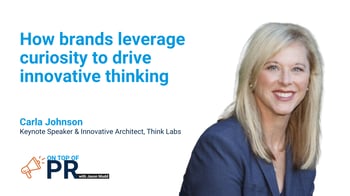
 In this episode, Carla Johnson joins host Jason Mudd to discuss how brands can use curiosity to drive innovation and ideation.
Tune in to learn more!
Listen to the episode here:



5 things you’ll learn during the full episode:
- How breakthrough ideas form and why you must push past the obvious
- How to turn “no” into momentum and a steady flow of stronger ideas
- Why curiosity matters
- How the “What I Like” and “What I Wish” method improves ideas
- How fresh perspectives transform PR and communication
About Carla Johnson
Carla Johnson helps organizations break out of conventional ways of thinking. She helps teams think bolder so they can create massive momentum and deliver a bigger impact much faster. She’s the author of 10 books, including the bestseller “RE:Think Innovation.” She’s worked with companies like Amazon, Dell, Intel, and Hilton on embracing change and welcoming new ideas. All of this has helped them transform their businesses, get people excited about the work they do every day, and deliver a level of results they never imagined possible.
Watch the episode here:
Quotables
- “We all like interesting things. We like stories that are clever, that are memorable, and the more memorable you make that story, the easier it is for somebody to share.” — @Carla Johnson
- “The beautiful thing about that whole process of coming up with the ideas, sharing the ideas and socializing them, talking about what they could look like, doesn't mean that you'll need that idea right now. But every corporate communicator, PR person, media relations person has needed an amazing idea at a drop of a hat.” — @Carla Johnson
- “People come to our profession for answers on how to solve something, or ‘How do I tell the story?’ Or ‘How do I fix this situation?’ But oftentimes, this diabolical need to answer the question really limits the creativity and innovative thinking that we're able to put into it.” — @Carla Johnson
- “When we hear about creativity and innovation, the term we always hear is about connecting the dots. And what we don't think about is in order to have dots to connect, we have to collect those dots.” — @Carla Johnson
- “If we have unlimited resources, we better be creative and responsible with those resources.” — @Jason Mudd
If you enjoyed this episode, please take a moment to share it with a colleague or friend. You may also support us through Buy Me a Coffee or by leaving us a quick podcast review.
Resources
Guest’s contact info and resources:
- @carlajohnson.co on Instagram
- Carla Johnson on Facebook
- Carla Johnson on LinkedIn
- Carla Johnson website
- “RE:Think Innovation” book
- Carla Johnson: Innovation Keynote Speaker (video)
Episode Resources:
- Axia’s Ideate and Innovative Brainstorming Session
- Ideation and innovation with Duncan Wardle
- Need better brainstorming? The power of saying “yes, and” to develop more creative ideas
- Ideation: The secret sauce for creative PR
Recorded: June 25, 2025
Our On Top of PR sponsors:
- Production sponsor: Axia Public Relations, one of America’s Best PR Agencies, according to Forbes Magazine
- Coffee sponsor: Fans like you fuel our efforts through Buy Me a Coffee.
About your host Jason Mudd

Jason Mudd is a nationally recognized public relations expert featured by CNN, Entrepreneur, Forbes, NPR, The New York Times, PRWeek, and The Wall Street Journal.
Named North America’s top PR leader by the World Communication Forum, he serves as CEO of Axia Public Relations — recognized by Forbes as one of America’s Best PR Agencies.
Jason has advised some of the country’s most admired and fastest-growing companies, leading campaigns for iconic brands including American Airlines, Budweiser, Dave & Buster’s, GE, H&R Block, Hilton, HP, Miller Lite, New York Life, Pizza Hut, Southern Comfort, and Verizon.
He’s also a professional public speaker, accredited PR practitioner, published author, entrepreneur, and host of On Top of PR with Jason Mudd — a podcast ranked among the top 3% globally by Listen Notes and a top 100 marketing podcast on Apple Podcasts. His guests have included leaders from Disney, Mall of America, Priceline, Southwest Airlines, Tyson Foods, and Wells Fargo.
Find more On Top of PR episodes on:
Transcript
00;00;00;00 - 00;00;01;25
Carla
At the end of the day, we're all people.
00;00;01;28 - 00;00;23;04
Carla
We all like interesting things. We like stories that are clever, that are memorable, and the more memorable you make that story, the easier it is for somebody to share. And isn't that what our whole line of business is about, at the end of the day, is how do we create amazingly memorable stories that people can't wait to share on our brand's behalf?
00;00;23;04 - 00;00;33;03
Announcer
Welcome to On Top of PR with Jason Mudd.
00;00;33;03 - 00;00;54;28
Jason
Hello and welcome to On Top of PR, I'm your host Jason Mudd with Axia Public Relations. Today we're joined by Carla Johnson. And Carla is here to help us talk about how brands can leverage curiosity to drive innovative thinking. You don't have to scan many headlines to recognize that industries like ours are under a huge pressure to think differently, to come up with new ideas and navigate a world of constant change.
00;00;55;00 - 00;01;13;19
Jason
As soon as we've come up with a solid plan, something unpredictable comes along and that changes everything. And we're right back to the drawing board. Carla is going to help us today realize how to break out of conventional ways of thinking. She helps teams think bolder so we can create massive momentum and build a bigger impact much faster.
00;01;13;25 - 00;01;34;14
Jason
She's the author of ten books, including the bestseller Rethink Innovation. She's worked with companies like Amazon, Dell, Intel and Hilton to embrace change and welcome new ideas. All of this has helped them transform their company and get people excited about. All are the work they do every day, and deliver the level of results that they never imagined possible.
00;01;34;16 - 00;01;40;25
Jason
And today, we're well. We're pleased to welcome Carla Johnson to on top of PR.
00;01;40;28 - 00;01;42;16
Carla
Hey Jason, it's great to be here.
00;01;42;16 - 00;02;13;25
Jason
Thank you Carla, it's great to be here. I'm glad to be here. Glad you're here. Carla and I have known each other for a couple years through agency, association groups. And, also we just went to the Kentucky Derby in May together and had a great time there with, some colleagues as well. And, when I saw her again, later that month, I said, well, come on my podcast, let's talk about your keynote, because Carla is a keynote speaker and speaks to corporations, associations and industry conferences on a regular basis.
00;02;13;28 - 00;02;18;06
Carla
Yeah. I don't know how you came out from the Derby, but I broke even in my batting.
00;02;18;08 - 00;02;19;28
Jason
Oh, I did pretty good, actually.
00;02;19;28 - 00;02;20;16
Carla
Okay, good.
00;02;20;20 - 00;02;24;00
Jason
Very, very pleased. I, I paid for most of my trip.
00;02;24;07 - 00;02;28;00
Carla
Oh, fantastic. Fantastic. Yeah. I paid for all of my free drinks.
00;02;28;02 - 00;02;30;12
Jason
Right.
00;02;30;14 - 00;02;46;10
Jason
That's good. Yeah. No, I, I, I, I tell people, people say, well, how is the Derby? And the Derby was great. I'm not sure. I was looking forward to watching horse racing for two days, but the people that I was with made it so much fun that I would have spent five days, you know, absolutely being there.
00;02;46;10 - 00;03;10;10
Jason
So yeah, it was a lot of fun. A lot of fun. So, Carla, we're talking about how brands can leverage curiosity to drive innovative thinking. And one of those takeaways from your keynotes, for me, as an as a PR firm owner, is that and I'll let you tell it. But basically, you know, clients are looking for their agencies to come back to them proactively with ideas and perhaps also often disappointed in that regard.
00;03;10;10 - 00;03;32;07
Jason
And, for full disclosure, that's why our second of five core values is ideas. And, so Carlos set the table for us. What, for the clients who are listening, the corporate communicators or corporate marketers that are tuned into our on top of PR with Jason Mudd show? They probably sense the same frustration with their agency relationship right now.
00;03;32;09 - 00;03;35;05
Jason
So, tell us what you know about that, Carla.
00;03;35;07 - 00;03;59;27
Carla
Well, there's a statistic from the agency management Institute that says the number one reason that a brand changes firms is because that firm quits coming to them for new ideas. And if you ask the agency, they say, well, all we ever hear is no. So why should we quit? You know, why should we keep, you know, beating ourselves up and working so hard on these new ideas when they never come to fruition anyway?
00;03;59;29 - 00;04;27;03
Carla
And I think that is a wonderful opportunity for all professionals on the brand side. Not that I'm asking you to say yes more often, but I am going to ask you to at least entertain some of those ideas more often, because the beautiful thing about that whole process of of coming up with the ideas, sharing the ideas and socializing them, talking about what could they look like, doesn't mean that you'll need that idea, right now.
00;04;27;03 - 00;04;58;08
Carla
But every corporate communicator, PR person, media relations, persons has needed an amazing idea and a drop of a hat to fit a deadline. And the way that you get those great ideas when you're on deadline and you have to have them, is that you practice that back and forth and that conversation that you have with your agency about what could be, because your brain packs all of those things away, and then you have this nice little portfolio of things that you can go back to over, you know, over the months, over the years, depending on what it is.
00;04;58;13 - 00;05;29;19
Carla
I have a project I'm working on right now that came from an idea that was just a small, little offhanded remark in a strategy session 14 years ago. So I think that legacy of, of keeping track of of what are some great ideas, what are possibilities that could be having those as fodder and material to rehash, reconnect, you know, reconnect those dots when we need them at a, at a moment's notice or when we need something completely different to make a stand out.
00;05;29;19 - 00;05;50;03
Carla
I think that's that's the real power. So no may end up being that ultimate answer for whatever reason, you know, budget need circumstances. But I think that practice and skill of having these conversations with your agencies also really develops that creative thinking skill in-house for everybody on your own team.
00;05;50;05 - 00;06;11;28
Jason
Yeah, that's a really good point, Carla. And I appreciate you bringing that up. As I think over my 23 year career, at Axia, you know, I can probably count on one hand the number of clients who we've brought ideas to. And when they said no, we're always encouraging about it and saying, look, I'm I'm saying no to these ideas right now, and it's probably not your fault, right?
00;06;11;28 - 00;06;35;02
Jason
It's either budget or culture or, you know, just where we are as far as prioritization and other items and but then they always I think this is the important part is they always say, but please keep bringing me ideas. Please don't forget to bring us ideas. So please don't stop bringing ideas. And and I think that's the right approach to take is to acknowledge, hey, I know you put a lot of work into this and we appreciate you thinking of us.
00;06;35;02 - 00;07;06;24
Jason
We appreciate you bringing them. These ideas aren't the right fit right now, or the timing is just not a right fit for any of these ideas right now. But please keep bringing them back. I think is is really critical. And I think it was a year or two ago we instituted hey, every 90 days we want to bring new ideas to the client, like not just one idea, but actually have an ideation session dedicated that client and bring them, you know, a response saying, hey, we brought the team together for a couple hours, sitting around, came up with some ideas.
00;07;06;28 - 00;07;30;25
Jason
Here's, you know, a preview of some of them, or here's five that we came up with. And, you know, sometimes the client will say, well, how many ideas per quarter do I get? And my answer is it varies, right? It could be 1 to 5 or it could be 20. But sometimes we have to leave some on the cutting room floor because either they're not the right fit after we kind of revisit them with fresh eyes, or we just know we don't have enough of your time and attention, right, to to give them to them.
00;07;30;28 - 00;07;52;16
Jason
So as we think about this, both internally and externally, because I think that's important too, is, Well, sorry, I don't mean to take up so much time here, but I recently was listening to a to a recording with the founder of Liquid Death. The the the the the the bottled water canned water company. That looks like an energy, drink, but it's not.
00;07;52;16 - 00;08;10;18
Jason
Right. So they took the most boring thing on the planet. They said it was bottled water. And how do we make it? You know, provocative. How do we make it stand out? And during the interview, I was listening to him. He said, I don't think I've ever been to a productive brainstorming session in my life. Right. And that's kind of my attitude to before.
00;08;10;18 - 00;08;29;11
Jason
In 2016, I studied how to come up with more and more innovative ideas because, as I mentioned earlier, our second core value is ideas. And so as we really started thinking about, you know, okay, how can we, you know, I'm in 2016, I started the year saying, okay, I think our ideas are getting stale. I don't think we have a good process for ideas.
00;08;29;11 - 00;08;48;24
Jason
So I studied, you know, Disney, Pixar, Google, Apple and all these other companies to figure out how do they innovate, how can we borrow from those ideas and expand upon them for ourselves and our agency? So that was my mission in 2016. And ever since then, we've been doing weekly brainstorming or ideation sessions at our agency ever since.
00;08;48;26 - 00;09;09;01
Jason
And we've gotten pretty good at it. So good that there's a couple agencies that actually hire our agency to brainstorm on behalf of their clients because they can't do it well. And, and these these are pretty big agencies, actually. And we all know big companies are the ones who struggle the most with innovation. And a lot of it is because of their culture of saying no to ideas and things like that.
00;09;09;01 - 00;09;31;26
Jason
So that's a long winded intro to say this, Carlo, which would be, you know, what advice could we give to our audience today regardless of their organization size, big or small, to help them embrace, and leverage curiosity to drive that innovative thinking internally as well as in cooperation with their external agency, if they have one.
00;09;31;29 - 00;10;12;10
Carla
Well, I feel like you just set me up to give the most amazing answer there. Jason, the first thing I think they should do is read my book, Rethink Innovation, because it codifies everything that you just talked about, about where do we find the inspiration for a great idea? How do we relate that into the concrete business need that we have right now to generate ideas and, and even how do we pitch them in a way that doesn't always mean 100% that somebody will say yes, but certainly increases that chance dramatically and also gives people a formula for feedback, because what I would hear from executives, chief marketing officer, chief communication officers, CEOs even, is
00;10;12;10 - 00;10;30;21
Carla
that my team never comes to me with new ideas. Now, this sounds kind of familiar with my agency never comes to me with new ideas. Right? And then you go to the team and the team says, well, all I ever hear is no. So why should I keep going through that when all I hear is no? So there's a nice way that we can give feedback that helps encourage that.
00;10;30;26 - 00;10;59;29
Carla
And this can also tie into curiosity. So the two statements that I always suggest people use when they give feedback to an idea, no matter how wonderful or awful that idea may be. The first is what I like, and what I like may be just as simple as I like. The fact that you have the courage to come forward and share an idea that you weren't sure how it would play out, that you, that you took that risk to do something very different, new and kind of avant garde.
00;11;00;03 - 00;11;20;03
Carla
Now, where it goes from there, you can talk about some of the other details. Now, the other side of the coin is to say what I wish. Here's what I wish the idea would address that's missing, because oftentimes somebody will come forward with an idea and you just hear, no, that's not a fit. This isn't the right time, and that doesn't help anybody.
00;11;20;03 - 00;11;40;24
Carla
But if you share, here's what I wish the idea had. It doesn't mean that when the person goes back to to work on that idea, to try and refine it, that you will say yes when it comes back. But what you're teaching them is how you would like them to think from a business perspective, to come to you with fresh ideas that can help solve a concrete problem.
00;11;40;27 - 00;12;03;18
Carla
Now, as we back up this process, one of the most important things is for people to understand the importance of curiosity. So many times, the problem that people come to us with as communicators and PR people isn't actually the problem they need to solve. So in order for us to do our job in the best way possible, it's important for us to get really curious.
00;12;03;20 - 00;12;27;15
Carla
And the first thing I always tell them to do is to just sit with the problem. People come to our profession for answers on how to solve something, or how do I tell the story? Or how do I fix this situation? But oftentimes, this diabolical need to answer the question really limits the creativity and innovative thinking that we're able to put into it.
00;12;27;18 - 00;12;53;27
Carla
So I always say sit with the problem, even if it is just five minutes, just sit with the problem and ask every question you can you can possibly think about for that problem. So when you go back to the example of liquid death, I love that example because the the whole idea for the brand came from a music festival that was in Denver, and I live in Denver and I love Denver, so I love it when I hear great ideas come from Denver.
00;12;53;29 - 00;13;15;22
Carla
And the owner said he was at this music festival, and his background is marketing. And what he noticed is that all these hardcore rockers, you know, guitarists and drummers that were known for being, you know, hard and badasses and things were secretly taking their cans of energy drink and going over to the water faucet and filling them with water.
00;13;15;25 - 00;13;40;15
Carla
So that right there, like looking at that whole scenario with just a little bit of curiosity, is amazing. Now, what could have been? He could have thought, well, all they need to do is just, you know, stocked, stocked the cooler, stocked. The fridges are, you know, have more water on hand. But the truth is, is that whole culture of musician didn't want to be seen drinking a Fiji water, a Dasani or a smartwater because that wasn't cool.
00;13;40;15 - 00;13;58;28
Carla
That wasn't tough. And so that bit of curiosity, as he started to ask people like, why are you taking your Redbull can over there and filling it with water, helped him dig into that question and really came up with an idea that turned into this multibillion dollar brand, really in a very short amount of time.
00;13;59;00 - 00;14;16;24
Jason
That's right. Right. Record breaking time. I think it was Kala that, whether it was Red Bull or Monster was the sponsor was a sponsor of the concert or the tour. And so they need to be seen drinking the product. And, you know, I also think he went a little deeper and said, how are these guys drinking?
00;14;16;26 - 00;14;37;19
Jason
You know, six Red Bulls or Monster Energy drinks in one hour, you know, or whatever it is while they're performing and, you know, not, you know, crashing or having major problems. So. Yeah. No, I love that example too. So getting back to kind of how brands can leverage curiosity to drive innovative thinking, you've got some other examples to talk about.
00;14;37;19 - 00;14;52;00
Jason
We'd love to hear about those. And also, you know, if at the right time, if you want to tie in, I mean, you, you expressed before you press record, you know, your experience working in media relations as well, which a lot of our audience being in PR is very interested in media relations. Also.
00;14;52;03 - 00;15;11;27
Carla
Yeah. And to your point, I worked in media relations on the on the corporate side, and it was for a tech and telecom company. And the thing that we always asked ourself in working with the media is how can we make the story that we're telling hyper relatable to the everyday reader? Because not all of the readers are tech savvy, kind of people.
00;15;11;29 - 00;15;31;04
Carla
And I remember one of the things that we did is that we had a new piece of tech, you know, telecom tech switching, technology and the engineers came to us and said, it's amazing. Here's all the things that it can do. And, you know, gave us a laundry list of all the tech specs and and how it connects to this and that.
00;15;31;12 - 00;16;04;00
Carla
And even though I was very tech savvy from the storyline point of view, I knew nobody was going to pay attention to that. So what we started to ask is, how can we begin to put this story of the impact of the technology in something that is so relatable that the everyday person could think of it? And what we came up with is, is talking about the technology in terms of how it saved power, because power is an incredible expense to companies who have huge telecom needs.
00;16;04;06 - 00;16;08;05
Carla
Telecom technology, voice over IP at the time on.
00;16;08;05 - 00;16;09;09
Jason
AI nowadays too.
00;16;09;14 - 00;16;34;27
Carla
Absolutely. With AI now. And what we did is we were able to quantify the amount of usage with, piece of equipment that this one was replacing and compare it to the new piece of equipment. So it would be the same as saying the previous piece of equipment takes 13, the equivalent of 13 city blocks of power. To make it go, this one takes the same amount of power as your dishwasher.
00;16;35;04 - 00;17;01;14
Carla
So then all of a sudden it became really, really relatable for pretty much anybody. So then if you somebody who is, you know, somewhat related to, business IP, voice over IP services or, you know, now AI or whatever, they're able to have those questions with other people in their company. Maybe they're an executive who doesn't understand all the tech part of it, but you give them that kind of a metaphor.
00;17;01;18 - 00;17;24;02
Carla
They can absolutely understand that and begin to ask smart questions. So when we think about this in other contexts of curiosity, we have this, this principle of let's just sit with the problem to start with, let's not jump and work so hard to solve the answers. Solve the or find the question answer to the question so quickly that we miss all the opportunities in front of us.
00;17;24;04 - 00;17;48;05
Carla
And the second thing that I suggest that people do is really spend time going down the rabbit hole, because I think when we go into those ideation sessions, many times we come out and we say, you know, we've got 2 or 3 really, really great ideas. Let's see which one of those will play out. But the truth is, research shows that we don't get to great ideas until we've gone through the first 200 ideas.
00;17;48;11 - 00;18;22;20
Carla
Now I'm not silly enough to ever suggest that we should try and and shoot for 200 ideas whenever we need a new idea, but what it tells us is that we need to go considerably further with the ideas. We do have to see the possibility of what we can come up with. Because if you think of of the brands and the PR campaigns and and the things that really stand out, the things that make it into the PR Hall of Fame, they are amazing campaigns and they aren't campaign that started that way because it was one of the first 8 or 10 ideas.
00;18;22;22 - 00;19;00;23
Carla
It was an idea that started a little bit and people said, well, let's see what we can do with that. And then they took it a little further, a little further, a little further. Now, I don't know the whole story behind how the ALS Ice Bucket Challenge came into play, but if you look at how viral that whole campaign is now, what we can learn from that is what was it that was so successful about that campaign that we could learn from and begin to be curious about in a way that relates to our situation and start to come up with ideas so we can ask ourselves, well, we know a couple of things that
00;19;00;23 - 00;19;19;09
Carla
made it successful is that you had two choices for I would say, you know, the extroverts, they have the big camera and all their friends, and they were dumping buckets of ice water over their heads. Or maybe they're a little more camera shy or introverts. They just wrote a check, so it gave people options. It was something that was easily scaled anywhere.
00;19;19;12 - 00;19;38;21
Carla
It didn't cost them anything to scale it. It had this, emotional connection, a little bit of a challenge between friends and things. And so there's so many of these elements that if we say, okay, if we're looking for something that that can be easily shared, what kind of things can we you know, what kind of ideas can we get around this?
00;19;38;22 - 00;19;57;17
Carla
You know, what could be easily shared? And, you know, in the keynote that you heard me give, I talked about the Shreddies cereal. And one of the things that they were facing is that their sales were tanking dramatically. They're a company that started in 1935, but in the early 2000s, it wasn't just other cereal makers they were competing against.
00;19;57;17 - 00;20;20;17
Carla
It was things like breakfast bars and protein drinks and fast food, you know, drive through breakfast and things like that. And so they had a strategy session and it was the brand and their agency, and there was an intern in there, and he got curious, and he just held up a piece of shredded cereal, which looks like a piece of Wheat Chex, and he held it up and he turned it 45 degrees.
00;20;20;17 - 00;20;42;20
Carla
And he says, what if we call these diamonds instead of squares? And his boss is like, amazing, run with that, see where you can go. And he went down the rabbit hole just as far as he could. And it's an amazing story of how they created this whole, mystique around the square, the square Shreddies versus the Diamond Shreddies and which one tastes better.
00;20;42;20 - 00;21;03;27
Carla
They did a taste test and and it just kept going and going and going. They did a survey of the entire country of Canada. Which do you like better, Square or Diamond Shreddies. Then they started to use it as, as a contest on Instagram and they said, show us pictures of when you have two Shreddies cereals that come together.
00;21;03;27 - 00;21;29;10
Carla
So almost like a double diamond and that's a natural thing that occurs in some boxes of cereal. And so people would start to post pictures of their cereal. You know, guys, single guys are posting pictures of their cereal. Moms have their pictures of their kids, you know, eating breakfast before school. And, and dog owners have shown pictures of the double Shreddies with their with their pug and and they started to give away prizes for people who would tag Shreddies when they posted this.
00;21;29;10 - 00;21;55;25
Carla
And so all of a sudden, people are now buying a cereal, almost like a lottery ticket. And you think, well, that's that's so crazy and that's absurd. But the reason it was so incredibly successful is because they were constantly curious about how far can we continue to push this idea. And I think that that makes it fun for everybody living in that land of of what if and what could this look like and how, you know, how crazy can this be?
00;21;55;25 - 00;22;17;24
Carla
And that's the absurdity behind that is actually what makes comedy and humor so successful. But it's also what makes us incredibly memorable as a brand. And if you look at, I mean, all the attention and the noise and in trying to break through that, regardless of what your industry is, regardless of who your customer base is,
00;22;17;24 - 00;22;19;19
Carla
at the end of the day, we're all people.
00;22;19;22 - 00;22;40;11
Carla
We all like interesting things. We like stories that are clever, that are memorable, and the more memorable you make that story, the easier it is for somebody to share. And isn't that what our whole line of business is about, at the end of the day, is how do we create amazingly memorable stories that people can't wait to share on our brand's behalf?
00;22;41;13 - 00;23;05;20
Jason
Yeah, 100%. When PR is at its best, you're creating shareable stories, right? Absolutely. And and the market resonates with that. So for our audience, we're going to put a link to Carla's book, on our, on top of PR website, which is on top of procom. But you can also go straight to this episode by going to on top of pr.com/carla-johnson in that will put a link to your book.
00;23;05;22 - 00;23;09;00
Jason
And where's where's the right way to find your book?
00;23;09;02 - 00;23;20;26
Carla
You can go to Amazon. I always encourage people to go to independent bookstores, booksellers, because I'm a big fan of those. Barnes and Noble is pretty much any place you buy other great books, you can find my book, Rethink Innovation.
00;23;20;28 - 00;23;35;29
Jason
Okay. And then secondly, if you'll provide the videos, we can we can include links to the videos or link if you can provide the links to the videos, we'll show the videos of this, campaign that you talked about because in your, in your keynote, you show the videos right of them doing so.
00;23;36;03 - 00;23;38;20
Carla
Yeah. Yeah, I absolutely do. Yeah, yeah.
00;23;38;20 - 00;23;41;15
Jason
So is that something you can provide links to that we can put in our.
00;23;41;15 - 00;24;01;15
Carla
Yeah. I think what I can do is, is share that section of my keynote because it tells the whole story behind the Shreddies cereal. And I think like that's one of my favorite stories, because I think especially as, as the storytellers and as PR people, communication people, we tend to default to what did we do last time and what worked best.
00;24;01;18 - 00;24;22;16
Carla
And I think especially now, we are working so incredibly hard to get and keep people's attention. Right. And if we always go back and do the status quo kind of thing, we're we're never going to get the kind of results that we want because we have this, this belief that there's certain things that we always do that are the safest bet.
00;24;22;18 - 00;24;29;11
Carla
But I think now in the world that we live in, that safest bet is probably our greatest liability.
00;24;29;14 - 00;24;48;00
Jason
Yeah. And the other thing I would say you're reminding me of is, like my previous employer, you know, my boss always, you know, this is the press release we sent a year ago for this same announcement. Why are you changing it? Why are you refreshing it? And I was always trying to bring in new ideas and innovation. And I really felt like that was the one way that he really tied my hands.
00;24;48;00 - 00;25;05;14
Jason
Because we were, you know, seeing the previous outcomes and outputs that, you know, that the company had before I got there. But, you know, he never wanted to refresh anything. I was like, oh, it worked at work last year. Let's keep doing it. So, you know, I think it depends on the culture of the organization, that you're with.
00;25;05;14 - 00;25;14;22
Jason
This episode is brought to you by Audible. Enjoy 30 days free of Audible Premium Plus by going to ontopofpr.com/audible.
00;25;14;22 - 00;25;39;09
Announcer
You're listening to On Top of PR with your host, Jason Mudd. Jason is a trusted advisor to some of America's most admired and fastest growing brands. He is the managing partner at Axia Public Relations, a PR agency that guides news, social and web strategies for national companies. And now, back to the show.
00;25;39;09 - 00;26;09;20
Jason
I want to talk to, before we press record, we talked briefly about, you know, the CDC and, how they produced an award winning campaign for very little dollars. And I think that's the best part about great ideas is that some of the best ideas you can come up with do not involve, you know, very much financial investment, minus the, you know, the cost of the idea, which can be acquired relatively cheap if you've got, in theory, or low cost, if you've got either an agency on retention retainer or an internal team that you can leverage but Toto share with our audience about the CDC story, and then we want to get
00;26;09;20 - 00;26;11;15
Jason
into another story as well.
00;26;11;18 - 00;26;39;10
Carla
Yeah, absolutely. And and you know, when we hear about creativity and innovation, the term we always hear is it's about connecting the dots. And what we don't think about is in order to have dots to connect, we have to collect those dots. And I think that's what the really fun lesson behind this CDC story is all about. So a little bit of background, it was it was about ten, maybe 12 years ago.
00;26;39;12 - 00;27;17;19
Carla
And this department of the CDC is their disaster preparedness division and their typical way of communicating every, you know, early spring is to send out press releases, public announcements to inform the public of things that they can do to prepare to prepare for hurricane season, for tornado season, for wildfire season, so that in the unfortunate event that they and their family and their whole communities were affected by one of these three, they would be in the best position possible to recover from this natural disaster.
00;27;17;21 - 00;27;39;02
Carla
And in the information it was, it was everything people needed to know. It was how to, you know, how to, pack food that was nonperishable and, and blankets and, and candles and, you know, keep your matches, you know, from getting wet and all of these things. And this year, it had already been a particularly bad year for tornadoes.
00;27;39;02 - 00;28;00;06
Carla
There had been like 12 already through Oklahoma that had caused just severe, severe damage. People had lost lives, they lost their livelihood. And so the person who was the assistant director at the time, his name was Dave Daigle, and Dave had a team of two people. So it wasn't that he had a big a big group with a huge budget to work with.
00;28;00;06 - 00;28;21;23
Carla
It was he and his two direct reports, and they would start out every Monday morning meeting, talked about, you know, how was your weekend, what did you do? And even this simple, simple banter of what each other was seen proved very, very helpful because they were always curious about what each other was seen. And one of his team members said, you know, have you ever seen The Walking Dead?
00;28;21;23 - 00;28;43;01
Carla
Because the episode that ended last week was zombies chasing people into the headquarters of the CDC in Atlanta. And like, that's how the season ended. And they they started to talk about this and like this obsession, this craze with zombie and zombie apocalypse. And and I remember in Denver at the time, there were, there were fundraisers that were for zombie themed.
00;28;43;01 - 00;29;06;08
Carla
We were doing five K's. Where you know, you dressed up like a zombie and it was running. You know, you did the zombie shuffle for 3.2 miles and and everybody cared about anything related to a zombie. And that's when his team member had the idea of maybe, instead of doing the thing we always do was sending out the public announcements and the press releases, you know, that that status quo way of always doing it.
00;29;06;11 - 00;29;26;24
Carla
What if we package it all in the terms of a zombie apocalypse? And so Dave went to, you know, get approval from his boss just to make sure. And his boss, Doctor Ali Khan, said, you know, I love it. Like, tell me what I can do and support you. And so what they did is they wrote a blog post on the CDC called How to Prepare for a Zombie Apocalypse.
00;29;26;27 - 00;29;46;05
Carla
And the hero image was like a zombie peeking through some blinds, like, I'm coming for you. And Dave said, we publish that blog, and then we kind of like, close your eyes and crossed our fingers and covered our heads. And he said, nobody got fired. So then that was on a Tuesday. On a Thursday, everything was okay. So they promoted it on social media.
00;29;46;05 - 00;30;05;12
Carla
So Facebook and Twitter, as it was called at the time. And he said within an hour they had over 60,000 hits. And the CDC server went down temporarily because everybody wanted to know how to prepare for a zombie apocalypse. And so they're like, oh my gosh, okay, our little simple test is paying off. So they took that idea.
00;30;05;15 - 00;30;22;22
Carla
You know, they had sat with the problem. They talked about it. They took this idea and they went down the rabbit hole with it. And they said, how much more like, what can we keep doing? So they created graphic novellas. Essentially, they they look like comic books, but they tell this amazing story about how to prepare for a zombie apocalypse.
00;30;22;22 - 00;30;49;18
Carla
And lo and behold, all of the information in those is exactly the same information that was in all of the public information that they had sent out for years that people completely ignored. And so they did. The third thing that I talk about being curious is, you know, swap out with somebody else. And so now they thought like zombies and they said, okay, if we actually are preparing for a zombie apocalypse, what do we need to do?
00;30;49;18 - 00;31;08;23
Carla
And that was their whole campaign was about how do we prepare for a zombie apocalypse? Absolutely. Went through the roof. Now this was inducted into the PR Hall of Fame. And Dave says, I remember being on stage with his his two team members and he said, we're we're kind of like elbowing each other and, you know, can't believe we're here.
00;31;08;23 - 00;31;32;28
Carla
You know, it's IBM and Coke and and Nike and Apple and all of these amazing brands with multi-million dollar budgets. And Dave said, we spent $87, $87. And wow, like that is the biggest pushback I hear is we just don't have the budget for it, right? $87. And it was purely for that first piece of stock art that was used in the blog.
00;31;33;00 - 00;31;47;05
Carla
And I think it's a great example of creativity. Doesn't need a big budget. It does need practice. Just like you've been doing with your team for nine years. You know, every single week. It's like anything, the more you do it, the better you get at it.
00;31;47;07 - 00;32;06;11
Jason
Yeah, 100%. The other thing I would add is that, you know, I laugh when I hear this, but every company, including the big names that you mentioned, they will all complain about their budget. You know, they all feel like, oh, we don't have a very big marketing budget here at Apple, Nike, Coca-Cola, whatever. And it's just laughable because yes, you do have a big budget, right?
00;32;06;18 - 00;32;27;20
Jason
And one of the things I used to preach a lot early in my agency, career was, you know, people would say, oh, we don't have the time, budget, resources, whatever it might be to be creative. And I said that, by definition is what creativity is, is you're working within the constraints of a timeline that's not, you know, three years you're working in the constraints of a budget that's not millions of dollars.
00;32;27;22 - 00;32;34;21
Jason
Because, you know, if we had unlimited resources, you know, of course we better be creative and responsible with those resources.
00;32;34;21 - 00;32;43;22
Carla
I always think people with all the resources are less creative because exactly what you just said, it is those constraints that forces us to think in different ways.
00;32;43;24 - 00;33;00;24
Jason
Yeah. I mean, and there's a ton of cliches about that, right? You know, like desperate times call for desperate measures. And what is it? Something is the necessity of all invention. Right. Kind of whatever that quote is. So, yeah, I mean, those things exist for a reason. Because, you know, most of those cliches end up being true.
00;33;00;26 - 00;33;22;08
Jason
And, you know, and that's why I think big companies struggle to innovate, one, because they can't get out of their own way, and everything has to be legal. And compliance, where, you know, the best innovation, the most cutting edge things happen with the smallest of companies where they have the freedom. And, you know, they didn't have to run everything by legal because I always joke that if attorneys had it their way, you would close the doors and not let any employees in and let your customers in.
00;33;22;08 - 00;33;23;21
Jason
Right.
00;33;23;24 - 00;33;25;04
Carla
They're too much of a liability.
00;33;25;05 - 00;33;36;26
Jason
Yeah. That's right. You get rid of all the liability. So, this has been great. I know we need to wrap up here, but let's talk about Doctor Elliot, because I remember that story specifically from your keynote.
00;33;36;29 - 00;33;53;22
Carla
Sure. And, I mean, Jason, you're you're such a creative soul, and I imagine you were, like a lot of kids when you were little. Like, you think, oh, when I grow up, I'm going to be in, like, an astronaut or a or a cowboy or, or, you know, fill in the blank. I'm going to be Batman.
00;33;53;22 - 00;33;54;24
Carla
I'm going to be Wonder Woman.
00;33;54;28 - 00;33;58;17
Jason
I was going to be a racecar driver, and I knew what company I wanted to sponsor. Me and everything.
00;33;58;20 - 00;34;20;26
Carla
There you go. Like. And so you like. You lived that identity as a race car driver. I can I can guarantee you. Like, I remember a couple of things as a kid, like, when I was little enough in, my parents would get a cardboard box or something, you know, we would get a marker, and we draw a gas and a brake pedal on the inside, and we take, a paper plate and we clip it in, and like, that was our steering wheel.
00;34;20;26 - 00;34;37;00
Carla
And I don't know that we hugged the curves. Maybe as hard as you did as a, as a kid racecar driver. But I remember one year for Christmas, I got a little doctor's kit and it was a, you know, plastic, you know, cheap plastic thing that you opened up. And inside was a, you know, a little fake stethoscope.
00;34;37;00 - 00;34;55;04
Carla
And, and on the side were little bottles of pills which are like Eminem's and Skittles and, you know, and whatever else. And, you know, it all of a sudden I had prestige. I was a doctor and, and I remember, you know, going around and putting that little stethoscope on my dad's chest and going, oh, yeah, like, you're you're truly sick here.
00;34;55;04 - 00;35;18;22
Carla
You need to Eminem's and a skittle and, you know, go to bed early and, and we have these like, these dreams and these, these visions of what adulthood could look like. And I was thinking about that one day as a mother, because I have three kids and I had to hand every single one of my kids over to a pediatric surgeon before they were three.
00;35;18;22 - 00;35;43;08
Carla
So this childhood dream had turned into like a real life nightmare. And I'm thinking just like, pay attention to every beep, every wire, every everything. Because as, as a parent, you're giving over complete control of your of your child's future. And there's there's so many things that can go wrong. And, and those were the kind of things that Doctor Martin Elliot considered every single day.
00;35;43;08 - 00;36;14;04
Carla
He's a pediatric heart surgeon at the Great Ormond Street Hospital. And he thought of these things because he knew that pediatric heart surgery is one of the most high risk processes that can that can ever be done. And you think about the vulnerability and the fragility of the patients and and for his situation, he had a process where after surgery, they had to move the patient from the surgery table to a gurney and down the hall to the ICU.
00;36;14;07 - 00;36;38;09
Carla
It was about a 15 minute process, but it had a 30% error rate. So that meant one out of every three actions. Was wrong. And you think a wrong action or a wrong decision, a missed something, a missed hand-off, you know, patient vital signs aren't either shared or shared correctly or whatever it is. This is a life and death thing.
00;36;38;09 - 00;37;02;27
Carla
And you think of the pressure that we're under as PR and communication people with deliverables and deadlines and accuracy of information. That's nothing compared to what Doctor Elliott faced every day. And and he had gone down the lines. He didn't, you know, Six Sigma and lean and process mapping and all of these things. And it had a huge price tag to it, you know, sticking with what they'd always done because it's a research hospital.
00;37;02;27 - 00;37;25;14
Carla
And so not only was there potential loss of patient lives, you can attract top talent with this kind of error rate. And if you can't attract the research talent, you don't attract the funding that comes along with it. Right. So it's it's a huge issue. And and this was a weight on his shoulders. And it was one Wednesday morning and Doctor Elliott came in to the patient lounge and ran at 10:00 in the morning.
00;37;25;17 - 00;37;49;20
Carla
He'd already done two pediatric heart surgeries. So he's physically exhausted. He's mentally exhausted. He has this constant weight about the error rate that he's always trying to solve. And he sits down on the couch and he's he's thinking like, I've got to be able to do something. And and he looks up and when he does, he sees the TV screen on the wall on the other side of the lounge.
00;37;49;20 - 00;38;09;09
Carla
And he says, like, like, that's it. I just found the answer to how I fix that 30% error rate, because what he saw on TV was a formula one pit stop, and he watched as a Formula One car pulled into the pit stop and the crew came out and they gassed it, and they changed the tires, and they cleaned the wipers and the car was out in 6.8 seconds.
00;38;09;11 - 00;38;31;00
Carla
And he said, what they do is just is life and death. And what I see, it's not just about process and tools, it's about performance. So he invited that Formula One team into the hospital to work with his team. And as they went through everything and how the whole procedure was conducted, they found two really, really critical things that made all the difference.
00;38;31;02 - 00;38;57;17
Carla
So the first is that in a pit stop, the Formula One team are all encouraged. If you see something, shout it out, call it out, let everybody know. But in the O.R., there's one person in charge and that's the surgeon. And you were very much, discouraged from speaking up and questioning the surgeon. And the second thing is that in a formula pit stop situation, there's one person in charge.
00;38;57;19 - 00;39;15;17
Carla
But what they found in the O.R. is that as soon as the surgeon had left the room, nobody was in charge. And it was total chaos. And so in looking at this, they were able to identify these critical things that they could fix. But Doctor Elliot, he didn't stop there. Like, he didn't just swap hats and think like a formula One pitstop crew.
00;39;15;20 - 00;39;31;13
Carla
He said. Everything that we do in the surgery environment is about communication, and oftentimes it's physical, not just verbal. So he invited in a professional dancer choreographer to teach all of the team members how to move their body.
00;39;31;15 - 00;39;31;26
Jason
Okay.
00;39;31;26 - 00;39;55;00
Carla
So yeah, you think about this. So he has learned from a formula one pitstop team and a professional dancer choreographer. So now he's learned to think like them. So he's done a technique that I call the hat swap, which is amazing for curiosity and creativity because we get stuck in our everyday life, our everyday deadlines and demands. And the way this is the way things are done.
00;39;55;03 - 00;40;14;04
Carla
But if you ask yourself what would a Formula one pitstop crew member do if they sat in my job today, how would they look at this differently? How would they think of it differently? How would a professional dance choreographer think of it? How would, you know, how would Beyonce think of it? You know, how would Lady Gaga think about how would Frank Lloyd Wright think of it all of a sudden?
00;40;14;04 - 00;40;29;14
Carla
It gives us a window into our work with new lines of sight that we've never, ever seen before. And the beautiful thing of this whole story with Doctor Martin Elliot is that they were able to drop that error rate by 20% in a matter of about six months. So that's not.
00;40;29;14 - 00;40;30;09
Jason
Just.
00;40;30;11 - 00;40;36;00
Carla
Transforming a procedure that's transforming a life and death situation.
00;40;36;03 - 00;41;00;07
Jason
And so if they can do it in an operating room, working with children, we can certainly do this in our boardroom, conference room or with our B2B service or our B2C product, you know, all day long. And at the end of the day, I mean, ultimately, innovation is ways that lives are saved and economies are created. And so what we're talking about here can be incredibly valuable, just like anything else in life.
00;41;00;07 - 00;41;16;23
Jason
The more you put into it, the more you'll get out of it. And, Carla, I want to thank you for being on the show today. Unfortunately, we've ran out of time. Otherwise, I think we can keep talking about this great topic forever. If our audience wants to get Ahold of you, whether that's for, you know, you're about your book, about your speaking, maybe even your consulting.
00;41;16;26 - 00;41;18;25
Jason
What's the best way for them to reach your car? Well.
00;41;18;28 - 00;41;43;03
Carla
You can reach me at my website. It's Carla Johnson, dot SEO. There's no m, just dot SEO. And I invite you to take advantage of two free tools. One is my newsletter that comes out every other Tuesday, and I teach you a technique or a tool, or share a case study like Doctor Martin Elliot about how you can become a more curious thinker, creative problem solver, innovative thinker.
00;41;43;05 - 00;42;04;14
Carla
And the other one is, if you go to my home page and scroll down just a little bit, there's an innovation archetype assessment that you can take, and it helps you identify what kind of an innovator thinker that you are and on your team. So if you take that and you want a free exercise, it's just a simple exercise that you can do with you and your team.
00;42;04;16 - 00;42;13;10
Carla
Take the assessment, email me, let me know that you heard this on Jason's podcast, and I'm happy to send that exercise to you for you and your team to give it a try.
00;42;13;13 - 00;42;34;00
Jason
Okay, awesome. That sounds terrific. We'll be sure to put a link to the episode on from the episode notes to all these resources. And you can find the episode notes at on top of Pre-comp Carla Johnson. And, Carla, thanks again for being on the show today. I really appreciate it. And, it's always good to see you, and hopefully I'll see you again soon at a future event.
00;42;34;02 - 00;42;35;29
Carla
That sounds great. Thanks so much, Jason.
00;42;36;01 - 00;42;56;26
Jason
Yeah. Thank you, thank you. Appreciate it. Okay, so with that, this has been another episode of On Top of PR. I hope you enjoyed hearing more from Carla. I know, I sure did, and I'm looking forward to, taking her up on her offer. If you found this episode helpful to you, and perhaps helpful to your organization, please take a moment and share it with those, that you think would benefit from it. They'll appreciate it. And so will we. And with that, this is Jason Mudd signing off, helping you stay on top of PR, be well.
00;42;57;05 - 00;43;52;27
Announcer
This has been On Top of PR with Jason Mudd presented by ReviewMaxer. Be sure to subscribe so you don't miss an episode and check out past episodes at ontopofpr.com.
 |

|
Topics: branding, On Top of PR



Comment on This Article