
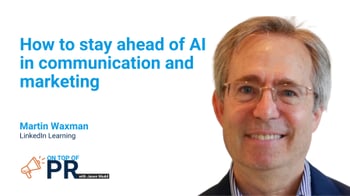
In this episode, Martin Waxman joins host Jason Mudd to discuss AI’s impact on communications and marketing, why training matters, and how to avoid “AI slop” by pairing AI with real expertise.
Tune in to learn more!
Listen to the episode here:



Meet our guest:
Our episode guest is Martin Waxman, LinkedIn Learning instructor, adjunct professor at the York Schulich School of Business, and associate director of the Future of Marketing Institute. He writes an AI and digital marketing trends newsletter, delivers hands-on generative AI training workshops, and conducts AI research.
5 things you’ll learn during the full episode:
- Why using AI only to offload tasks can lower quality and why thinking first matters
- What Martin predicted correctly about AI and what surprised him about its rapid adoption
- How to move beyond basic content generation to strategy and analytics
- Why subject-matter expertise is critical when using AI for insights and data
- How leaders can manage hype, train teams, and stay ethical as AI evolves
More about Martin Waxman
Martin Waxman writes a popular AI and digital marketing trends newsletter, delivers hands-on generative AI training workshops, and conducts AI research. He’s a LinkedIn Learning instructor, adjunct professor at the York Schulich School of Business, and associate director of the Future of Marketing Institute.
Watch the episode here:
Quotables
- “Use their brains first so they can start to push themselves and then get AI tools to push them even farther.” — Martin Waxman
- “We have to prompt AI, but we also have to get AI to prompt us to think about things from a different perspective.” — Martin Waxman
- “You don't have to go at the pace of AI development, which is really fast, but you need to go at a much faster pace than we as communicators have been used to using.” — Martin Waxman
- “There's a new term called FOMO, fear of becoming obsolete, which is really real. Because we don't know what we need to learn to do our job successfully. So managing The hype is job number one, figuring out what's new, when it's going to start affecting us, and what can we do to prepare along the way.” — Martin Waxman
- “AI will take your job if you're the master and commander of it.” — Jason Mudd
If you enjoyed this episode, please take a moment to share it with a colleague or friend. You may also support us through Buy Me a Coffee or by leaving us a quick podcast review.
Resources
Guest’s contact info and resources:
- @martinwaxman on X
- @martinwaxman on Instagram
- Martin Waxman on Facebook
- Martin Waxman on LinkedIn
- Future of Marketing Institute
- The Neuron newsletter
- Axios AI newsletter
- LinkedIn Learning course: Using Generative AI in Public Relations
- Listen to more episodes of the On Top of PR with Jason Mudd podcast.
- Find out more about Axia Public Relations.
Additional Resources:
- Axia’s AI Service
- AI in PR: Transforming communication strategies
- Will AI replace news desks?
- AI is transforming PR: What are the risks and benefits?
If you like this episode, you're going to love this:
- AI in Public Relations with Antony Cousins
- The power of AI in communications: Basic applications to strategic implementation
- How AI is transforming strategic communication
Recorded: September 15th, 2025
About your host Jason Mudd

Jason Mudd is a nationally recognized public relations expert featured by CNN, Entrepreneur, Forbes, NPR, The New York Times, PRWeek, and The Wall Street Journal.
Named North America’s top PR leader by the World Communication Forum, he serves as CEO of Axia Public Relations — recognized by Forbes as one of America’s Best PR Agencies.
Jason has advised some of the country’s most admired and fastest-growing companies, leading campaigns for iconic brands including American Airlines, Budweiser, Dave & Buster’s, GE, H&R Block, Hilton, HP, Miller Lite, New York Life, Pizza Hut, Southern Comfort, and Verizon.
He’s also a professional public speaker, accredited PR practitioner, published author, entrepreneur, and host of On Top of PR with Jason Mudd — a podcast ranked among the top 3% globally by Listen Notes and a top 100 marketing podcast on Apple Podcasts. His guests have included leaders from Disney, Mall of America, Priceline, Southwest Airlines, Tyson Foods, and Wells Fargo.
Find more On Top of PR episodes on:
Transcript
00:00:00:00 - 00:00:23:24
Martin
if all you're doing is using AI to offload things that are on your to do that to do list, write this blog post, write you know, prepare this report, create this video, then you're just getting AI sloppier. I think you're doing it the wrong way. So what I'm try to encourage students to do is not to use AI first.
00:00:23:26 - 00:00:33:19
Martin
Use their brains first so they can start to, you know, push themselves and then get AI tools to push them even farther.
00:00:33:19 - 00:00:43:18
Announcer
Welcome to On Top of PR with Jason Mudd.
00:00:43:18 - 00:00:46:15
Jason
Hello and welcome to On Top of PR. I'm your host, Jason Mudd with Axia Public Relations.
00:00:46:17 - 00:00:53:25
Jason
Today we're talking about AI and PR again. This time we're joined by Martin Waxman. He writes a popular
00:00:53:25 - 00:01:20:10
Jason
AI and digital marketing trends newsletter. He delivers hands on generative AI training workshops and conducts AI research. He's a LinkedIn learning instructor, adjunct professor at York School College of Business, and associate director of the Future of Marketing Institute. Martin, that is an amazing, resume and bio for an artificial intelligence expert.
00:01:20:10 - 00:01:27:00
Jason
I feel like we have found, a unique guest today. And I'm excited to have you on our show. Welcome, Martin.
00:01:27:03 - 00:01:38:27
Martin
Thank you, Jason, and really great to be here and sort of reconnect with you because we're both, connected through PR Counselor Academy for a long, long time.
00:01:38:29 - 00:02:01:10
Jason
Yeah. That's right. I mean, we were just acknowledging how we haven't seen each other in a while, but yeah, certainly we are thankful for that organization, for connecting us originally. And, just to tee up this conversation, not only my excited to be here and glad to be here, but I'm glad to have you on as a guest, because, Martin, to your credit, since the day I met you, which I'm going to ballpark, is around 2012, 2014.
00:02:01:10 - 00:02:24:03
Jason
Yeah. And you've been the leading voice in my radar talking about generative AI and machine learning from the day I met you. And, and that always stuck out to me because you were kind of, I don't know what the right word is, but, you know, you were the one telling all of us how big of a deal this is and how important that it is.
00:02:24:05 - 00:02:41:19
Jason
And you. I'll just say you were right and you were aware and you were advocating very early on which credit to you, I think that creates, you know, a very good position in my mind and in the mind of others is Martin not only knows what he's talking about, but he's the go to expert. So I hope that's been paying off for you and beneficial to you.
00:02:41:26 - 00:03:21:22
Martin
I it actually has been really interesting at this point in my career, in part. Yeah, I, I feel like I was maybe the PR canary in the AI coma. Yeah. Believe me, we're. Yes, this is coming. We've got to pay attention. Right. And not getting a lot of uptick in you know, certainly people were happy to talk about it, but I don't think anyone expected the transformation that we've had since, you know, ChatGPT in, in around, October 2022, which transformed everything.
00:03:21:29 - 00:03:56:04
Martin
But, you know, the signals had been there and anyone who was paying attention to social media or to Netflix or to search for that matter, knew that the algorithms that powered them were all based on artificial intelligence making predictions, except it was always behind the scenes. And with generative AI all of a sudden, in some ways it's a great analogy to PR, which used to be behind the scenes, but with social media we become a much more transparent, profession or industry.
00:03:56:09 - 00:04:16:27
Martin
And I think that's the same with generative AI. All of a sudden it's front and center, and we have these tools that all of us can use, and that do some pretty amazing things, but also do some also make some pretty horrific mistakes. If we're not paying attention.
00:04:16:29 - 00:04:54:04
Jason
Yes, I totally agree with you. It like I said, or like we agreed you were ahead of everybody and suddenly now everybody's, super interested. And so, you know, I give you credit for being, you know, so far ahead of the curve, with everybody. And here we are now where people can't seem to get enough, and, you know, so I told you before we press record that I would ask you, you know, Martin, tell me what you got right, what you got wrong, and kind of what is surprised you, as we've made this journey into, you know, the I would call it kind of the normalization, if you
00:04:54:04 - 00:04:59:01
Jason
will, or commercial acceptance and marketplace acceptance of generative AI tools.
00:04:59:04 - 00:05:23:05
Martin
It's really interesting, Jason, because I first started like I was interested in generative AI, but I don't have a coding or computer science background. So I'd read all of these articles in the early days and have no idea what they were talking about. And then I'd read them again, and then I'd look up all these different words like machine learning.
00:05:23:12 - 00:05:57:07
Martin
And it wasn't until I decided to go back to school to do my master's in communications management in around 2016, that I was able to look at generative AI or artificial intelligence from a more structured and a more theoretical perspective. And that's where I really began reading about AI, and in a much more systematic way, and starting to piece together a few of the signals so that I could make sense of it.
00:05:57:09 - 00:06:44:23
Martin
And that starts with learning the vocabulary again, you know, just stuff you have to learn. Fast forward to 2019. When I did my thesis, I did it on AI and communications right? Title was called my BFF is a Chat bot. My thesis looked at human AI relationships. And how they're going to affect communications. And so fast forward to today and AI agents coming into the workforce alongside, you know, human members of your team, how is that going to change the way we operate when you think of them as these new intermediaries between, you know, us, our organizations and the audiences we want to meet?
00:06:44:27 - 00:07:10:23
Martin
So just going back to your question that's, you know, going at it from a very roundabout way, what did I get right? What did I get wrong? I think, I got the idea of AI agents. Right? Or how important they would be, I think, and how they're going to really start to transform the way we build relationships, which is, you know, what communicators do and the way we communicate.
00:07:10:23 - 00:07:41:06
Martin
And we're seeing that the tip of the iceberg of that with prompt engineering, for example, what I got wrong is I thought the adoption would be quick, but I had no idea it would be as transformative. So when ChatGPT was released, and if 2022, I thought, okay, great, now people are going to pay attention. Now there's a tool that we can use, but it's going to take another two, three, five years before we start using the tools.
00:07:41:08 - 00:07:58:27
Martin
Not true. It came faster than anything I've seen before, and probably you as well in in your career in terms of digital tools or workplace transformation. Social media I thought, was fast, but AI is operating at a whole different speed.
00:07:58:29 - 00:08:30:14
Jason
Yeah, I completely agree with you. There's no doubt you are 100% correct about that. I would sense, though, to give you credit. I mean, you were talking about this for years, even before, you know, the quick adoption of all this. So I also sense that, like, I mean, maybe I don't have my facts in front of me, but maybe people were, you know, I know we started thinking about social media conceptually at the digital marketing agency I ran in back in 19, you know, back in, the year 2000.
00:08:30:14 - 00:08:54:22
Jason
Right. We were talking about it conceptually. We are seeing where, you know, message boards and all this. You know, they had to evolve. They had to become more user generated, content focused and more accessible and and and not so, you know, kind of I don't want to say dark web or rogue, but you had to go kind of out of your way to they were just not, you know, I mean, sure, AOL existed and things like that, but the meaningful message boards, right?
00:08:54:28 - 00:09:13:27
Jason
And now I'm dating probably both of us here by that example. But, you know, I think that you were the guy who was talking about this way ahead of time. So even though the adoption has been very quick because something became available and easily highly accessible, you know, I still again give you credit for how long you were talking about it ahead of time.
00:09:13:29 - 00:09:14:27
Martin
Thank you.
00:09:14:29 - 00:09:42:29
Jason
And and you know, what's interesting is you're you are your position yourself. Well, you're an educator in this space. It's so funny how many educators I bump into and and, you know, part of it's a generational, challenge, but, you know, people who just say, oh, I refuse to use I refuse to let my students use AI. And I'm like, okay, so you know, when you say that, I think you think you're taking a stance that is, you know, you feel a sense of, you know, purpose behind saying it.
00:09:43:04 - 00:10:07:09
Jason
What I'm hearing you say is you're the teacher. That's telling students that you still want them to use a typewriter as opposed to a word processor or a computer. Right. And I and I think I understand why you're trying to do that. And the principle is you're standing by for that. But I also think at the same time, like, you know, would you penalize a student because they emailed you their assignment instead of printed it out and brought it to you?
00:10:07:09 - 00:10:23:02
Jason
Because to me, that's a little bit of what I'm seeing is this technology limitation. That is well, I never had a I when I was a student or whatever it might be. Do you, do you see that when you're doing work with other colleagues in academia and otherwise?
00:10:23:05 - 00:10:46:20
Martin
I think there's a pretty wide range. I think a lot of the marketing and communications instructors have realized pretty quickly that they need to embrace AI. For me, I'm teaching two courses this fall, one which is called The Future of Marketing. It's a graduate level course at the Schulich School of Business in Toronto. Second time I've taught it.
00:10:46:22 - 00:11:11:15
Martin
And oh my gosh, last year I had to develop it, you know, as a brand new course. This year I have to completely redo it because of all the changes, not completely the structures there. And, a lot of what I know I want to cover is there, but all the details have changed. For example, everything is updated.
00:11:11:17 - 00:11:40:24
Martin
So that's one thing too. In my courses. ChatGPT is not or ChatGPT any, paid AI system is not a nice to have. It's a requirement, right? You don't have a textbook. Students must have a paid ChatGPT or Gemini or Clod account for the duration of the semester, just because they can get so much more out of the tools right than if they used a free one.
00:11:41:01 - 00:11:45:20
Martin
But the flip side of that is I slap, oh my gosh,
00:11:45:20 - 00:12:09:14
Martin
if all you're doing is using AI to offload things that are on your to do that to do list, write this blog post, write you know, prepare this report, create this video, then you're just getting AI sloppier. I think you're doing it the wrong way. So what I'm try to encourage students to do is not to use AI first.
00:12:09:16 - 00:12:19:09
Martin
Use their brains first so they can start to, you know, push themselves and then get AI tools to push them even farther.
00:12:19:09 - 00:12:22:26
Martin
And,
00:12:22:28 - 00:12:46:06
Martin
We have to prompt AI, but we also have to get AI to prompt us to think about things from a different perspective. And that's where I think the tools are so valid. But, you know, I slops an issue because unfortunately there is a ton as you know, of human slop out there, so poorly written, poorly thought out. Right.
00:12:46:09 - 00:13:18:16
Martin
Communications and marketing materials. So we're good at doing that. AI is also very good at doing that. How can people plus I get beyond that to come up with some thinking or creative outputs. It just I don't like this expression, our mind blowing, but really that surprised us in ways that we never expected before. And I think that's the challenge for all of us, for students, certainly, and for communications professionals.
00:13:18:22 - 00:13:52:01
Martin
And if you don't have a sandbox to test the tools, which is something that, in my classes, it's a safe environment. Students are encouraged to use them, find out what works, what doesn't work as long as they do their best not to turn an eye slot. Then I'm happy, and then they get an opportunity to figure out what works for them and how they want to use it, so that when they get out into the workforce, they're skilled at what agencies and other organizations need.
00:13:52:03 - 00:14:12:04
Jason
Yeah, I think that's a big play. You know, a couple years ago, I was speaking before in front of college students about the future of PR. And, you know, of course, when you speak before college student, it's all about the career path. And I told them this had to be over a year ago. I there are three things I said.
00:14:12:04 - 00:14:36:02
Jason
And and Martin, they were all provocative and contrary to what the other other panelists were saying, which surprised me and disappointed me candidly. But what I told them were, there are three threats to your success, entering the workforce today. And a lot of these are in your control. And the first one was I said, you know, I and all the other panelists had already gone, and they all said, don't worry about AI.
00:14:36:08 - 00:14:54:00
Jason
A it's not going to take your job. B I'm not using it at the agency I work at. And I just, you know, couldn't disagree more with any of those things. Right? So I said, number one, I will take your job if you're not kind of the master and commander of it, if you don't know how to prompt engineering, you're not using it today, right?
00:14:54:03 - 00:15:02:01
Jason
Yes. There will be somebody else who knows it. And you know, at that point, and even more so at this point, I said, you know,
00:15:02:01 - 00:15:17:18
Unknown
AI platforms to me are the equivalent of an intern or an entry level employee. You know, the quality you get from it kind of thing. And so, you know, if we're if we at axi are having to teach you how to use AI, then then we're really handicapped.
00:15:17:20 - 00:15:39:00
Unknown
The second thing I told them that was a challenge is, you know, their, their salary, expectations and work experience that they may not have, meaning that, you know, I'm finding so many college students are doing the minimum necessary. Some colleges aren't requiring internships anymore. And then in turn, they're entering the marketplace with almost zero real world experience.
00:15:39:03 - 00:15:47:16
Unknown
And the third thing that I. I might be off here a little bit, Martin, was this idea of there are people overseas who are willing to work for much
00:15:47:16 - 00:16:07:20
Jason
lower salaries compared to the inflated salary costs that, people around the college are expecting. I'm not saying that's wrong. I'm just saying it's so much higher now that we have because of AI, because of, you know, the adoption of remote work that, you know, companies are now looking at hiring people from all over the world.
00:16:07:22 - 00:16:28:13
Jason
And some of those people are coming right out of college speaking English, even better than us, based, you know, students are, and, you know, even more skilled and adept with, generative AI tools. So I told them, hey, you can fix most of these, right? You just got to own it. And want it.
00:16:28:16 - 00:16:38:00
Jason
And, unfortunately, nobody on the panel was willing to agree with me on any of those points, but I still, to this day, I think I had it pretty right. So, yeah.
00:16:38:02 - 00:17:03:13
Martin
I feel that's a point of differentiation for your agency, right? Because that's what you're looking for. Honestly, we can't do what a lot of agencies or companies did with social media, which was pretend it doesn't exist. I to your point, I was on a panel. This is in 2010. So how long ago was that? Right? 15 years ago.
00:17:03:13 - 00:17:29:08
Martin
Yeah. At a PR conference with, another person, Joseph Thornley, I think you may have met him. Really, really smart and forward thinking. And in terms of social media and digital communications, way, way, way ahead of his time from an agency or communications perspective. We were talking about the new tools and, you know, how media was changing.
00:17:29:10 - 00:17:33:17
Martin
And a very senior agency professional,
00:17:33:17 - 00:17:49:22
Martin
at the back of the room, raised their hand and said, this is all B.S., it's all media. This will just go away. You know, we looked at each other. And what do you say to that when you don't have the data,
00:17:49:22 - 00:18:00:27
Martin
But you know that this is a wrongheaded comment to a roomful of, you know, yes, there were some senior professionals, but mostly mid-level and junior professionals.
00:18:01:03 - 00:18:22:28
Martin
You're giving them the wrong advice. It's not that media isn't important. Traditional media, it's just that now there's a whole other layer on to it with social media and with AI, we have synthetic media, which adds another layer on it. Right? We need to pay attention to how these various types of media work together.
00:18:22:28 - 00:18:32:07
Jason
This episode is brought to you by Audible. Enjoy 30 days free of Audible Premium Plus by going to ontopofpr.com/audible.
00:18:32:07 - 00:18:56:24
Announcer
You're listening to On Top of PR with your host, Jason Mudd. Jason is a trusted advisor to some of America's most admired and fastest growing brands. He is the managing partner at Axia Public Relations, a PR agency that guides news, social and web strategies for national companies. And now, back to the show.
00:18:56:24 - 00:19:19:17
Jason
So let's talk about kind of if you are a, you know, executive and overseeing or influencing internal communications, corporate communication or, even marketing within, you know, a brand or a corporation or organization, you know, what advice would you give to them on kind of what do you see as somebody who's been studying this longer than anybody I know?
00:19:19:17 - 00:19:40:06
Jason
Martin, what do you see as next? Like what's next? And what should they be thinking about? You know, one, just a quick anecdote is, you know, I've served on the board of a bank before, and, you know, the bank, unfortunately, you know, I, I tell them, you know, hey, our digital solutions are five years behind everybody else. And they're like, oh, don't worry about it.
00:19:40:06 - 00:20:00:05
Jason
We've got our new website. You know, it's ready to go live in about eight months. I said, okay, there's a target we're shooting for to keep up with everybody else or we shooting a target to say, hey, we're five years behind. We need to be five years ahead. So are we shooting for what? You know, our website's going to look like the competitors are gonna look like five years from now.
00:20:00:05 - 00:20:21:27
Jason
Or are we just catching up? Because guess what? I guarantee you the other banks are currently redoing their website also, and we're going to again be five years behind. So my point to you would be that is like what what do these leaders and decision makers need to be thinking about? Martin. So they're not five years behind, as their competitors are working on these same things.
00:20:22:00 - 00:20:47:11
Martin
It's a great question and really a great point. I think the number one thing we have to do, because the pace of change is just so incredible and it's hard to keep up with what's happening. In fact, there's a new term called FOMO, Fear of Becoming Obsolete, which is really real. Like because we don't know what we need to learn to do our job successfully.
00:20:47:11 - 00:21:10:18
Martin
So I think managing the hype is job number one, figuring out what's new when it's going to start affecting us. And what can we do to prepare along the way. So as you were saying, Jason, five years ahead, you know, or two years ahead, what do we need to do two years ahead? Okay, let's look back. What should we be doing now to make sure that we get there?
00:21:10:20 - 00:21:37:21
Martin
Training is a big part of that. I think a lot of organizations have not done a great job of, training their team on how to use these tools, and they're too focused on the low hanging fruit. So content generation, which just gets you mediocre junk. I mean, sure, it feels magical when you can say, write me a post about X and you get it in a second, but it's also generic.
00:21:37:21 - 00:22:07:22
Martin
So how do you combine our subject matter expertise, which is so important, our knowledge and then use that in tandem with an AI system to get a piece of content that's really, really creative. And, makes sense, makes us want to pay attention to it. So that's when training is really, really important. I think number two is figuring out how to go beyond the low hanging fruit of content generation.
00:22:07:22 - 00:22:32:11
Martin
So how do we use AI and analytics? How do we create these predictive analytics systems that we can, you know, plug in to our dashboards or build, you know, based on vibe coding? In other words, just saying to AI systems what you want and getting these fantastic tools that we can then not only use, but, maybe provide to our clients.
00:22:32:11 - 00:23:13:11
Martin
So that's number two. And, and number three is just continuing to be ethical communicators and marketers thinking about the consequences long, medium and short term and how these AI systems are going to change the way we work, our relationships, the cultures our organizations have as we adapt our workflows and teams. And all of a sudden you have not only just not only a team of people, but you have a team of people and autonomous AI agents that are performing certain tasks alongside your team.
00:23:13:15 - 00:23:41:22
Martin
How is that all going to work? And a lot of that takes a lot of thinking or strategic foresight. You have to really plan for different outcomes and then step back and take it one step at a time. But you've got to keep moving forward. You you don't have to go at the pace of AI development, which is really fast, but you need to go at a much faster pace than we as communicators have been used to using.
00:23:42:11 - 00:24:05:21
Jason
That's, that's really good. Input there. You know, you mentioned something that. Well, first of all, I agree with everything you said, and I love the order that you put that in. And I love that you ended with talking about the importance of ethics and you reminding me, you know, in May of 2023, you know, we sent a lot a communication to all of our clients saying, look, if you're wondering, you know, yes, we're using AI.
00:24:05:21 - 00:24:33:24
Jason
Here's how we're using it. Here are the seven ethical guidelines that we're using or the seven I forgot we called them. But basically, you know, seven directives that we're using and talking about internally about how we're using AI, feel free to check them out here. Feel free to ask us any questions. But, you know, for full disclosure, as part of our, you know, master Services agreements, you know, we're disclosing when we're using, you know, new technology or software or a third party or whatever it might be.
00:24:34:00 - 00:24:56:01
Jason
We are using, you know, this. And please come to me with any questions. You know, nobody came to us with any questions, much to my surprise. But I think because we were pretty early to, you know, not taking the stance as an agency on, you know, just coming up front saying, yes, we're using it, you know, and, and a lot of I just got back from an agency conference in some of the other industry where I'm afraid to tell our clients that we're using AI.
00:24:56:02 - 00:25:13:18
Jason
They might ask us for a discount or lower rate or whatever. And I was like, no, this allows you to elevate, to be more strategic and, yes, be more available as a trusted advisor instead of in the weeds doing, you know, kind of the work, that you mentioned. The second thing, that you said was, you know, go beyond content creation.
00:25:13:18 - 00:25:32:26
Jason
And I think you hit the nail on the head. Everybody's so focused on that part. But what what gave me pause. And this is on my only my own personal experience and fear is you mentioned using it for data and analytics. And, you know, my heart skipped a beat there for a minute, Martin, because whenever I've just I know it's gotten better.
00:25:32:26 - 00:25:53:12
Jason
I know I need to get over it. But my big issue is when you input, data. Yeah. And it comes back and it's wrong. I just, I feel like I can't trust it enough to make it worth the while sometimes to go combing through everything to ensure everything is accurate at the level of the data I want to input and go with.
00:25:53:14 - 00:26:13:13
Jason
So I mean to me, I struggle, as you said earlier, with the content creation, making sure it's the right quality and things like that. I know that part works from the hours we've put into, you know, customization and input and training and prompt engineering and all that stuff. But when I throw some big data at it and I'm like, hey, tell me what's going on here.
00:26:13:20 - 00:26:23:27
Jason
You know, sometimes I just I'm thankful that I know enough about what is going on here, that I know when it's wrong and I stress out big time about what I don't know, you know.
00:26:23:29 - 00:26:52:18
Martin
We you know what? But that's like the key point. It's like subject matter expertise. I think that is our superpower. Yeah. The things I do for, student assignments is I'll ask them to, you know, when I'm teaching them how to do prompt engineering or speak to machines in languages, in a language that is English, but English, structured in a way that machines understand.
00:26:52:21 - 00:27:29:19
Martin
So I'll give them a little case study to create a science based skin care product for example, that reduces the signs of aging permanently. And they have to come up with a name and a tagline and some creative ideas or messages and things like that. And what they don't realize is that I have a little bit of subject matter expertise in that skin care area, because when I ran my agency way, way, way, way, way back when, the beauty industry was one of the industries we served.
00:27:29:19 - 00:28:17:25
Martin
So I had a lot of skin care clients. I know about that. And I know when I see a piece of outputs they generate how novel it is or how innovative it is, or if it just kind of picked up, on the science behind skin care products that's available now or that they're working on. So that's why when you said that you do need to have some expertise, when you're digging into the data or analytics or looking for predictions or insights, because otherwise you'll look at it and the insight you get is new to you, but not new to the world, because the world or subject matter experts know more right about certain things.
00:28:18:01 - 00:28:40:07
Martin
And that's why that is a key element. So if we can train our young people to develop subject matter expertise in a wide range of areas, that's so important that that's one of the things I try to teach in this Future of marketing course, how to learn, how students can learn how to become subject matter experts, the level of research they need to use.
00:28:40:11 - 00:29:08:17
Martin
And then in the agency world, every single client requires us to become subject matter experts. And so we have to get up to speed quickly on that. But I think that it's really, really important. And there's a role for us strategic role, the creative role and that knowledge workers road. Yeah. Yes I know a ton of stuff. But we can figure out how it pieces together.
00:29:08:19 - 00:29:23:13
Martin
Plus the audiences we're trying to reach still are people. Although I chat bots or I agent as intermediaries may mean we have to segment that into a new type of audience.
00:29:23:15 - 00:29:46:13
Jason
Yeah, that's really good. I like that a lot too. Yeah. Well, Martin, this has been an informed conversation. As we're wrapping up, I'm going to ask you if, you know, maybe to share some resources and some closing thoughts with our audience today. But before I do that, I want to encourage everyone to if you've enjoyed this episode, not only share it with a friend like I always encourage you to do, but also consider getting connected with Martin.
00:29:46:18 - 00:30:05:07
Jason
He's on LinkedIn and, LinkedIn.com. Slash in slash, Martin Waxman, all one word. And be sure to send him a custom invite if your account access allows you to. Just so you can tell him that you heard him on on top of PR and so he doesn't think you're another person trying to sell him some sort of, services.
00:30:05:07 - 00:30:05:25
Jason
Yeah.
00:30:05:27 - 00:30:08:13
Martin
You know, we get a lot. We both get a lot.
00:30:08:13 - 00:30:26:24
Jason
Yeah, yeah. Unfortunately, I think everybody is. And with, with, with all the AI tools that are out there, it's just it's getting even worse. So in fact, that's something that I've overheard from some clients saying, you know, hey, your work's doing great, but we're getting all this spam. And I'm like, well, it's not just you, you know, you're not the only one.
00:30:26:24 - 00:30:44:26
Jason
But yes, as you get more attention and more website traffic and these other things, you're also going to be getting, you know, or whatever, right? Yeah. My salespeople are complaining about I'm like, oh, so salespeople are complaining about salespeople, but, you know, no, I'm only joking because obviously, you know, we all have to make a living and, and all that stuff.
00:30:44:26 - 00:30:49:09
Jason
But yeah. So, Martin, some closing thoughts here. And resources you would share.
00:30:49:12 - 00:31:18:23
Martin
Yeah. So really, all of us need to step back and remember, when it comes to generative AI, we're all kind of new at the table because it hasn't been around for that long. The tools haven't been around for that long. There's a lot of churn in the, Silicon Valley tech tools development arena. And so we have to pay attention to that and try to figure out, you know, how we can stay on top of things.
00:31:18:23 - 00:31:43:19
Martin
So what do I do? I it's part of my job, too, because I'm so into researching about generative AI, I must read for an hour and a half to two hours every single day, and then try to step back and say, okay, this is hype, or this is coming in a few years. This is never promise. We already have this, you know, really assess what's going on.
00:31:43:22 - 00:32:17:09
Martin
And, I'll give you a couple of places that, that you can sign up for. One is called the neuron newsletter comes out daily. It's free. Newsletter. And it explains what's happening in the AI world in very simple and easy to understand terms. Another one is the Axios AI plus newsletter. Again, it's free, comes out five days a week and they'll have 2 or 3 stories providing context using the Axios Smart Brevity style.
00:32:17:09 - 00:32:51:18
Martin
So really short and succinct, but with links. If you want to dive deeper. So those are two really great resources. As Jason said, you know, hopefully you'll connect to me and check out my AI and digital marketing trends newsletter on LinkedIn, where I try to again explain things. And if you're interested in have access. I do have a course on LinkedIn learning called Using Generative AI in Public Relations, developed specifically for communications professionals.
00:32:51:18 - 00:33:21:04
Martin
It goes beyond the low hanging fruit of content creation. So you may want to check that out. And the last thing is I encourage you to follow the Future of Marketing Institute, which is a global think tank based out of the York Schulich School of Business. We publish content every 2 or 3 days on LinkedIn and on our website and on Instagram that looks at what's new and the implications for marketing and really, by extension, for communication.
00:33:21:04 - 00:33:26:28
Martin
So check out the Future of Marketing Institute on LinkedIn and connect with me.
00:33:27:00 - 00:33:54:22
Jason
Martin. That's fantastic. We will be sure to put links to that in the episode notes, which everyone can find. Add on top of PR. Com slash Martin Waxman. And that'll be the best shortcut for everybody to promote, and share this episode, including you and I. Martin, on our socials. And then in that page will not only be a link to these resources and the, different, formal nouns and things that we've talked about during this conversation.
00:33:54:25 - 00:34:19:05
Jason
But we'll also have embedded both the video recording of this and links to different audio platforms such as Spotify and Apple Podcasts, and YouTube podcasts, where everybody can basically have the opportunity to view this on the platform of their choice. So anyway, Martin, it was a real pleasure to reconnect with you, especially after all these years and the crazy times that we've been in, from technology and culturally and other things.
00:34:19:05 - 00:34:36:05
Jason
And just for the record, we are recording this on September 15th, 2025. And, Martin, I just want to say thank you for sharing your smarts with our audience today and, appreciate you. All that you've done and all that you've done, for me and with me over the years regarding this topic.
00:34:36:08 - 00:34:49:24
Martin
Thank you. Jason, great talking with you again. And, any questions, if your audience has, they can leave it, you know, on the podcast. Right. And I'm happy to try to answer them or send them to you. You'll forward them to me.
00:34:49:26 - 00:35:09:06
Jason
Yeah, absolutely. The best thing I think people can do is tag us in their comments, wherever they, can catch the episode, whether it's on through social media, we're on on top of PR on almost every channel, except for maybe, TikTok. I think, we're on something weird, like on underscore, top underscore, that kind of thing.
00:35:09:09 - 00:35:32:09
Jason
And the, of course, on our YouTube channel. So that's probably the best way. So, with that, I want to say thanks to, Martin Waxman for joining us today and sharing his smarts about, generative AI. I will be sure to be checking out the resources he shared. I hope you will, too. You can see those on ontopofpr.com/Martin- Waxman without Jason Mudd signing off from Axia Public Relations, thanking you for helping allowing us to help you stay on top of PR, be well.
00:35:32:09 - 00:36:28:00
Announcer
This has been On Top of PR with Jason Mudd presented by ReviewMaxer. Be sure to subscribe so you don't miss an episode and check out past episodes at ontopofpr.com.
Topics: strategy, On Top of PR, artificial intelligence



Comment on This Article