
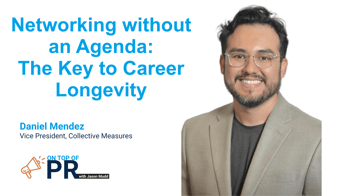
Daniel Mendez of Collective Measures shares how the importance of early and active networking.
Tune in to learn more!
Listen to the episode here:



5 things you’ll learn during the full episode:
- How networking must be intentional and ongoing
- Why you must give in a relationship before you can take.
- Why PR professionals shouldn’t neglect personal branding.
- The role of PR and communications and how it shapes narratives.
- The role of community in your career and the impact it has on it.
About Daniel Mendez
Daniel Méndez Aróstica founded #CommsJobs, a volunteer-driven platform that connects PR and communications professionals with job opportunities and each other. He is a seasoned public relations and corporate communications professional with more than 17 years of experience leading global strategies in employee engagement, executive visibility, and reputation management across industries such as healthcare, energy, and pharmaceuticals. His work spans multiple continents, bringing a multicultural lens to corporate storytelling and strategic communications.
Watch the episode here:
Quotables
- “What you’re trying to do is build relationships” — @DanielMendez
- “PR people are amazing at promoting others and telling other people's stories, but we forget to tell our own story.” — @DanielMendez
- “The best opportunities that I've ever gotten in my career didn't come from a job board, they came from people.” — @DanielMendez
- “People think communications is just sending an email or a poster … It's not. It's so much more than that.” — Jason Mudd
- “That personal brand is what people remember when they're making decisions about who to bring on board.” — Jason Mudd
Resources
Episode Resources:
Additional Resources from Axia Public Relations:
- Navigating PR and communications hiring with Brooke Kruger
- How public relations impacts company reputation, revenue, and recruiting
- Corporate comms, PR, and marketing employee turnover and staffing is hurting brands
- Listen to more episodes of the On Top of PR podcast.
- Find out more about Axia Public Relations.
Disclosure: One or more of the links we shared here might be affiliate links that offer us a referral reward when you buy from them.
Our On Top of PR sponsors:
Production sponsor: Axia Public Relations, one of America’s Best PR Agencies, according to Forbes Magazine
Presenting sponsor: ReviewMaxer, the platform for monitoring, improving, and promoting online customer reviews
Coffee Sponsor: Fans like you fuel our efforts using buy me a coffee.
Enjoy the Podcast?
If you enjoyed this episode, please take a moment to share it with a colleague or friend. You may also support us through buy me a coffee or by leaving us a quick podcast review.
Have any questions?
Connect with us on Facebook, Twitter, LinkedIn, and our LinkedIn Group. For more updates, visit our On Top of PR website or join the community. You may also tune in on Apple Podcasts, Spotify, and YouTube.
Transcript
00;00;00;00 - 00;00;05;15
Daniel
No one ever has time to network. That's why you need to make time to network.
00;00;05;16 - 00;00;09;12
Jason
Right. It's a priority. It's a priority. We all have the same number of hours a day. Right.
00;00;09;14 - 00;00;28;29
Daniel
Exactly. And that's something that I always remind people that, you know, some for some people it happens naturally because you're either you're in a job that requires that you attend a lot of events or you have a lot of meetings with different people, so you're always out there. But for those that don't have that opportunity, you need to try to find a way.
00;00;28;29 - 00;00;52;04
Daniel
And again, I'm not saying that everything means that you have to attend every single happy hour or dinner or conference that close. Yep, it's close to you. But it starts small, like it's something that I started doing and I continued to do ten years. And right is that I dedicate my Friday lunch time to connect with someone that could be that could be someone that I work with and I don't have.
00;00;52;07 - 00;01;09;29
Daniel
I don't have I don't work with them very often, so I just see them every once in a while, just to check in or like with a former colleague, or just to meet with someone that I connected with on LinkedIn and learn a little bit about each other. No agenda? No. Just meeting people. Right. That that channel open.
00;01;09;29 - 00;01;19;27
Announcer
Welcome to On Top of PR with Jason Mudd.
00;01;19;27 - 00;01;40;19
Jason
Hello and welcome to On Top of PR. I'm your host, Jason Mudd. And today I'm joined by Daniel Mendez. He is a seasoned public relations and corporate communications professional with more than 17 years of experience leading global strategies and employee engagement, executive visibility and reputation management across industries such as health care, energy and pharmaceuticals.
00;01;40;21 - 00;01;41;27
Jason
His work spans multiple
00;01;41;27 - 00;02;03;13
Jason
continents, bringing a multicultural lens to corporate storytelling and strategic communications. He is also the founder of Hashtag Comms Jobs, a volunteer driven platform that connects PR and communications professionals with employment opportunities and with each other. Daniel, welcome to on top of PR.
00;02;03;15 - 00;02;07;08
Daniel
Hi. Thank you so much for having me. I'm very excited to be here.
00;02;07;11 - 00;02;32;29
Jason
Well, I'm excited that we're able to do this as well. And excited to share our audience a little bit more about comms jobs and, talk about, elevating your PR career through community clarity and confidence. So, a great topic, I think, for everybody here. Daniel, is there anything else you want to add to our audience about your background and experience before we get started?
00;02;33;02 - 00;02;55;22
Daniel
No. I mean, the only thing that I think it's relevant just because of this, the the story of how comms Jeff's was born, is that I'm originally from Chile. I, started my career there, I studied there, so when I relocated to the US in 2015, I had to rebuild my network from scratch. Definitely.
00;02;55;22 - 00;03;16;04
Daniel
When you relocate from, one country to another, you always think like, oh, I'm going to leave my friends here. I'm going to leave my family here. But you never really think about, leaving your professional network. And that is something that hits you in the face afterwards. So that is actually the the where the origin of comms jobs.
00;03;16;06 - 00;03;18;06
Daniel
With everything started.
00;03;18;09 - 00;03;27;04
Jason
Very nice. Now, I've got to mention here I'm seeing what looks like at least nine guitars in the background. So do you regularly play all of those guitars?
00;03;28;13 - 00;03;39;04
Daniel
If that's a question that my wife always asks. But, what, a musician is going to answer is that each guitar
00;03;39;04 - 00;03;59;02
Daniel
has its own sound. So it's for different songs. You always have your favorites. So if you see the the electric guitar, there's a Fender Telecaster. I see that in my my Martin there. I probably that the ones that I use the most but but yeah, I'm very, I'm very passionate about music.
00;03;59;05 - 00;04;23;10
Daniel
I've always been, listening and started to play guitar when I was seven years old and had my band when I was in China. And that's another thing that I left there. So these days it's just me, myself and I, trying to do some, some work, with my guitars and, and the computer sometimes, recording on my own.
00;04;23;10 - 00;04;25;20
Daniel
So. Yeah. Nice hobby.
00;04;25;23 - 00;04;29;08
Jason
Yeah. I see you still have some CDs back there, too, so that's pretty cool.
00;04;29;10 - 00;04;32;18
Daniel
Yeah, there's some CDs and vinyls at the bottom.
00;04;32;18 - 00;04;34;06
Jason
So nice. Also. Yeah.
00;04;34;08 - 00;04;35;05
Daniel
I love it.
00;04;35;08 - 00;04;42;18
Jason
I love it. So, Daniel, give me just a quick story. How did what what was your inspiration for comms jobs?
00;04;42;21 - 00;05;09;11
Daniel
Yeah, I mean, my my inspiration really was, I've always been very community driven and, again, as I was mentioning before, when I relocated to to the US in 2015 and I landed, here, it hit me real quick that who do I go to? Like who? Who can I call to advocate for me and and introduce me to people connect me with hiring managers.
00;05;09;14 - 00;05;42;00
Daniel
Or recruiters and and, open the door for me to, to go back to the workforce after relocating because, you know, my wife and I decided to, to move to the US, on our own. So we basically, quit our jobs in Thailand and just moved here. So, I was very intentional about building, relationships and connecting with people that, could help me in my job search, but also maintain that relationship in the long term.
00;05;42;03 - 00;06;09;11
Daniel
And, five years later, at the end of 2020. Yeah, the end of 2020, beginning of 2021 at the company, where I was working at that point went through, significant reorganization. So unfortunately, a lot of colleagues were impacted, and, a lot of them, had been with the company for 15, 20 years. So a lot of them actually, that was their first job out of college.
00;06;09;11 - 00;06;43;02
Daniel
So their whole experience in the workplace was with that company. Their network was only that company. So when I asked them how I could help them, what will be helpful for them as they start this job search, they were like, well, I don't even know where to start. Like, I don't even know, where to go, who to talk to because I've, I've been out of the market for so long, and because I had curated my network so methodically just following communicators, and, and in the companies that I was targeting at that point, I was seeing a lot of opportunities coming up.
00;06;43;04 - 00;07;22;21
Daniel
So I offered to start, sharing those opportunities with them using the hashtag comms jobs. And the reason why we used, a hashtag was because it's open. Anybody? Well, in the past, LinkedIn allows you to follow hashtags. So you could just follow the hashtag and not even be, connected with me, and you would see all those opportunities, and something that started just from my colleagues suddenly started growing and growing and definitely, filled, a white space that was there, of connecting people in the communication space, looking for jobs with those who were hiring.
00;07;22;23 - 00;07;40;20
Daniel
So fast forward to this year when LinkedIn retired. The follow hashtag functionality. We started a group, a proper group in LinkedIn, and we has close to 3000 users right now. And and we just recently started one for the UK as well.
00;07;40;23 - 00;08;00;27
Jason
Gotcha, gotcha. Well, good. Let's jump right into elevating your PR career through community clarity and confidence. I think this is a great topic. Timely now, but probably evergreen for everybody. So how do you build a supportive online community like comms job to grow your network and give back to your network? Daniel.
00;08;00;29 - 00;08;28;17
Daniel
I think the most important thing really is to it's to really focus on building relationships. A lot of people, unfortunately, when they're impacted by a reorganization or, a reduction in force and they're pushed out of work, that's when they start networking. Right? And, and they start activating their, their, their network and reaching out to people.
00;08;28;20 - 00;08;51;21
Daniel
But it's very hard to operate in that environment where your house is on fire, you're very needy and you're just starting to reach out to your network. If you haven't done that before, right when you were fine, when you were employed, when you were, making a salary and, and you were in a comfortable position, it's very hard to activate or start doing that when you're in need.
00;08;51;23 - 00;09;12;20
Daniel
So, the first thing that I always tell people when I connect with them on LinkedIn is that the first, the the best time to start networking was at the beginning of your career, right? Like probably when you went to college and that that was the best time. If you didn't start then or you started and then stop, the next best time is today.
00;09;12;22 - 00;09;42;24
Daniel
But this time around, you should never stop. I, I a lot of people have this misconception of networking as a concept that involves, you know, attending happy hours and dinners and paying for memberships to attend certain events or conferences. Or keeping track of in a spreadsheet of all the people that you're connecting with and when you need to reach out to them.
00;09;42;26 - 00;10;12;27
Daniel
And I think that's really, not understanding what networking means, because at the end of the day, what you're just trying to do is to create relationships, to build friendships and, and make friends before you meet them. And to achieve that, the first thing that you need to focus on is in giving, not receiving. So that's why it's very important that you start doing this when you're in a comfortable position, when you are able to give before receiving.
00;10;12;27 - 00;10;21;28
Daniel
So, I would say that that's probably the most important thing about building a community that can be there for you when you need it.
00;10;22;00 - 00;10;45;10
Jason
Yeah, that is an excellent point. And, something I think most people don't find out, until it's too late. And, Daniel, I'm just going to. Yes. And what you said, because I've seen this happen a lot, where for whatever reason, people feel comfortable and confident in their role and they're not very collaborative and community minded in that role.
00;10;45;13 - 00;11;08;11
Jason
And then when they start looking for help, it's actually kind of feels like a bad look. And the example I can give is, you know, they don't, you know, get back to people. They don't collaborate with people. They don't pursue opportunities to give back to the community or, or whatever the case may be. And I think it's because they're busy, you know, and they don't really, prioritize giving back to the community.
00;11;08;11 - 00;11;28;22
Jason
They don't prioritize, you know, this idea. But the examples I would use and I've used this before is like, you know, a sports team who, you know, doesn't want to participate in certain community activities when they're winning. But as soon as they start losing, they seem desperate to be connected to the community in any way. The community will receive them.
00;11;28;25 - 00;11;48;14
Jason
And to me, I just remember how they acted when times were good. Right? And, you know, or the example might be, you know, the news director who would never cover the stories that we would pitch him on. But then as soon as he got laid off in that newsroom environment, he was telling me how good he'd be at PR and how much he admires the work that we do.
00;11;48;14 - 00;12;10;08
Jason
Right. So it's kind of one of those things like, you know, I'm not saying he had to cover our stories, but he could have been kinder or at least more responsive. Right. And I get it. We're busy. We're doing our jobs. We weren't expecting to be unemployed, but the day you're unemployed, it's kind of one of those things like, you know, I remember how you treated me, and I worried that you're going to treat others internally or externally of my organization when that happens.
00;12;10;08 - 00;12;11;11
Jason
Does that make sense?
00;12;11;13 - 00;12;35;16
Daniel
Yeah. No, definitely. I mean, it's a small world out there. Yeah. Small world. Like you should always be, kind to everyone and and, focus on, you know, being in someone else's shoes. Right. Like, how is it on the other side? And, and I think something very important that you said is that everybody's busy, right.
00;12;36;00 - 00;12;41;16
Daniel
No one ever has time to network. That's why you need to make time to network.
00;12;41;17 - 00;12;45;13
Jason
Right. It's a priority. It's a priority. We all have the same number of hours a day. Right.
00;12;45;15 - 00;13;05;02
Daniel
Exactly. And that's something that I always remind people that, you know, some for some people it happens naturally because you're either you're in a job that requires that you attend a lot of events or you have a lot of meetings with different people, so you're always out there. But for those that don't have that opportunity, you need to try to find a way.
00;13;05;02 - 00;13;28;07
Daniel
And again, I'm not saying that everything means that you have to attend every single happy hour or dinner or conference that close. Yep, it's close to you. But it starts small, like it's something that I started doing and I continued to do ten years. And right is that I dedicate my Friday lunch time to connect with someone that could be that could be someone that I work with and I don't have.
00;13;28;10 - 00;13;46;00
Daniel
I don't have I don't work with them very often, so I just see them every once in a while, just to check in or like with a former colleague, or just to meet with someone that I connected with on LinkedIn and learn a little bit about each other. No agenda? No. Just meeting people. Right. That that channel open.
00;13;46;20 - 00;14;06;05
Jason
I think that's good advice, Daniel. And I hope people listening will take the opportunity to emulate something like that. Whether it's a Friday lunch or whatever the case may be, because, you know, the cliche is what your network is, your net worth. And at the end of the day, if no one knows you or hasn't had positive experiences with you, now's the time to kind of turn that around.
00;14;06;05 - 00;14;32;09
Jason
Because really, what you're doing is creating a first impression. And like you said, and what I thought of, is I was thinking about it is, you know, it's just like pitching the media. Right. The best thing you can do is kind of start building a relationship ahead of time, get them to know you like you, trust you, and want to work with you before you just start, you know, force feedings, whether it's, hey, hire me or whether it's cover my story or whatever it might be like, you know, in PR, I talk about this all the time.
00;14;32;09 - 00;14;58;27
Jason
It's time that we start putting the relationships back into public relations. Because we're so focused sometimes on publicity or, you know, getting media coverage or tracking, you know, you know, KPIs. And it's like. But did we build a relationship with that person? Does that person, that audience, that organization now know us, like us, trust us, and want to do business with us instead of just looking at people as a number?
00;14;59;00 - 00;15;39;03
Daniel
Yeah. No, I think I love that and put it back to relationships. In public relations. It's something that it's, always good to remember is that we do communications. Communications is a very inherently human ability. Yes. And and it's the foundation of everything. Yeah. Of community. Of society, of organizations, teams. So, so prioritizing that part and bringing back that human element of communication is so important these days, especially in, in the world of, that we're living in, this days with AI and,
00;15;39;03 - 00;15;48;09
Daniel
the synthetic content that it's out there, I think humanity, you know, consistency and, and trust have become very, very important.
00;15;48;11 - 00;15;51;01
Daniel
In our space and in many other fields.
00;15;52;14 - 00;16;23;18
Jason
Yeah, absolutely. And then, Daniel, the next thing I know we want to talk about was tips for communicators who have who find it hard to self-promote, and how to confidently showcase your value. Contributions, work, whatever it might be. I think this is a good topic. I saw this on LinkedIn earlier today where people were saying that, you know, PR people are really good at, you know, you know, elevating the visibility for other organizations and for others, but not necessarily any good at doing it ourselves.
00;16;23;18 - 00;16;26;21
Jason
So let's well, I'm eager to hear what you have to say about that.
00;16;26;24 - 00;16;49;21
Daniel
Yeah. That's definitely something that happens a lot. I see it all the time. And probably I was one of them as well. Like, I think the fact that corporate communicators and PR professionals are always within either, corporate affairs organization or, or a human resources organization, if you're an internal communications, you're always very close to the policies.
00;16;49;23 - 00;17;21;12
Daniel
Right. And, when there's a social media policy in place, a lot of people, a lot of people feel that nothing that they do in a public space can be about them. It's always about the company. It's always about what you're doing. So for a job. Right. And and I always tell people and this is something that I realized I guess the hard way is that unfortunately jobs are not forever.
00;17;21;17 - 00;17;44;08
Daniel
Right. They're not guaranteed. And if you build a brand on social media or in the platform that you choose, that it's attached to something that you don't own, it's going to be taken away from you at some point. Right. So that's why I think it's very important to differentiate between a personal brand and an employer brand. Right.
00;17;44;11 - 00;18;18;23
Daniel
And, and something that people really struggle with. And, and this is very anecdotal, right? From coming from, from the conversations that happen with community communicators in LinkedIn is that they struggle to get started because they feel that, oh my gosh, they have to put a content calendar for that, and they have to schedule things, and they have to participate in post every day, three times a day for six months to get to a point where you think where they have a certain amount of followers and become, you know, a recognized voice in the platform.
00;18;18;26 - 00;18;42;15
Daniel
And what I always say is like, it doesn't have to be that way. You have to find what you're comfortable with and you have to find, what what is it that you can do without putting a lot of work into it? So what do you feel comfortable discussing on On your Feet? Something that you can you can address with your eyes closed, right or without any preparation?
00;18;42;18 - 00;18;59;26
Daniel
And those are the type of things where you can start sharing your, your, your thoughts. I heard I don't know if this is true, but they said that only 1% of the people on LinkedIn are creating content. All the other ones are lurkers. So it's, I.
00;18;59;26 - 00;19;00;06
Jason
Believe.
00;19;00;08 - 00;19;29;06
Daniel
Opportunity, right? Because there's space for many points of view for different expertise, for, different ideas and getting started in your journey of building, a personal brand on social media doesn't mean that you have to put together a content calendar post three times a day for six months straight, start small, start commenting on others people, content starting getting those conversations.
00;19;29;08 - 00;19;54;28
Daniel
Jump in when you feel that you can add something, that it's valuable, right? And then start to see what resonates with the type of audience that you're trying to build. And then when you figure out, like, what is your niche? What is an area where you can definitely add value and add a perspective, perspective that it's, valuable for others, then you're going to realize very quickly, how you can start contributing to that conversation.
00;19;55;00 - 00;20;11;18
Daniel
And it's just finding your niche right. So I'll, I'll stop there. But, I think that's probably one of the, the key advices I will give people. And just to, to not put so much pressure on them because.
00;20;11;19 - 00;20;12;11
Jason
Right, not.
00;20;12;11 - 00;20;28;03
Daniel
Everybody is going to be an influencer and a content creator, that it's going to happen millions of followers. If that's not that the role, well, you want to go. It's just really being part of a community where you are recognized as someone who has a good point of view.
00;20;28;06 - 00;20;50;25
Jason
Yeah. That's a that is a good point of view. I was just reading something this morning that was talking about the idea of, you know, I can't remember the term they use, but basically up leveling or lifting up. I wish I could remember the exact term, but what they say is every interaction you have with someone, you want them to feel, empowered and feel better because they interfaced with you on that day.
00;20;50;27 - 00;21;14;18
Jason
And as I started kind of thinking about that thought, you know, several people came to mind who are the types of people who do that. And so, Daniel, I guess my point for you and my audience is that people remember other people and how they made them feel. Right. And the studies show, actually, I saw this like the most popular kids in school, high school or whatever it might be.
00;21;14;18 - 00;21;38;11
Jason
Right? The research came out, I think, last year that that said that the most popular kids in school are always the kids, the students who other students felt like they were liked by them. So in other words, Sally is popular because Sally puts on an aura or a, a position about you that makes you feel like Sally really likes you.
00;21;38;13 - 00;21;59;09
Jason
And so because Sally likes me, I like her in return. And so, you know, I think that's what we can do is whenever we interact with with other people, you know, we can just make them feel, you know, liked, make them feel special, do it genuinely. Right. But notice the things they do well and pointed out to them, because, you know, that's how you really make friends and influence people.
00;21;59;09 - 00;22;00;09
Jason
I would say.
00;22;00;12 - 00;22;27;07
Daniel
Now that that's a really great point. And definitely, I think another avenue to start and contributing to conversations and adding value to your community is to amplify the voice of others that are already out there, and you align with their their thoughts because the fact that you are following me or, I'm following you on, on LinkedIn, for example, doesn't mean that my neighbor is going to be following you as well.
00;22;27;08 - 00;22;45;27
Daniel
Or, you know, like that's why it's a social network. And that that's at the core of building communities is how you bring people into someone else's field and scope so they can explore those ideas. And then start other conversations. So that's definitely a really valuable point of building community.
00;22;45;29 - 00;23;03;07
Jason
I just looked it up. The term that the author uses is an impression of increase. So you want to increase each person you come into and to, access with or you come in contact with throughout your day. So and that's a great challenge. You know, that's like one of those challenges of saying, like, I want you to go a whole day without complaining.
00;23;03;09 - 00;23;13;11
Jason
And then, you know, you kind of realize how much you actually complain. So, but in this case, you know, the idea is to give each person, you know, increase each person that you come into contact with. So
00;23;13;11 - 00;23;22;19
Jason
This episode is brought to you by Audible. Enjoy 30 days free of Audible Premium Plus by going to ontopofpre.com/audible.
00;23;22;19 - 00;23;47;06
Announcer
You're listening to On Top of PR with your host, Jason Mudd. Jason is a trusted advisor to some of America's most admired and fastest growing brands. He is the managing partner at Axia Public Relations, a PR agency that guides news, social and web strategies for national companies. And now, back to the show.
00;23;47;06 - 00;23;55;11
Jason
I know we had one more point we wanted to cover in this episode, which is why people often misunderstand the communication profession and how to change that narrative, which I'm all ears for.
00;23;55;11 - 00;23;57;04
Jason
This one.
00;23;57;06 - 00;24;23;03
Daniel
Yeah. So, I think that's actually how we connected, on LinkedIn, because I wrote something about, it was a series of what is it that you do, when you're in corporate communications that I cover, you know, internal communications, executive communications, PR, media relations and others and, and that series really started because there's so many people that struggle with this, that I thought it was funny.
00;24;23;03 - 00;24;59;28
Daniel
It's just a very interesting thing because our weapon of choice is, is stories, right? It's like narratives and and and and tell compelling stories to others. But we are so bad at telling our own story. And what do we do? And how do we explain to people, what corporate communications. So what public relations is. And normally it boils down to something like, oh, so you write emails or oh, so you, you, you know, make posters or, you know, signs or you are in advertising.
00;25;00;03 - 00;25;29;13
Daniel
Because those are the key things that the people that it's visible to people. And also I feel because there's a huge disservice that does some TV shows and, and, and Hollywood have, have done with our profession, most of the time is is full of glamor and, you know, like, if you compare our work to the work that, Emily in Paris is doing, right, it's very different.
00;25;29;16 - 00;26;05;17
Daniel
But in thinking a lot about why I think communicators struggle to explain others, what we do is because communications is something very obvious and and it's very basic. It is something that we all do. No matter if you work in corporate communications or not. Everybody communicates. And when you explain to people, right, that that you're helping others do something that they already do right, it sounds like a fake job.
00;26;05;23 - 00;26;26;20
Daniel
It's like, right. It's like, but why do you have to write messages for someone like they're they're the CEO of a company. Can they do it themselves? Like right there? I'm sure they're smart enough or, you know, why do you have to, write an article, you know, for someone that it's in, in it to communicate a change.
00;26;26;20 - 00;26;47;27
Daniel
Can they just do it like we all do these things, right? But getting into the details and into the weeds of how actually internal communications works in a big enterprise, for example, where you have many different points of view, many internal politics, many egos, and you want to make sure to communicate something that it's going to engage employees.
00;26;47;27 - 00;27;08;29
Daniel
It's kind of, clarity to the work they're doing or how they're contributing to the bottom line of a company. Right? That it's a whole different thing. And and yes, we can all talk. We can. All right. We can all, you know, stand in front of people and just say a couple of words, but that doesn't mean that we're doing it right.
00;27;09;06 - 00;27;32;09
Daniel
That doesn't mean that we understand fully what the key message is. How is that going to, cascade across the organization and have a series of consequences right after a message is deployed. So when we start getting into the details of all of that, it gets awkward. And that's why people struggle so much to to explain what we do in corporate communications.
00;27;32;11 - 00;27;40;00
Daniel
I don't know if that resonates with you, but, that, that is the perspective that I have in discussing this with, with many others in the community.
00;27;40;03 - 00;28;04;26
Jason
Yeah, it makes sense. You know, what you're reminding me of, Daniel, is one that, you know, everyone does it. So whether they're good at it or not, they do it too. We have the unique opportunity to get paid for it. And then three, I find that, you know, the average, you know, citizen, if you will, the average American, the average consumer, they they have no idea how much ghostwriting takes place right there.
00;28;05;03 - 00;28;23;09
Jason
We've kind of, as a society adopted this idea that, yeah, you know, there's speechwriters, right, that help people write speeches. And yeah, the president might have somebody actually managing their correspondence, and it's not really them doing it. And by president, I just mean whoever like the, you know, president United States might be at the time. Right. That's become acceptable.
00;28;23;11 - 00;28;47;08
Jason
But I don't think, you know, people really realize that, you know, you're not actually, you know, receiving, you know, executives aren't really doing their own writing. And thankfully for many of them, right, not only does that obviously keep us employed, but it helps the company communicate a little bit better, too. And it lets the executive focus on their highest and best use and delegate to those that they, seem to, you know, or decide to employ.
00;28;47;08 - 00;28;47;26
Jason
So.
00;28;47;28 - 00;29;14;28
Daniel
Yeah. No. And I feel like one of the main, fields within corporate communications, that is internal communications is very misunderstood because, again, all the external stuff like media relations, public relations, advertising, marketing, all of that is very, very visible to everybody. But internal communications is always kind of like in the backstage. Right. And it's it's invisible for a reason.
00;29;15;01 - 00;29;21;10
Daniel
Like if you don't know the work that internal communications is doing is because it's been doing it's been done well.
00;29;21;14 - 00;29;22;25
Jason
Right, right.
00;29;22;28 - 00;29;44;10
Daniel
And and that's why I, because a lot of my career has been in the internal communications. I always try to expand, you know, like we are the bridge between a company's leadership and the employees. Right. And what we do, really is to craft messages to help everyone stay on the same page and really explain the bigger the big picture of the strategy of the company.
00;29;44;16 - 00;30;13;21
Daniel
Deliver, help, deliver everyday updates in and pursuing that mission and and reaching the objective of the company and really mobilizing people around a common goal. Like that's what we do. That's our expertise. So it's a business, very related to emotions, to, to awakening things that are very human into the organizations and that you need to know a lot of different things to achieve that.
00;30;13;24 - 00;30;17;06
Daniel
An important thing is to understand the audience.
00;30;17;09 - 00;30;25;21
Jason
Yeah. Daniel, that's a good point. As we begin wrapping up, our audience can find you on LinkedIn. How do they best do that?
00;30;25;23 - 00;30;51;20
Daniel
Yeah. So you can find me either, in commerce jobs, you will find a group, probably very, very easily. Or you can find me on LinkedIn. My profile. Daniel Mendez at Optica. I also have very highlighted columns, jobs at the top, and would love to connect with everybody and invite you to follow my content and benefit from it, because it's free and it's available to anyone.
00;30;51;23 - 00;31;10;01
Jason
Yeah. And so Daniel in our audience will be sure to put a link to directly to your LinkedIn within the episode notes so that you're easy to find. And any other resources. Daniel, that you think would be valuable for us to share. We'll also insert a link to those, within that. Daniel, any closing thoughts to our audience here?
00;31;10;01 - 00;31;26;09
Jason
And just and I'll put you on the spot in addition to that is to ask you, are you seeing anything, in the employment marketplace right now that you feel like is an interesting observation, trend or tip that you might have, and feel free to, share several of those if you have them?
00;31;26;11 - 00;31;51;14
Daniel
Yeah. I mean, there's, there's many, things there, but probably one thing that I'm really going to, highlight because I think it's very important people really need to understand that. Is that you're not going to be successful in your job search just by applying for jobs that you find in your job staff, right? On LinkedIn or, indeed, or any platform that you use.
00;31;51;17 - 00;32;11;15
Daniel
You need to nurture, build, and maintain good relationships with coworkers, with, former colleagues, with people that you meet, in, in other settings because humans connect with humans, and humans are going to open doors for other humans.
00;32;11;19 - 00;32;12;23
Jason
Right.
00;32;12;25 - 00;32;36;24
Daniel
And, and really, what I hear from most people that have been successful in their, in their job search is exactly by following that approach. Right. Is relationship that having built, through the years where, there's been an exchange of value for several, months or like a long amount of time and where those two people can trust each other.
00;32;37;00 - 00;33;03;19
Daniel
Right. And that's where you're going to find, the best opportunities or, or, they're going to introduce you to someone, that can offer an opportunity for you. So prioritize networking. And again, if you don't want to call it networking, prioritize making friends, prioritize reaching out to people, building your your credibility and trust and maintaining that.
00;33;03;21 - 00;33;27;26
Daniel
And never stop because something that I always like to remind people is that unemployment, it's a temporary thing. It's going to have it's going to pass your opportunities out there and the student, as you land that next opportunity, remember the hard work that you have to put in reactivating that network. So keep that work going. Right. So that you don't have to start from scratch again.
00;33;27;29 - 00;33;48;01
Daniel
I always say stay ready so you don't have to get ready because potentially it can happen again. Hopefully doesn't. But it can happen again. If it happens, then you're going to be ready and you're going to be grateful that you continue doing that work in a time where you were comfortable, not when your house was on fire.
00;33;48;04 - 00;34;06;22
Jason
Yeah, that's a really good point. I know, Alan Weiss is a consultant to business consultants, and he's got a great quote. I'm going to misquote it, probably, but it's something like, you know, if something happens once, right? Okay. If it happens twice, you might want to start looking in the mirror and figure out what you can do to prevent it from happening again.
00;34;06;25 - 00;34;23;18
Jason
That's not exactly what you're saying, but the idea is the same that you know, if you found yourself unemployed the first time, you might not have expected it second time, maybe be more prepared so that you're always ready, like you said. And I think that's really good advice. You know, it's kind of like the Boy Scout expression, right?
00;34;23;18 - 00;34;51;22
Jason
Be prepared. And that's I think that's what you're saying is, you know, prepare yourself for the unexpected. We as good communicators should always be thinking like that. We just need to take time and invest in our own career. At a client once say he's shocked that people aren't willing to spend 1 or 2 days a year looking at their personal finances, but yet they will work in accounting or finance for someone else, you know, 40 hours, 60 hours a week and never, you know, commit 16 hours a year to their own personal financing.
00;34;51;22 - 00;34;59;05
Jason
And I think we're kind of seeing the same thing here. Right? Invest in yourself and give back to yourself because your the your best investment that you've got.
00;34;59;07 - 00;35;02;13
Daniel
Exactly, exactly right. So that that's really well set.
00;35;02;16 - 00;35;06;04
Jason
Yeah. You know this was great I really enjoyed it. Thanks again for joining us.
00;35;06;06 - 00;35;08;06
Daniel
Oh thank you for having me.
00;35;08;08 - 00;35;24;16
Jason
Awesome, awesome. So, this has been another episode of On Top of PR. Jason Mudd, your host with Axia Public Relations. If you enjoyed this episode, do us a favor and share this with a colleague, your friend. Take a moment. Connect with Daniel on LinkedIn and let him know that you heard him on On Top of PR and, again, Jason Mudd signing off, helping you stay on top of PR, be well.
00;35;24;16 - 00;36;20;08
Announcer
This has been On Top of PR with Jason Mudd presented by ReviewMaxer. Be sure to subscribe so you don't miss an episode and check out past episodes at ontopofpr.com.
 |

|

About your host Jason Mudd
On Top of PR host, Jason Mudd, is a trusted adviser and dynamic strategist for some of America’s most admired brands and fastest-growing companies. Since 1994, he’s worked with American Airlines, Budweiser, Dave & Buster’s, H&R Block, Hilton, HP, Miller Lite, New York Life, Pizza Hut, Southern Comfort, and Verizon. He founded Axia Public Relations in July 2002. Forbes named Axia as one of America’s Best PR Agencies.
Find more On Top of PR episodes on:
Topics: PR tips, B2B, On Top of PR



Comment on This Article