
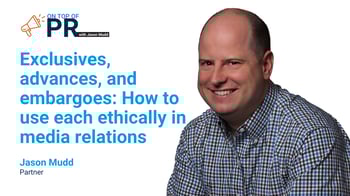
In this solocast, On Top of PR host Jason Mudd discusses the ethical and practical differences between exclusives, advances, and embargoes and how to use them correctly in media relations.
Tune in to learn more!
Listen to the episode here:



5 things you’ll learn during the full episode:
- The clear differences between exclusives, advances, and embargoes
- The most common PR mistakes that quietly damage credibility
- Why advances don’t restrict publication unless you explicitly say so
- How to structure ethical exclusives without limiting coverage
- Practical scripts you can use for exclusives, advances, and embargoes
Quotables
- “If you promise a national consumer outlet an exclusive and then you pitch another national consumer outlet the same story, you broke your promise.” — @jasonmudd9
- “Reporters don't forget. They may confront you; they may not. They may complain; they may not. But they will remember, so always be honest and ethical in all of your communication.” — @jasonmudd9
- “Embargoes work best when your organization has a plan for what happens if the embargo breaks. If you want to use embargoes correctly, you must be precise.” — @jasonmudd9
- “This is a critical lesson: Don't rely on terminology alone. Don't assume the other party defines the offer the same way you do.” — @jasonmudd9
- “Media relations is not about getting coverage. Media relations is about earning trust, earning credibility, and building relationships that last.” — @jasonmudd9
- “If your goal is first-class media relations, the standard is simple. Say what you mean, mean what you say, deliver what you promise.” — @jasonmudd9
Watch the episode here:
About Jason Mudd, Axia Public Relations
Jason Mudd is a trusted adviser and dynamic strategist for some of America’s most admired brands. Since 1994, he’s worked with brands including American Airlines, Budweiser, Dave & Buster’s, H&R Block, Hilton, HP, Miller Lite, New York Life, Pizza Hut, Southern Comfort, and Verizon.
Jason founded Axia Public Relations in 2002. Forbes named Axia one of America’s Best PR Agencies. At Axia, Jason oversees strategic communications for national clients and leads top PR talent. Clients love his passion, innovation, candor, commitment, and award-winning team. He consults with leadership teams at billion-dollar global business-to-business and business-to-consumer brands, advising them on spokesperson training, crisis communications, analytics, social media, online reputation management, and more.
In an increasingly tech-forward world, Jason’s grasp of the technological demands companies face helps his multiple-sector clients reach their target audiences. After teaching himself HTML in 1994, Jason helped pioneer internet marketing strategies as an early adopter of e-commerce, search engine optimization, and social media, inspiring tech giants like Yahoo. He speaks to corporations and industry groups and writes about PR trends and best practices for American City Business Journals and other national outlets.
Resources
- Jason Mudd on X
- Jason Mudd on LinkedIn
- Axia Public Relations website
- Axia Public Relations resources
- 1:1 consultations and training with Axia
If you like this episode, you're going to love this:
- What journalists want from your media pitch with Jason Mudd, Axia Public Relations
- Common mistakes publicly traded companies make when working with the news media
- Getting More Media Coverage by Making Journalists’ Lives Easier
Disclosure: One or more of the links we shared here might be affiliate links that offer us a referral reward when you buy from them.
Media pitch scripts you can use
-
True exclusive (story or interview) — when you're offering something truly exclusive:
Hi [Name],
I’m reaching out to offer you an exclusive interview with [Spokesperson Name] about [Topic]. If you’re interested, we can schedule it as early as [Day] or [Day]. And we’ll hold this interview opportunity for you until [specific date, time, and time zone]. Let me know by then if you’d like to proceed, and I’ll send available time slots.
-
Exclusivity (National vs. trade vs. local) — when you're offering exclusivity within a defined lane:
Hi [Name],
We’re offering this story as an exclusive to one national consumer outlet, and your publication is our top choice.
If you’d like to pursue it, we can schedule an interview with [Spokesperson] this week and provide supporting materials immediately.
We’re planning broader outreach to trade and local outlets after [date], but no other national consumer outlets will receive this story before then.
-
Exclusive angle (not exclusive announcement) — when multiple outlets will cover the same announcement, but each gets something unique:
Hi [Name],
We’re sharing [announcement] with multiple outlets, but I wanted to offer you a unique angle: [specific angle].
We can also provide an exclusive interview with [person] focused specifically on that angle if you’re interested.
If so, we can schedule it before [date] so you have time to publish it when it best fits your editorial calendar.
-
Embargoed pitch — when you're offering early access to a publication restriction:
Hi [Name],
We’re sharing this information in advance under embargo until [Day, Date] at [Time] [Time Zone].
If you agree to the embargo, I can send the full report and supporting materials today, and we can schedule an interview with [Spokesperson] before the embargo lifts.
-
Embargoed follow-up with confirmation — when you already sent materials and you need to confirm that they accept the embargo:
Hi [Name],
I wanted to confirm that you received the materials and that you’re comfortable honoring the embargo until [Day, Date] at [Time] [Time Zone].
If you’d like an interview before then, we can make [Spokesperson] available on [Day] or [Day].
-
Advance notice (no embargo) — when you're giving early notice for planning with no publication restriction:
Hi [Name],
I wanted to share advance notice that [event/announcement] is scheduled for [Day, Date].
If you’d like to cover it, we can coordinate interviews in advance and provide additional details as we get closer.
-
Advance notice with optional embargo — when you need them to plan early but also want controlled timing:
Hi [Name],
I wanted to share advance notice that [announcement] will take place on [Day, Date].
If you’d like early access to the details, we can provide the full materials under embargo until [Day, Date] at [Time] [Time Zone].
Let me know if you’d like to work under embargo, and I’ll send everything over.
-
Clarity language (anti-confusion script) — when you want to avoid misunderstanding:
Hi [Name],
To be clear, this information is not under embargo.
We’re sharing it early simply to help with planning. If you’d like an exclusive angle or interview access, we can discuss that separately.
Our On Top of PR sponsors:
Production sponsor: Axia Public Relations, one of America’s Best PR Agencies, according to Forbes Magazine
Presenting sponsor: ReviewMaxer, the platform for monitoring, improving, and promoting online customer reviews
Coffee Sponsor: Fans like you fuel our efforts using buy me a coffee.
Enjoy the Podcast?
If you enjoyed this episode, please take a moment to share it with a colleague or friend. You may also support us through buy me a coffee or by leaving us a quick podcast review.
Have any questions?
Connect with us on Facebook, Twitter, LinkedIn, and our LinkedIn Group. For more updates, visit our On Top of PR website or join the community. You may also tune in on Apple Podcasts, Spotify, and YouTube.
Transcript
00:00:00:11 - 00:00:14:02
Jason
Let's start with something uncomfortable somewhere right now. A PR person is emailing a reporter and saying, we'd like to offer you an exclusive. And at the same time, they're sending that same pitch to 40 other media outlets.
00:00:14:04 - 00:00:39:17
Jason
If you ever wonder why some reporters stopped responding, that's one of the fastest ways to make that happen. Because in media relations, your word is your reputation. And today, in this solo cast episode, we're going to clear up three items that get misuse constantly exclusive, advance and embargo. We'll cover what they mean when they work, common mistakes and how to use them ethically.
00:00:39:23 - 00:00:46:11
Jason
So you protect your organization, honor commitments, and practice first class media relations.
00:00:46:13 - 00:00:55:23
Announcer
Welcome to On Top of PR with Jason Mudd.
00:00:56:01 - 00:01:09:12
Jason
Welcome to On Top of PR with Jason Mudd. This is a show where marketing leaders and communications professionals learn how to build trust earned visibility, and avoid the PR mistakes that quietly damage credibility. I'm Jason Mudd, and today we're getting tactical.
00:01:09:14 - 00:01:42:18
Jason
Here's why this topic matters. Exclusive advances and embargoes aren't clever PR tricks. Their trust based agreements. And when your team uses these terms incorrectly, it doesn't just create confusion. It creates damage. It damages your reputation with that reporter. It damages your organization's credibility, and it creates long term friction that shows up later as fewer media responses, fewer media opportunities, less media coverage, and more skepticism from journalists.
00:01:42:20 - 00:02:17:02
Jason
So if you're organization cares about reputation, brand visibility, and long term relationships with the media, you need to get this right. So let's define these terms clearly and correctly. An exclusive means one outlet gets something that others do not. That something could be the full story. An interview. Access to an executive original data. Maybe it's a customer case study, behind the scenes access or a unique angle, but the exclusive must be real.
00:02:17:04 - 00:02:45:18
Jason
If media outlets are all getting the same thing, it isn't an exclusive. The second term is advance, and advance means you share information early so the journalists can prepare in advance. Is about access timing. But here's the key point an exclusive does not automatically restrict publication. If you give information early and you don't specify restrictions, the journalists may publish immediately.
00:02:45:20 - 00:03:15:18
Jason
We'll talk more about that in a moment. A third term embargo. An embargo means you share information early, but with a specific agreement keyword. There is agreement. Maybe that agreement is do not publish until a defined date and time. An embargo is about publication timing and an embargo is not exclusivity. You can embargo something and share it with 50 media outlets, as long as they all agree to publish at the same time.
00:03:15:20 - 00:03:21:22
Jason
Here's the easiest way to remember the difference. Exclusive only you get it. Advance.
00:03:21:22 - 00:03:38:06
Jason
You get it early. Embargo. You get it early. But you can't publish it until a certain date. And yes, you can combine these. You can have an exclusive under embargo, but you need to understand what you're promising and so does the journalist.
00:03:38:08 - 00:04:08:22
Jason
Let's go deeper into exclusives. Most people assume an exclusive means one single media outlet. Overall. Sometimes that's true. Oftentimes that's true. But in real world PR exclusives can also be structured by category. For example, you may offer an exclusive to one national consumer media outlet or one industry trade publication, a podcast, a television show, one local market outlet that can be ethical and smart.
00:04:08:23 - 00:04:33:02
Jason
The key is that you define the category clearly. If you promise a national consumer outlet an exclusive, and then you pitch another national consumer outlet the same story, you broke your promise. And reporters don't forget they may confront you. They may not. They may complain, they may not, but they will remember. So always be honest and ethical and all of your communication.
00:04:33:07 - 00:04:52:15
Jason
Here's another important distinction you can offer an exclusive to the story itself. Or you can offer an exclusive to a specific asset. For example, one outlet might get the CEO interview, another might get an exclusive customer interview, another outlet might get first access to the report data.
00:04:52:17 - 00:05:11:02
Jason
Meanwhile, another outlet gets behind the scenes access and yet another outlet gets an exclusive local angle. That's a smart media relations strategy. It expands coverage while in maintaining trust, but it only works if your internal team understands what you promised and follows through.
00:05:11:04 - 00:05:39:09
Jason
Now let's talk about advances in advance is often the most misunderstood term because PR people and journalists might use the word casually or too casually. An advance simply means you're giving the media information early. There are two reasons you might do that. Reason number one planning. You want the editor or producer to assign the right reporter plan the shoot coordinator photographer, or schedule the interview.
00:05:39:11 - 00:06:10:01
Jason
Reason number two context. You want them to have background details in preparation time to produce a better story. But here's the critical truth. If you send something in advance and you do not clearly specify an embargo, then you have not restricted publication, meaning you can't be angry if the journalist publishes early. If your team gives early information and assumes confidentiality without saying so, that's not the journalist's fault.
00:06:10:03 - 00:06:43:23
Jason
It's not their mistake. That's your mistake. Now let's talk about embargoes. Embargoes can be one of the most useful tools in public relations. When used correctly, an embargo gives a journalist easy access so they can do better work. A well-run embargo improves story quality because it gives them time to read the materials, interview experts, verify facts, requested additional data, get quotes, and write a complete story that's good for you and good for them.
00:06:44:01 - 00:07:13:16
Jason
Embargoes are not guaranteed. Now here's the part marketing leaders need to understand. The embargo is not a guarantee. Embargoes get broken, sometimes accidentally, sometimes intentionally. Sometimes because a journalist misunderstands, sometimes because another outlet broke the news first and everyone else scrambles to keep up so your information cannot survive being leaked early, you should think carefully about whether to distribute it widely under embargo.
00:07:13:18 - 00:07:46:02
Jason
Embargoes work best when your organization has a plan for what happens if the embargo breaks. If you want to use embargoes correctly, you must be precise. A real embargo includes a specific date, a specific time in a specific time zone, not simply embargoed until next week or embargoed until Friday. That's unprofessional. It's vague, a professional embargo says. Embargoed until Tuesday, February 6th at 9 a.m. eastern.
00:07:46:04 - 00:07:58:17
Jason
And ideally, you clarified that this means no social post, no partial quotes, no early publication, and maybe even no teasers. Let's talk about when each of these tools work best
00:07:58:20 - 00:08:12:19
Jason
Exclusives work best when the story has real value. You want a flagship piece of coverage. You want one outlet to invest time into deeper reporting, and you want a high quality narrative, not just a quick mention.
00:08:12:21 - 00:08:43:01
Jason
Advances work best when the announcement requires planning. There's an event or logistics involved you want journalists to attend. You need scheduling and coordination. Meanwhile, embargoes work best when you want a wave of coverage at once. You have research data. You have a major report, you have a significant product launch, or you have earnings or results. Or perhaps you have a story where timing matters most.
00:08:43:02 - 00:09:10:04
Jason
Now let's talk about mistakes that cause PR teams to lose credibility. Because credibility loss rarely happens in one big moment. It happens in the small moments. It happens when your team makes promises they don't keep. Mistake number one calling it an exclusive one. It's not. If you say exclusive, but you're pitching the same story to other outlets, you are misleading the reporter even if you don't intend to.
00:09:10:06 - 00:09:36:06
Jason
Even if you think it's standard, it's still damages trust. And if you're working with a journalist who has been burnt before, they will spot it quickly. Important note to be fair, PR people aren't the only ones who misuse these terms. Reporter sometimes use them differently too, and this happens because it means you can do everything with good intention and still end up in conflict.
00:09:36:08 - 00:10:08:13
Jason
I recently saw a journalist post a complaint on social media about an exclusive not being honored, but when I read it, what she described wasn't describing an exclusive she was describing in advance. And it happens more often than you think. Even journalists who are very experienced sometimes use terms differently than PR professionals do. And here's another nuance if you share information early with a small group of reporters, some journalists may interpret that as exclusivity unless you clearly say otherwise.
00:10:08:15 - 00:10:17:11
Jason
So this is a critical lesson. Don't rely on terminology alone. Don't assume the other party defines the offer the same way you do.
00:10:17:13 - 00:10:43:05
Jason
Let's talk about mistake number two. Soft embargoes with no date and time. If your team says please hold off or not yet or this is confidential, that is not a real embargo. That's vague language that creates misunderstandings. If you need to restrict publication, you must specify the exact embargo time. Mistake number three assuming advanced means embargo.
00:10:43:07 - 00:11:12:12
Jason
If you send something early and you don't explicitly say that's an embargo, then you can't assume they won't publish. Advance is not a restriction. Embargo is a restriction. Mistake number four overusing embargoes. If everything's in embargo, nothing feels special. Embargo should be used when there's a legitimate reason, not because your organization wants control. Journalists will resent embargoes if they feel like manipulation.
00:11:12:14 - 00:11:35:07
Jason
Mistake number five if you offer a CEO interview, you need to deliver the CEO interview. If you offer access to a report, you need to provide that full report. If you offer a customer case study, you need to provide the customer because from a journalist's perspective, an exclusive is a professional commitment. If you break it, you're not simply disappointing them, you're wasting their time.
00:11:35:12 - 00:12:02:05
Jason
And that's one of the fastest ways to lose the relationship. Let's take a minute to be sure we talk about ethics. Integrity is one of our first core values and access a public relations. And I think it's important that we spend time in each episode talking for a moment about ethics. Media relations is not about getting coverage, media relations about earning trust, earning credibility and building relationships that last.
00:12:02:07 - 00:12:26:02
Jason
And if your organization becomes known for vague promises, sloppy embargoes or fake exclusives, you'll still get some coverage, but it won't be the coverage you want. It'll be transactional. And the best reporters will stop engaging. So if your goal is first class media relations, the standard is simple. Say what you mean. Mean what you say. Deliver what you promise.
00:12:26:04 - 00:12:43:11
Jason
Here's the system that works. Step one decide what your offering is. An exclusive story, an exclusive interview and exclusive data, or an embargoed release. Don't blur the words. Don't blur the terms. Don't blur the setup. Step two is confirm. Define it clearly. If it's an exclusive,
00:12:43:11 - 00:12:47:04
Jason
define the lane. If it's an embargo, define the time.
00:12:47:06 - 00:13:17:21
Jason
If it's in advance, clarify whether and when publication is allowed. Is it allowed immediately? Or is there some delay in inferred? Step three put it in writing this. This doesn't need to be legalistic, but it needs to be explicit. Clear writing prevents misunderstanding. And remember, even journalists don't always use these terms consistently, so don't assume shared definitions. Be explicit about what you mean.
00:13:17:23 - 00:13:43:04
Jason
Step four create internal alignment. This is where organizations feel your internal team must know who has the exclusive. What they have exclusively. When the embargo lifts and what other outlet outreach is allowed, otherwise someone on your team will accidentally break the promise. And I've seen this happen many times, especially when multiple organizations are involved in a joint announcement.
00:13:43:06 - 00:14:08:05
Jason
Sometimes those other organizations get excited. Quote unquote. Forget about what they agreed to and maybe have loose lips in a, informal environment. And next thing you know, you're well coordinated. The story is now broken. Step five. The last step here is follow through quickly. Speed matters if you offer access. Provide access. If you offer materials, send them materials.
00:14:08:11 - 00:14:10:18
Jason
If you promise a follow up, follow up.
00:14:10:20 - 00:14:14:21
Jason
Here's the best tip I can give you as we start to wrap up.
00:14:14:23 - 00:14:36:23
Jason
Explain the intention carefully and clearly. Don't depend on the terminology alone, and don't expect the other party to hold the same perception about the offer situation as you do. Because if you and the reporter have different definitions in your head, you're going to end up with confusion, frustration, and damaged trust.
00:14:37:01 - 00:14:53:14
Jason
Now let me give you scripts you can use and I'm going to model something important. When a timeline matters, you'll hear a timeline. When confirmation matters, you'll hear confirmation. But you won't hear unnecessary confirmation requests because that can weaken your position.
00:14:53:16 - 00:15:01:11
Jason
So here, let's talk about what to say. With pitch scripts, you can actually use. And don't worry, all of this is going to be in our episode notes.
00:15:01:13 - 00:15:15:10
Jason
So you'll be able to find these online. Copy and paste them. So they'll be at on top of Procom and we'll put in the links to the show description that you're viewing this in. So you can find this very easily.
00:15:15:12 - 00:15:39:00
Jason
Okay, so script one is a true exclusive for a story or an interview. Here's when you use it. When you're offering something truly exclusive, the script might go something like hi name. I'm reaching out because we'd like to offer you an exclusive interview with spokesperson name regarding topic. If you're interested, we can schedule it as early as day or day.
00:15:39:02 - 00:15:51:12
Jason
And we'll hold this interview opportunity for you until a specific time, date, and time zone. Let me know by then if you'd like to proceed, and I'll send available time slots.
00:15:51:14 - 00:16:04:09
Jason
Script two. Category. Exclusivity. National versus trade versus local. When you'll use it, you're offering exclusivity within a defined lane. Here's the script.
00:16:04:11 - 00:16:34:00
Jason
High name. We're offering this story as an exclusive to one national consumer outlet. And your publication is our top choice. If you'd like to pursue it, we can schedule an interview with spokesperson this week and provide supporting materials immediately. We're planning broader outreach to trade and local outlets after date, but no other national consumer outlets will receive this story before then.
00:16:34:02 - 00:16:38:21
Jason
The third script is an exclusive angle, not exclusive announcement.
00:16:38:23 - 00:16:46:09
Jason
Use it when multiple outlets will cover the same announcement, but each gets something unique. Here's the script.
00:16:46:11 - 00:17:17:12
Jason
High name. We're sharing announcement with multiple outlets. But I wanted to offer you a unique angle. Specific angle. We can also provide an exclusive interview with person focused specifically on that angle if you're interested. If so, we can schedule it before date so you have time to publish it when it best fits your editorial calendar. Script three. Embargo.
00:17:17:12 - 00:17:47:05
Jason
Pitch. Done the correct way. Use when you're offering early access to a publication restriction. Hi. Name. We're sharing this information in advance. Under embargo. Until day. Date. At time. Time zone. If you agree to the embargo, I can send the full report in supporting materials today. And we can schedule an interview with a spokesperson before the embargo lifts.
00:17:47:07 - 00:18:12:22
Jason
Script five embargoed follow up with confirmation. Use it when you already sent materials and you need to confirm they accept the embargo. The script might go like this. Hi. Name? Wanted to confirm you received the materials and you're comfortable honoring the embargo until day. Date at time. Time zone. If you'd like an interview before then, we can make spokesperson available on day or day.
00:18:13:00 - 00:18:40:12
Jason
Script six advance notice. No embargo. Use when you're giving early notice for planning with no publication restriction. Hi. Name. I wanted to share advance notice that event slash announcement is scheduled for day date. If you'd like to cover it, we can coordinate interviews in advance and provide additional details as we get closer. Script seven advance notice with optional embargo.
00:18:40:14 - 00:19:06:19
Jason
When to use it. You need them to plan early, but also want controlled timing. Hi. Name. I wanted to share the advance notice. That announcement will take place on day date. If you'd like early access to the details, we can provide the full materials under embargo until day date at time and time zone. Let me know if you'd like to work under embargo, and I'll send everything over.
00:19:06:21 - 00:19:29:14
Jason
And our final script, script number eight is clarity language. It's an anti confusion script. When to use it. You want to avoid misunderstanding. Hi. Name. To be clear, this information is not under embargo. We're sharing it early simply to help with planning. If you'd like an exclusive angle or interview access, we can discuss that separately.
00:19:29:16 - 00:19:34:01
Jason
All right. And our final segment is I want to address the scenario nobody wants.
00:19:34:01 - 00:20:01:19
Jason
But every serious PR team must prepared for what happens. Not if, but when the embargo breaks. Here's the professional approach. If one outlet publishes early, you have two options. Option one. Keep the embargo in place often. Option two lift the embargo. There's no perfect answer here, but there's one principle you need to make a decision quickly. Because once the story is public, the embargo becomes meaningless.
00:20:01:21 - 00:20:30:22
Jason
And if you delay, you create chaos. So your internal team should have a pre-defined plan for who makes the call, who informs other outlets, and how fast you respond. That's not media relations tactic. That's risk management. Let's wrap all this up. Exclusives, embargoes and advances have their role. Don't overuse them. Use them wisely, strategically and targeted in the right situations and circumstances.
00:20:31:00 - 00:20:46:19
Jason
Because if you overuse them, you'll exhaust your media contacts and frankly, you'll exhaust yourself and your team. If you tell reporters something is an exclusive, it must be exclusive. If you say something is embargoed, it must include a date, time and time zone.
00:20:46:21 - 00:20:57:07
Jason
you say something, send something in advance without restrictions. You should assume it can be published immediately because journalists are not responsible for your assumptions.
00:20:57:09 - 00:21:23:22
Jason
Your organization is responsible for your clarity. If you want help building a media relations strategy like this that protects your credibility and earns high quality coverage. This is actually a PR. Com slash resources and explore all of our free resources there. You'll find tools, guides, and practical guidance specifically defined for marketing leaders and communicators who take reputation seriously.
00:21:24:00 - 00:21:39:07
Jason
Before we go, here's a question worth thinking about. Where does your organization lose the most trust with media unclear exclusives, poorly managed embargoes, or inconsistent follow through?
00:21:39:09 - 00:21:47:00
Jason
Happy to encourage you to have that conversation internally and to share this episode with a friend or colleague you think would benefit from it.
00:21:47:02 - 00:21:56:01
Jason
This is Jason Mudd with Axia Public Relations. Until next time, stay ethical, stay clear, and stay on top of PR.
00:21:56:03 - 00:22:08:11
Announcer
This has been On Top of PR with Jason Mudd presented by ReviewMaxer. Be sure to subscribe so you don't miss an episode, and check out past episodes at ontopofpr.com.
 |

|

About your host Jason Mudd
On Top of PR host, Jason Mudd, is a trusted adviser and dynamic strategist for some of America’s most admired brands and fastest-growing companies. Since 1994, he’s worked with American Airlines, Budweiser, Dave & Buster’s, H&R Block, Hilton, HP, Miller Lite, New York Life, Pizza Hut, Southern Comfort, and Verizon. He founded Axia Public Relations in July 2002. Forbes named Axia as one of America’s Best PR Agencies.
Find more On Top of PR episodes on:
Topics: media relations, earned media, On Top of PR, solocast



Comment on This Article